
Acoustic Reconfiguration for Open-Plan Work
This headquarters project centered on a modern open-plan office defined by exposed structure, glass-enclosed meeting rooms, polished concrete flooring, and long bands of shared workstations. The spatial language delivered transparency and visual lightness, but acoustically it created an environment where hard surfaces amplified reflections and everyday conversations traveled far beyond their intended zones.
The brief was not simply to make the office quieter. The client needed a workspace that could support concentrated individual work, informal team collaboration, and confidential discussions within the same architectural envelope. That meant reducing reverberation time across the open floor while preventing speech privacy leakage between workstation clusters, circulation paths, and adjacent meeting rooms.
LYN ACOUSTICS approached the project as a combined passive-and-active system. Rather than concealing the ceiling with conventional mineral fiber tiles, the design integrated absorptive acoustic elements directly into the exposed interior language, then overlaid a calibrated sound masking network to address overheard conversations that absorption alone could not solve.
Suspended Acoustic Grids Above the Desk Field
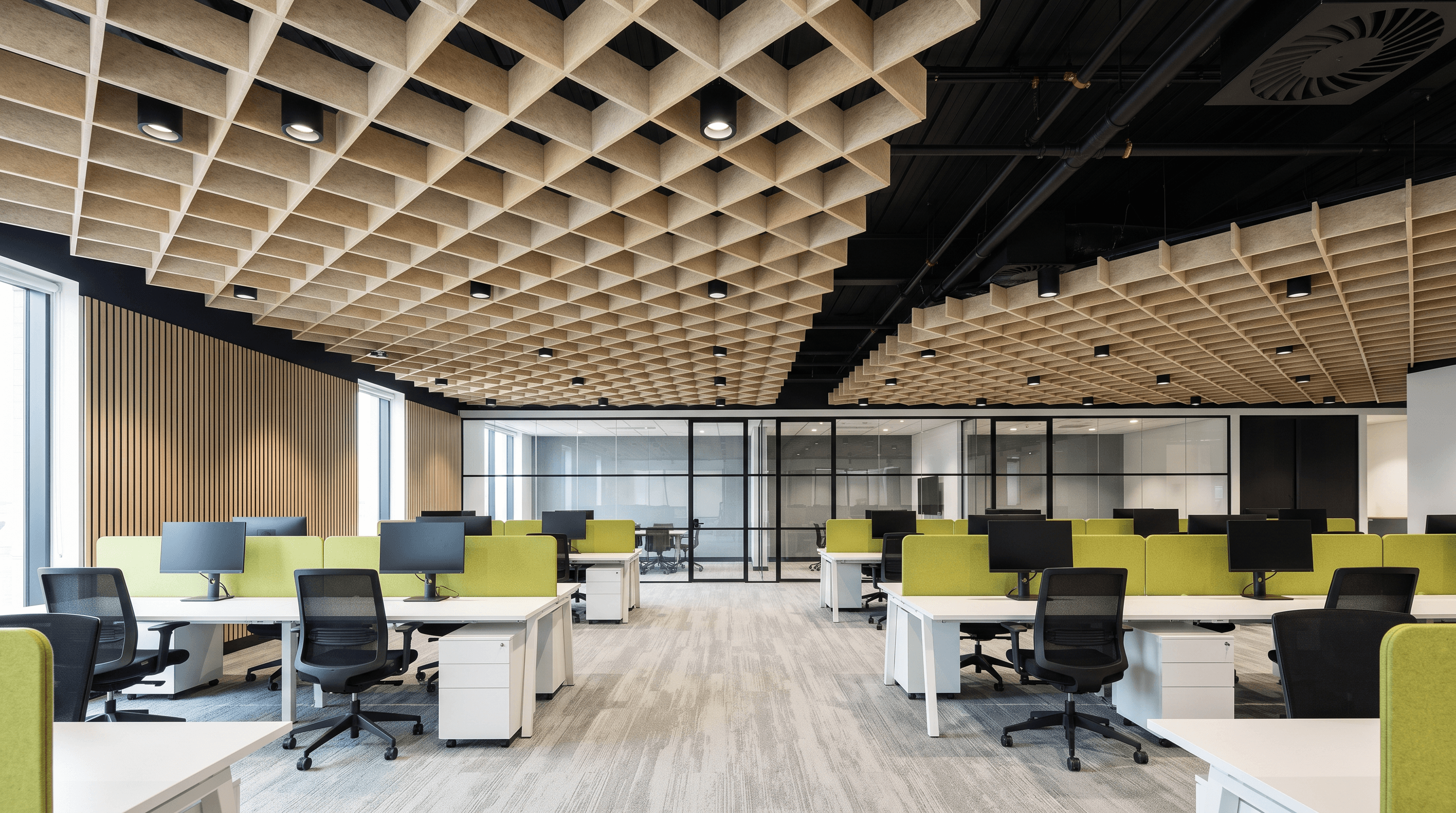
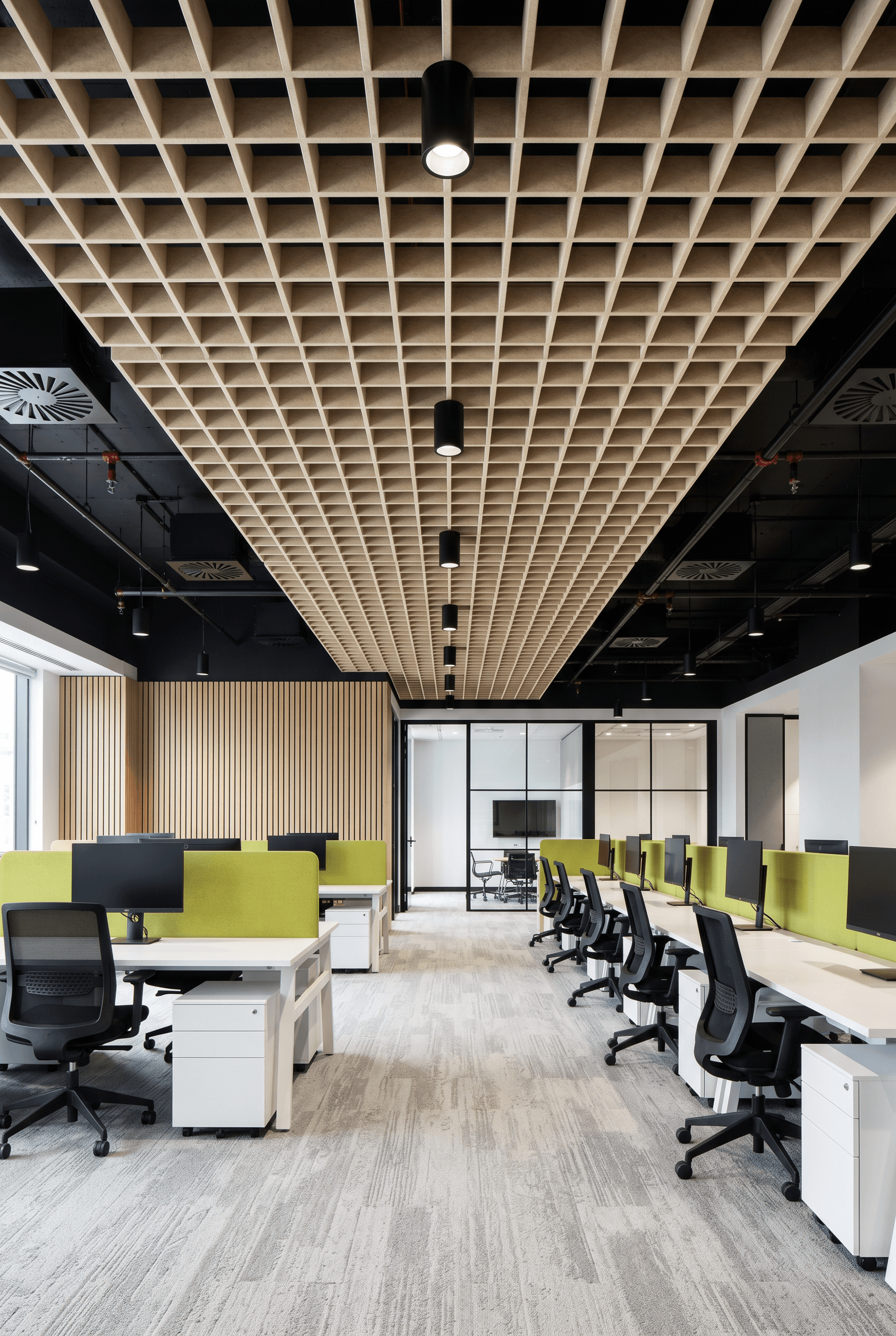
The largest source of acoustic disorder came from the exposed soffit above the open work areas. With metal decking and mechanical services left visible, sound energy repeatedly reflected between the ceiling plane and desk surfaces, extending reverberation and blurring speech across departments.
To control this, custom suspended acoustic grid baffles were positioned directly above the primary workstation zones. Formed from high-absorption acoustic felt, these vertical elements increase effective absorptive area without blocking maintenance access to the MEP infrastructure above. Their geometry disrupts repetitive reflection paths while preserving the open, lightweight character of the office.
This intervention lowered the perceived noise floor across the work area and improved local speech comfort. Conversations remained intelligible at the team level, but no longer spread as uncontrolled ambient chatter across the full floor plate, making the workspace more usable for sustained focus.
| Parameter | Value | Notes |
|---|---|---|
| Primary Treatment | Suspended Acoustic Grids | High-absorption baffles were concentrated above dense workstation zones rather than applied as a uniform ceiling blanket. |
| Design Goal | Lower Reverberation | The treatment targeted mid-to-high frequency reflections that most strongly affect conversational distraction. |
Localized Attenuation for Pantry and Social Areas
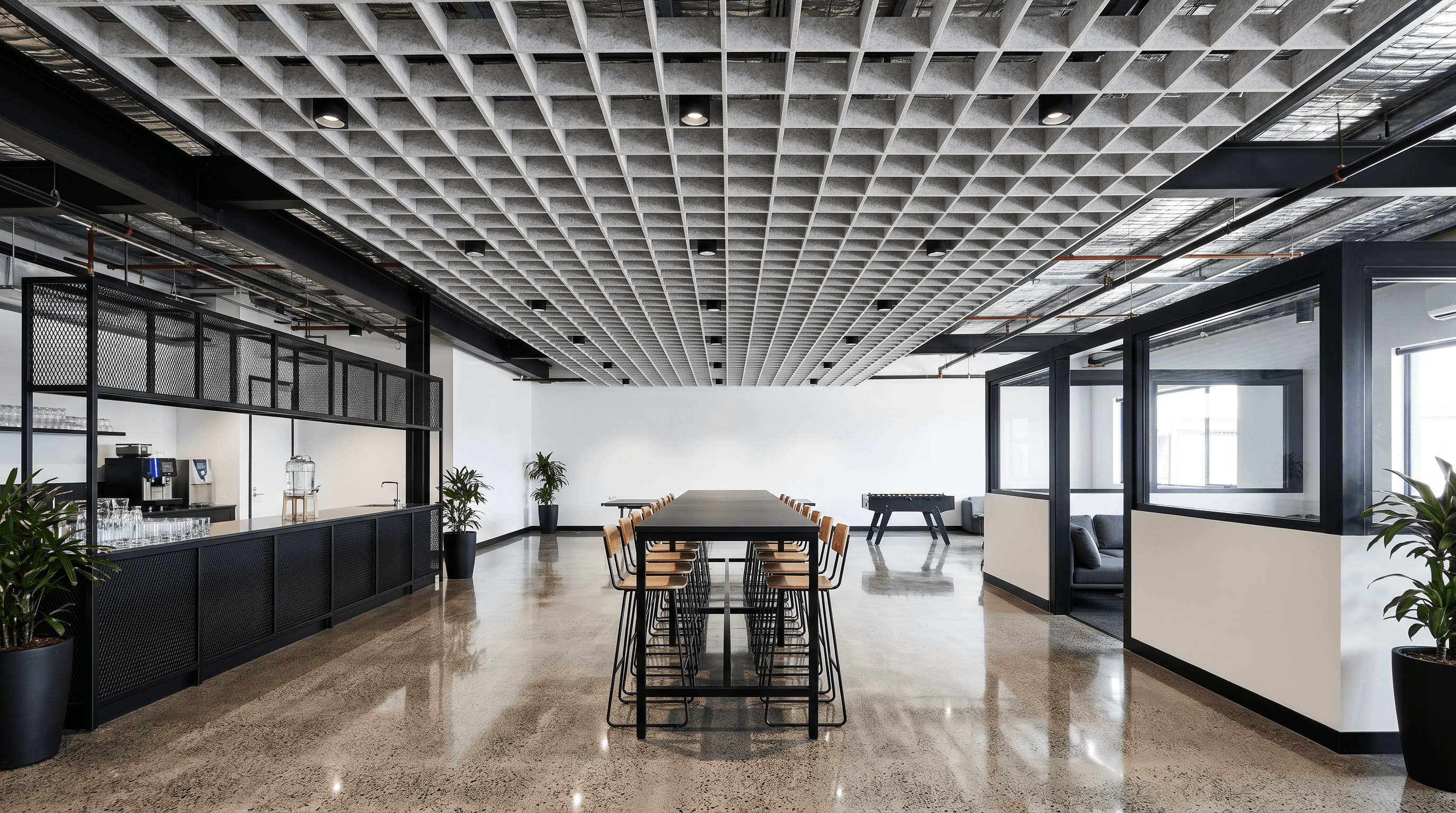
Informal collaboration spaces, pantry counters, and social hubs often become the dominant noise generators in an open office. Appliance noise, short meetings, and ad hoc conversations produce dense bursts of speech energy that can spill into nearby task-oriented zones if they are not locally controlled.
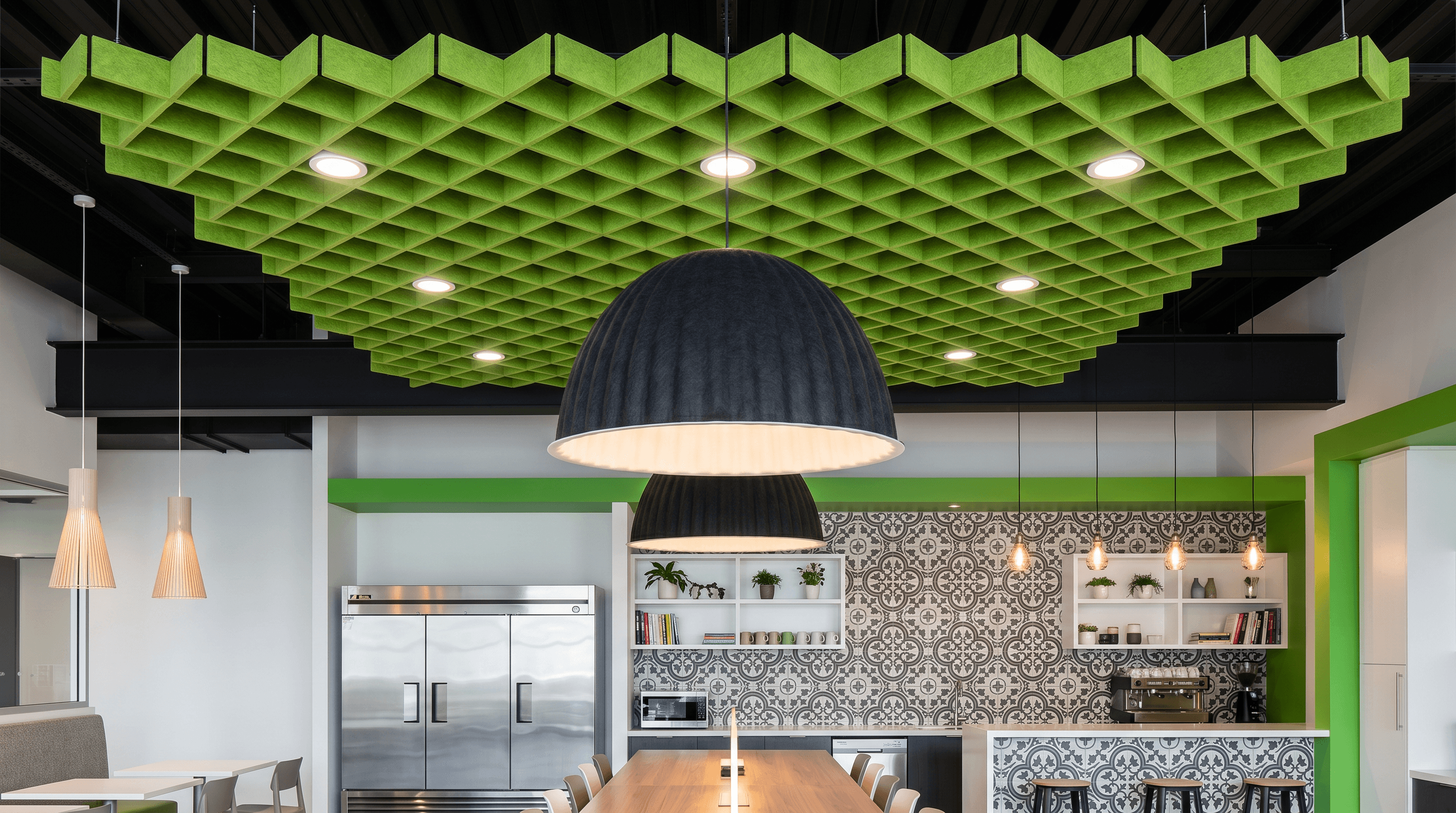
In this project, those areas were treated as acoustically distinct micro-environments. Additional ceiling-mounted absorptive arrays were deployed with adjusted density and suspension depth to create invisible acoustic boundaries around the noisier social zones. This allowed the office to remain socially active without forcing the entire floor to perform like a café.
The result was a more deliberate acoustic gradient: energetic where collaboration is encouraged, restrained where concentration is expected. Instead of using partitions that visually fragmented the workplace, the project relied on spatially tuned absorption to preserve openness while reducing the radius of distraction.
Glass Rooms, Flutter Echo Control, and Privacy Edges
Fully glazed meeting rooms introduced a second layer of acoustic risk. Parallel glass surfaces are highly prone to flutter echo, which muddies video conference audio and reduces speech clarity inside the room. At the same time, perimeter leakage at glass joints and door frames can allow sensitive discussions to spill into public circulation areas.
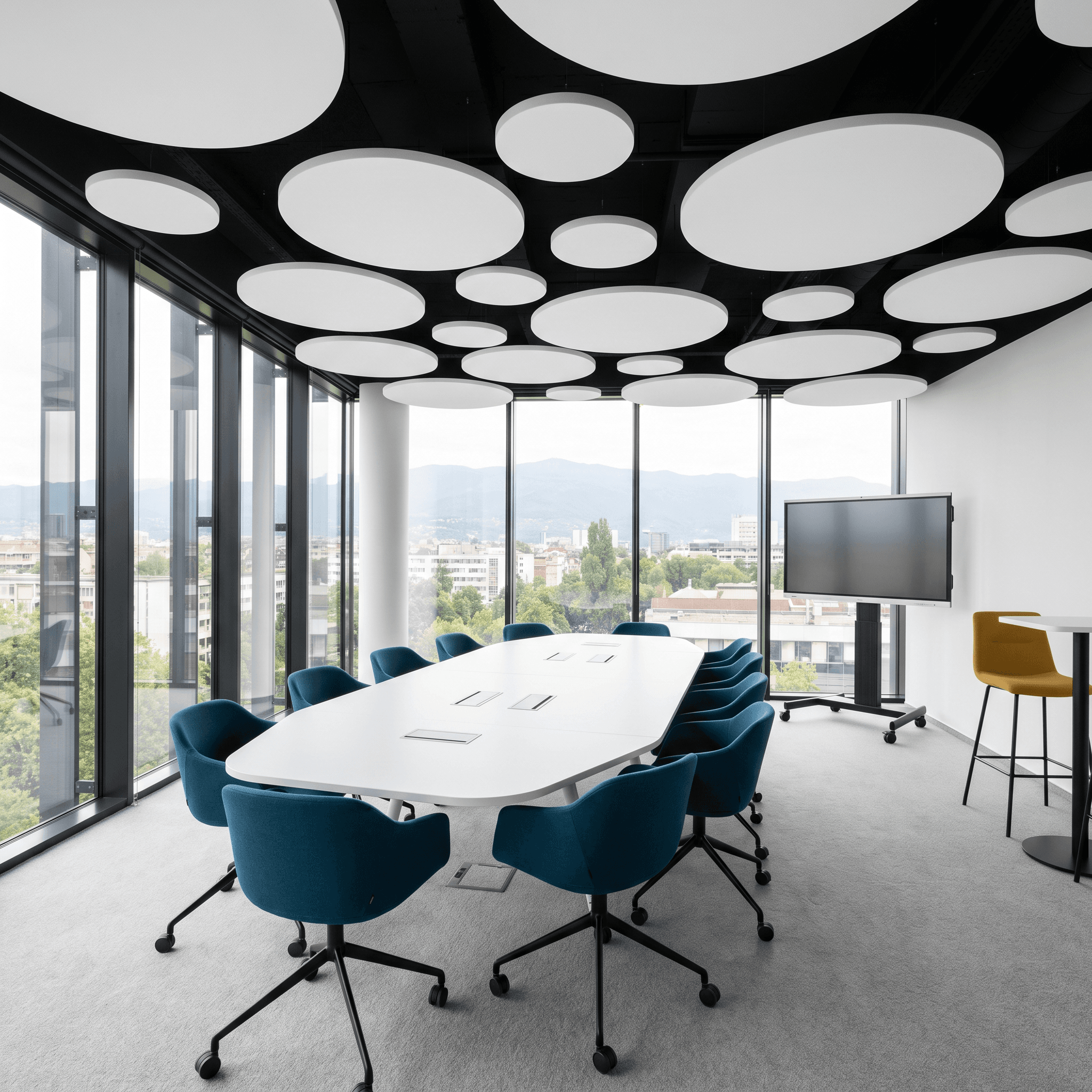
To address the in-room problem, suspended acoustic clouds were placed above conference tables to intercept early reflections and break up vertical oscillation paths. This improved clarity for both in-person discussion and remote conferencing, especially in the vocal frequency range where hard glazed rooms tend to sound harsh and uncontrolled.
Along the room perimeter, the broader acoustic strategy was calibrated to protect confidentiality. The meeting rooms were not treated as isolated boxes; they were integrated into the larger floor-wide privacy plan so that private speech lost intelligibility rapidly once it crossed into adjacent open zones.
A Zoned Sound Masking Network for Speech Privacy
Passive treatments were essential for reverberation control, but they could not solve the core weakness of open-plan work: overheard conversation. The final layer of the solution was therefore a distributed active sound masking system installed above the exposed ceiling field and tuned to the speech spectrum.
Using DSP-controlled emitters, the system introduced a soft, broadband background sound calibrated to sit just high enough to reduce speech intelligibility at distance without making the office feel artificially noisy. Different masking levels were applied by zone, with open work areas tuned for comfort and meeting-room perimeters strengthened to limit confidentiality breaches through glazed boundaries.
Together, the architectural acoustic treatments and the masking network transformed the headquarters from a reverberant, transparent shell into a workplace that supports both collaboration and concentration. The project demonstrates that high-performance office environments are not achieved by visual design alone; they require acoustic engineering that remains almost invisible once the space is occupied.
| Parameter | Value | Notes |
|---|---|---|
| Masking Level | 45-48 dB(A) | The open office masking spectrum was calibrated to improve privacy without creating a sense of added noise. |
| System Logic | Zoned DSP Control | Different work areas, circulation zones, and meeting-room edges were tuned independently for local acoustic behavior. |
| Outcome | Focus + Privacy | The completed workplace balances speech comfort, confidentiality, and architectural openness within one continuous floor plate. |