
Project Overview and Engineering Challenges
Modern university and municipal arenas have long transcended single-purpose athletic functions, evolving into "Mission-Critical Multi-Purpose Spaces" designed to host large-scale assemblies, theatrical performances, and academic symposiums.
The core engineering challenge of this project lies in its massive spatial volume (over 20,000 cubic meters) and expansive hard reflective surfaces (solid wood sports flooring and metal roof structures). Without intervention, the reverberation time (RT60) in such spaces typically exceeds 4.0 seconds, leading to severe speech muddiness and acoustic focusing.
As the principal full-discipline system integrator, we mitigated these high-risk variables by intervening in the front-end architectural acoustic design. By seamlessly integrating top-tier electro-acoustic architectures, high-bandwidth video networks, and dynamic telescopic seating, we successfully transformed a highly reverberant cavernous hall into a precisely controlled, modern performance and athletic center.
Architectural Acoustics: Passive Soundscape Control in High-Volume Spaces
To meet the stringent Speech Transmission Index (STI) requirements for conferences and live performances, physical intervention through Room Acoustics formed the foundation of the entire project.
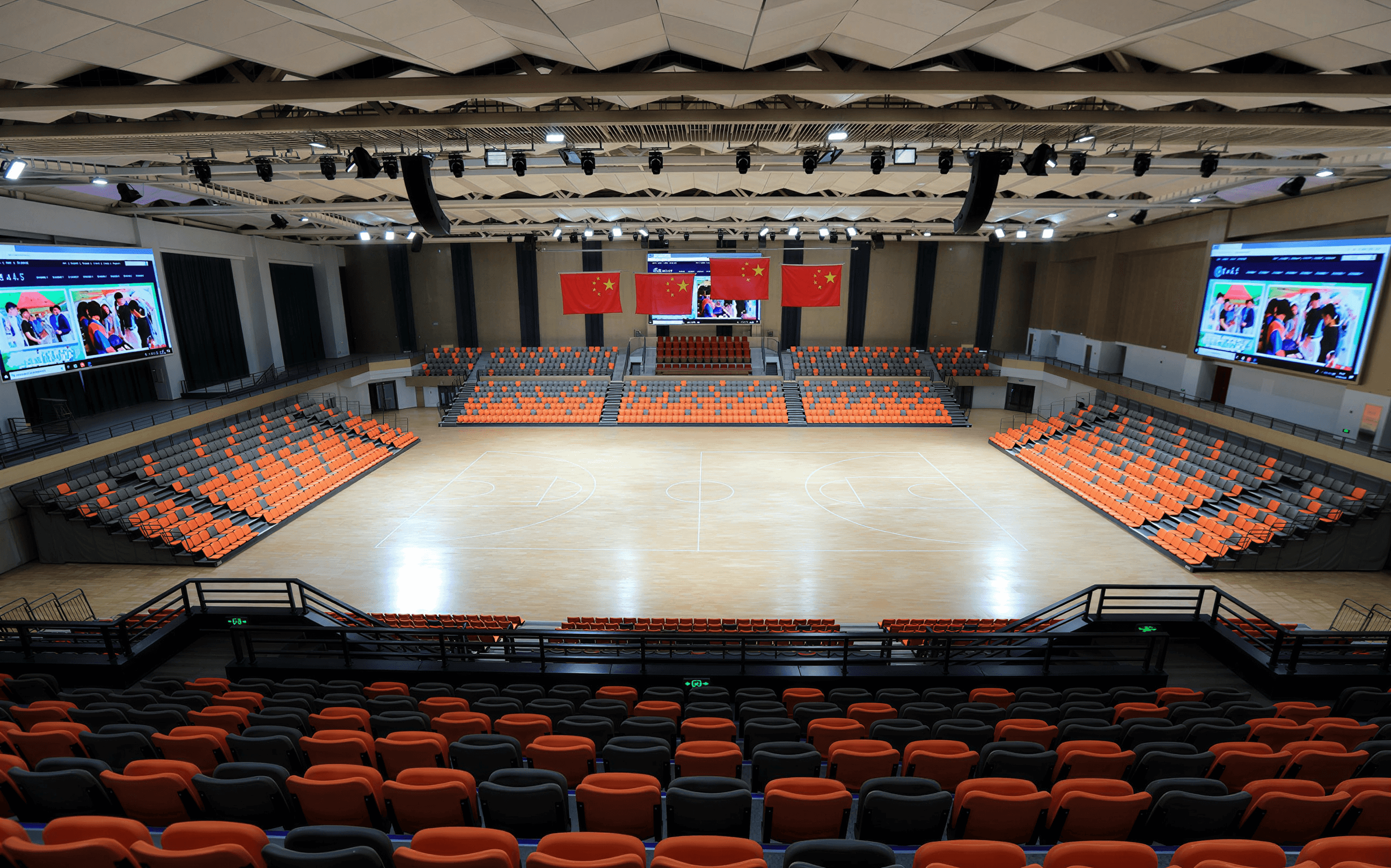
Broadband Acoustic Ceiling Matrix: As illustrated, we suspended "V-shaped origami" acoustic baffles with strong geometric characteristics beneath the steel truss structure. This topology not only conceals the complex overhead MEP (Mechanical, Electrical, and Plumbing) infrastructure but also significantly increases the equivalent surface area of the absorptive materials. The calculated dihedral angles effectively break up standing waves between parallel surfaces, delivering broadband absorption across the critical 125Hz-kHz spectrum.
Lateral Acoustic Impedance and Diffusion: The upper side walls are extensively clad with micro-perforated and grooved timber acoustic panels. Combined with the upholstered surfaces at the lower levels, this completely eliminates cross-court flutter echoes.
Engineering Data Validation: Driven by preliminary EASE 3D acoustic simulations and verified by post-construction field testing, we successfully dialed in the unoccupied RT60 (at 500Hz) to a precise "golden ratio" of 1.8 +/- 0.1s. This is drastically lower than the chaotic 2.5s+ standard of traditional gymnasiums, establishing a flawless physical baseline for the electro-acoustic reinforcement.
| Parameter | Value | Notes |
|---|---|---|
| RT60 Target | 1.8 +/- 0.1s | Measured at 500 Hz in the unoccupied condition to support speech-heavy and performance-oriented event use. |
| Acoustic Method | Broadband Passive Control | Ceiling absorption and lateral wall treatment were used together to tame the arena's hard reflective envelope. |
Electro-Acoustic Architecture: Precision-Mapped Line Array Systems
Building upon the optimized room acoustics, we deployed a mission-critical passive line array sound reinforcement system, ensuring ultra-low distortion even under extreme sound pressure levels.
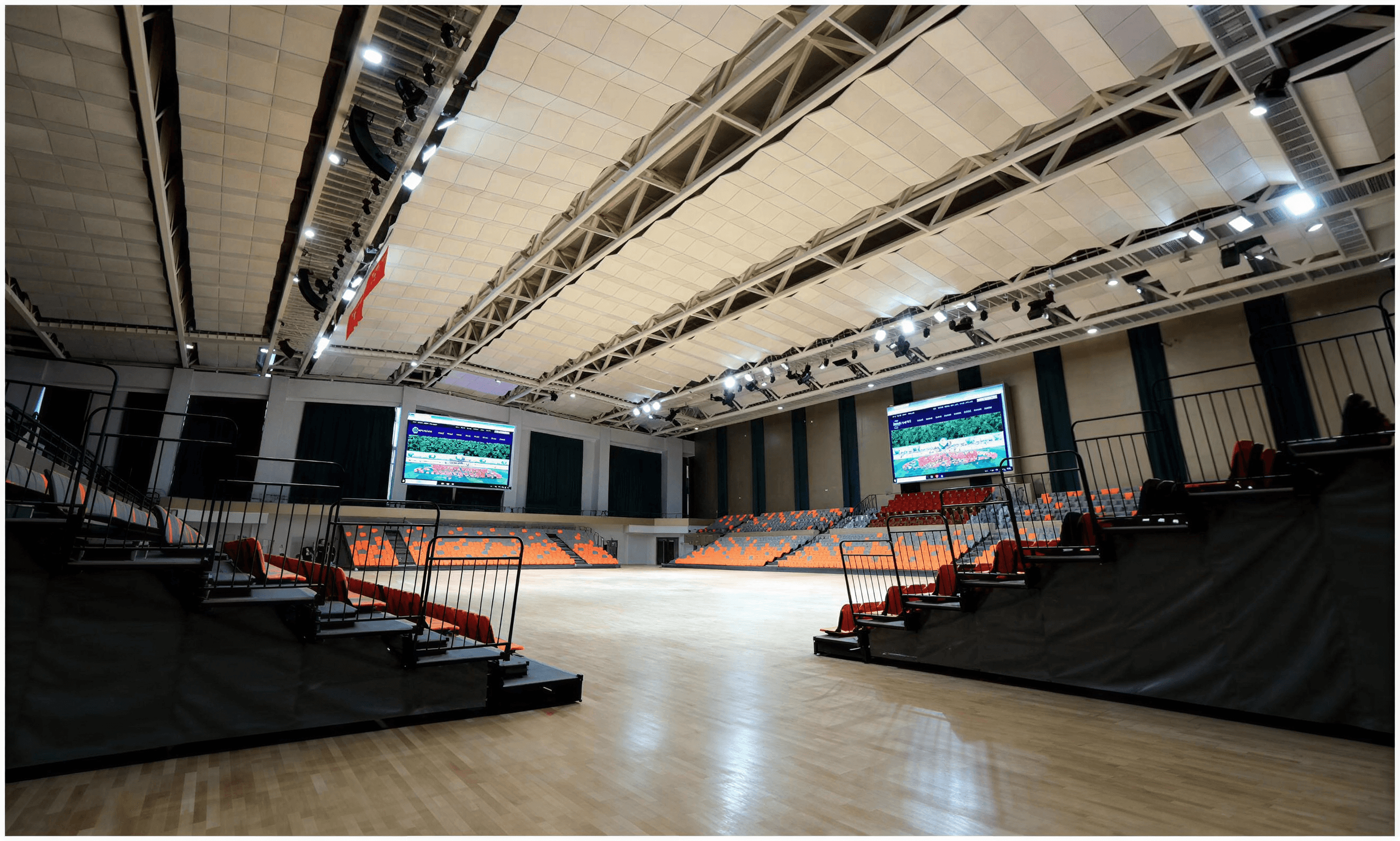
Main PA Topology Design: To cover the deep seating tiers and the central court, we deployed an L/R stereo suspended line array configuration. Each array consists of multiple dual-10-inch or dual-12-inch line source full-range modules. Precisely calculated vertical splay angles ensure that the acoustic energy is evenly projected as a cylindrical wave to every row of seats.
Soundscape Mapping and DSP Alignment: Utilizing FIR filter technology within the Digital Signal Processors (DSP), we executed microsecond-level phase alignment between the suspended main arrays and the auxiliary fill speakers.
Engineering Data Validation: Under full load, the system delivers a continuous maximum sound pressure level (Max SPL) exceeding 108 dB(A) inside the venue. The SPL variance across the entire audience area is strictly contained within a +/-3dB margin. Field tests confirmed a Speech Transmission Index (STI) of >= 0.65 (Excellent rating), ensuring crystal-clear intelligibility for everything from high-energy sports commentary to formal keynote addresses.
| Parameter | Value | Notes |
|---|---|---|
| Max SPL | 108 dB(A)+ | The reinforcement system maintains event-scale output while preserving intelligibility across the bowl. |
| Coverage Uniformity | +/-3 dB | Audience-area variance was tightly controlled through array geometry and DSP alignment. |
| Speech Intelligibility | STI >= 0.65 | Field verification confirmed excellent clarity for speech-led programs and announcements. |
Visual Distribution: Low-Latency Distributed LED Systems
Visual systems in modern large-scale arenas must cater to near-360-degree, blind-spot-free viewing requirements.
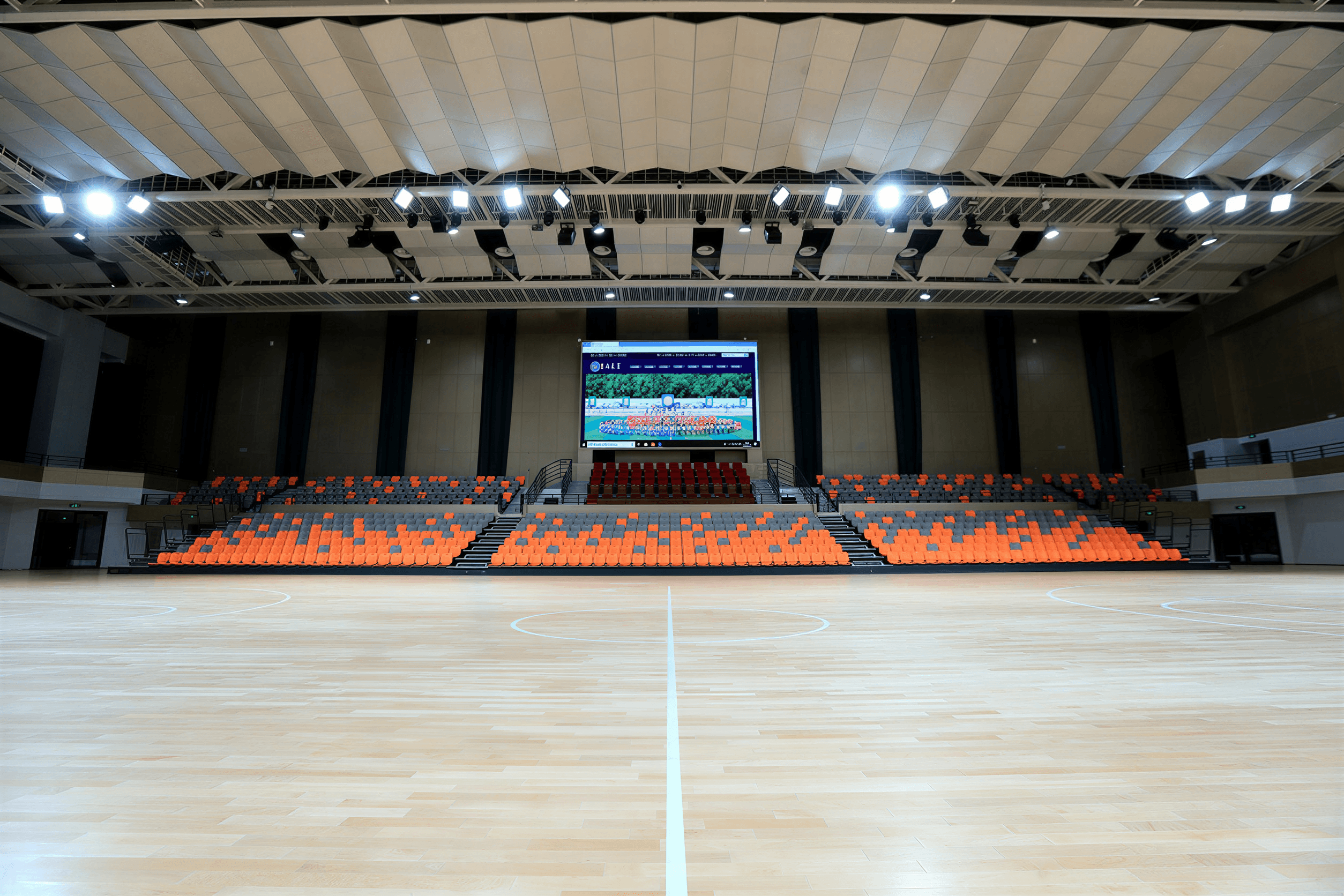
Three-Screen Distributed Topology: We abandoned the centralized single-screen approach in favor of a "one primary, two secondary" distributed LED matrix. The main screen anchors the core live feed and presentation visuals, while the symmetrically positioned secondary screens ensure optimal viewing angles for audience members in the lateral tiers, achieving zero-blind-spot coverage.
High-Bandwidth Video Backbone: The entire visual distribution architecture is built on an AV-over-IP fiber optic backbone. It supports zero-latency (sub-1ms) transmission of uncompressed 4K/60Hz 4:4:4 video signals.
Engineering Data Validation: The LED displays utilize high-refresh-rate (>= 3840Hz) driver ICs, completely eliminating moire patterns during broadcast camera capture. Brightness levels are dynamically and intelligently adapted to the ambient environment (peaking at 1200 nits), maintaining extreme contrast and color saturation even under full arena lighting.
| Parameter | Value | Notes |
|---|---|---|
| Video Backbone | AV-over-IP Fiber | The arena distributes high-bandwidth signals over a low-latency networked video architecture. |
| Refresh Rate | >= 3840 Hz | High-refresh LED drivers reduce visible scan artifacts in camera capture and live production use. |
| Peak Brightness | 1200 nits | Adaptive brightness preserves legibility and contrast under full arena lighting conditions. |
Dynamic Spatial Reconfiguration: Ultra-Quiet Telescopic Seating
The "multi-purpose" nature of an arena depends heavily on the flexibility of its physical space. Here, we deployed a heavy-duty motorized Telescopic Seating System.
Rapid Turnaround and High Payload: The lower tier utilizes custom ergonomic folding seats in an alternating dark grey and orange scheme. When the venue transitions to host large conferences or center-court matches, the bleachers can fully deploy via a single-button command within 5 minutes, instantly adding hundreds of tiered seats. Conversely, for full-sized basketball games or indoor training, the system retracts flush against the perimeter walls, maximizing the flat floor area.
Silent Automation and Rigid Interlocks: The undercarriage drive system employs polyurethane silent rollers and variable-frequency synchronous motors. The deployment and retraction processes are smooth, generating an operational noise level below 50 dB. Once fully extended, multiple mechanical interlocks engage, ensuring the seating structure possesses the absolute structural rigidity of concrete tiers, completely eliminating structural resonance or vibration under heavy foot traffic.
| Parameter | Value | Notes |
|---|---|---|
| Turnaround Time | ~5 min | The telescopic seating can rapidly shift the room between spectator and open-floor event modes. |
| Operating Noise | < 50 dB | Low-noise rollers and synchronized drives keep reconfiguration quiet and operationally practical. |
| Outcome | True Multi-Purpose Use | Athletics, ceremonies, lectures, and performances can share one venue without compromising clarity or flexibility. |
Conclusion
This multi-purpose arena project stands as a benchmark for the deep integration of architectural spatial aesthetics with audio, video, lighting, and kinetic machinery.
Through proactive acoustic simulation, rigorous physical soundscape intervention, and world-class AVL and mechanical control topologies, we delivered more than just a venue; we engineered a high-performance digital and physical infrastructure defined by ultimate fault tolerance and absolute operational certainty.