
01. The Engineering Challenge: Taming the Wave
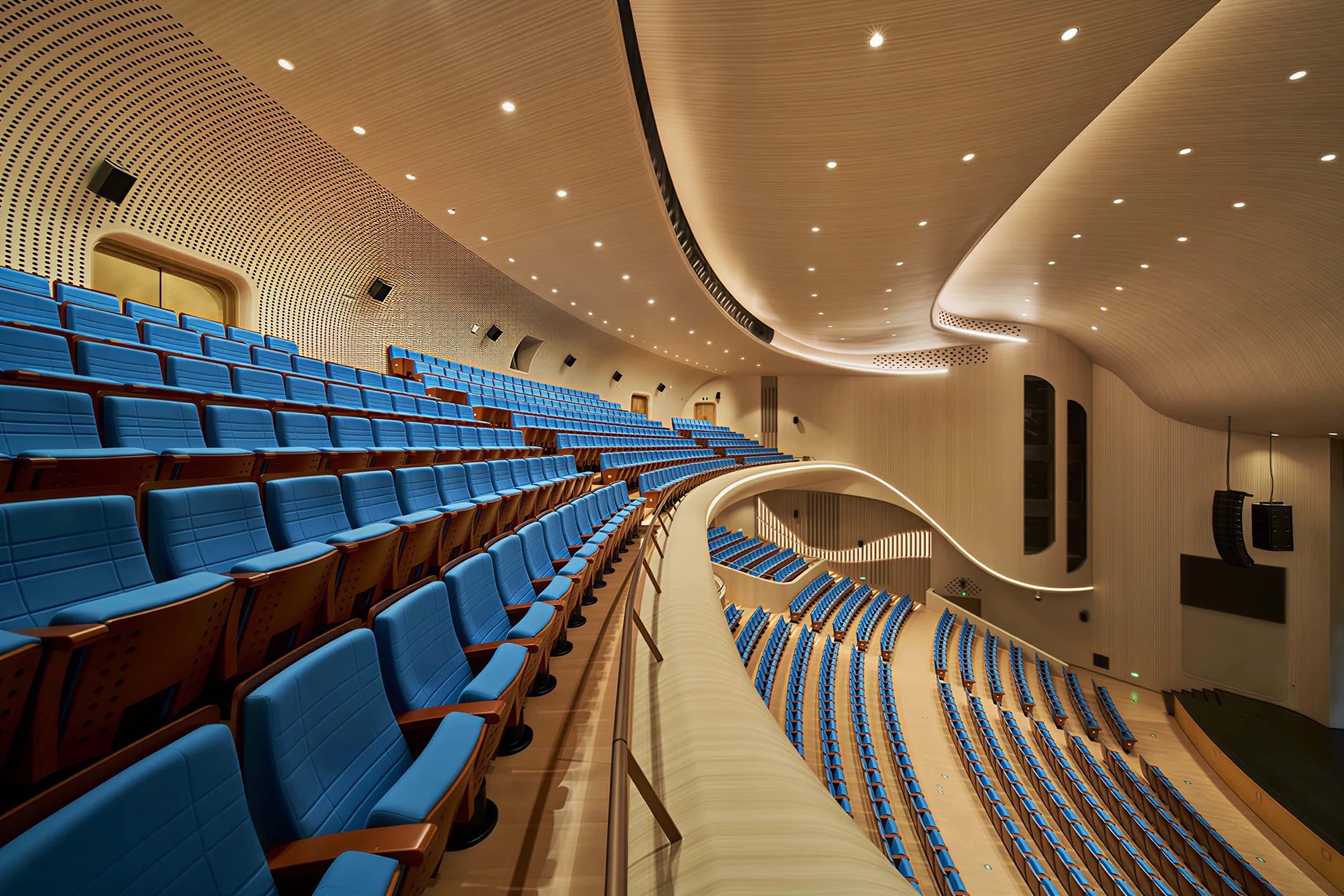
The architectural centerpiece of The Grand Theater is its breathtaking, continuous wave-like parametric ceiling and asymmetrical curved walls. While visually spectacular, these sweeping concave surfaces are inherently dangerous from an acoustic engineering perspective.
During the initial design phase, our acoustic ray-tracing simulations revealed that these curves would act as parabolic reflectors, creating severe sound focal points in specific seating zones while starving others of acoustic energy.
The venue's operational mandate also required extreme versatility: hosting highly intelligible theatrical plays and amplified musicals that demand a dry, controlled room, while also supporting unamplified classical orchestras that require a rich, enveloping reverberant field. A static acoustic environment would fundamentally fail to bridge this gap.
"Our mandate was clear: engineer a space where the dramatic architectural curves do not fight the sound, but actively diffuse and absorb it, while possessing the digital agility to transform the room's volume at the push of a button."
02. Architectural Acoustics: The Parametric Wood Envelope
To neutralize focal points without compromising the architect's organic vision, conventional off-the-shelf acoustic materials were entirely insufficient. The sweeping panels themselves had to become the acoustic solution.
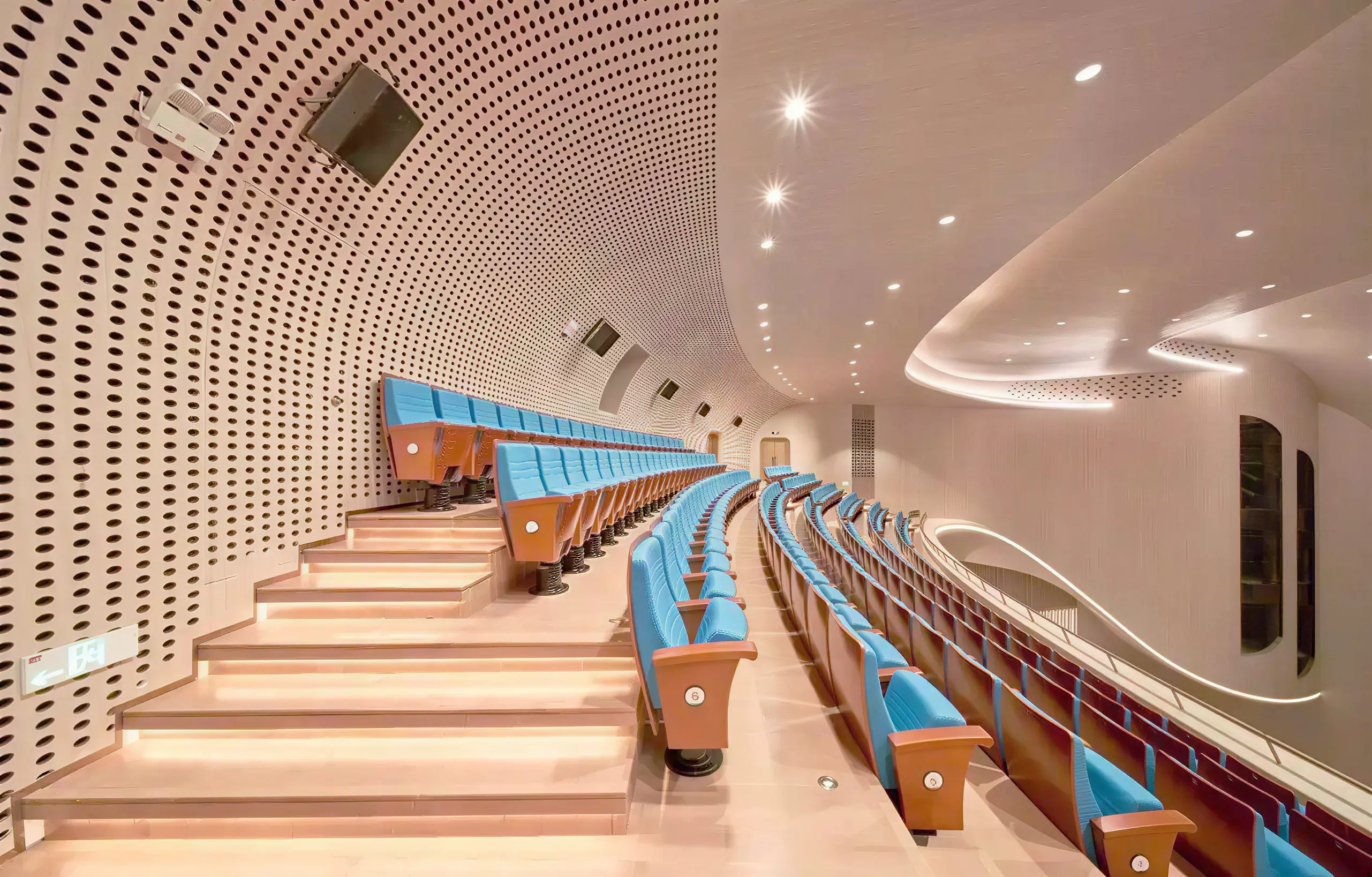
LYN ACOUSTICS engineered a custom-fabricated acoustic shell built from variable-aperture perforated arrays. The distinct dot patterns visible along the ceiling swoops and balcony fascias are not decorative alone; they are curved, fire-rated panels with precisely milled micro-perforations backed by tuned cavities, functioning as highly efficient mid-to-high frequency absorbers.
The convex portions of the undulating walls naturally operate as acoustic poly-cylindrical diffusers. By fine-tuning the radii of these curves during fabrication, we successfully scattered early reflections, widening the auditory impression without sacrificing precious high-frequency energy.
To prevent the deep under-balcony seating areas from sounding muffled, the geometry of the overhang ceilings was precisely angled to funnel direct sound from the stage back toward the last row of the 1,211-seat house.
03. The Active Acoustic Network & Electroacoustic System
With the passive architecture tuned to a dry baseline optimized for speech, we introduced a regenerative Active Acoustic System alongside a tour-grade main PA system, unified across a Dante AoIP network topology.
To digitally extend the room's reverberation to 1.8 seconds in symphonic mode, the venue deploys 24 suspended studio-grade omnidirectional microphones, dual-redundant DSP mainframes operating at sub-2-millisecond latency, and 142 micro-coaxial loudspeakers embedded invisibly across the ceiling and lateral bulkheads.
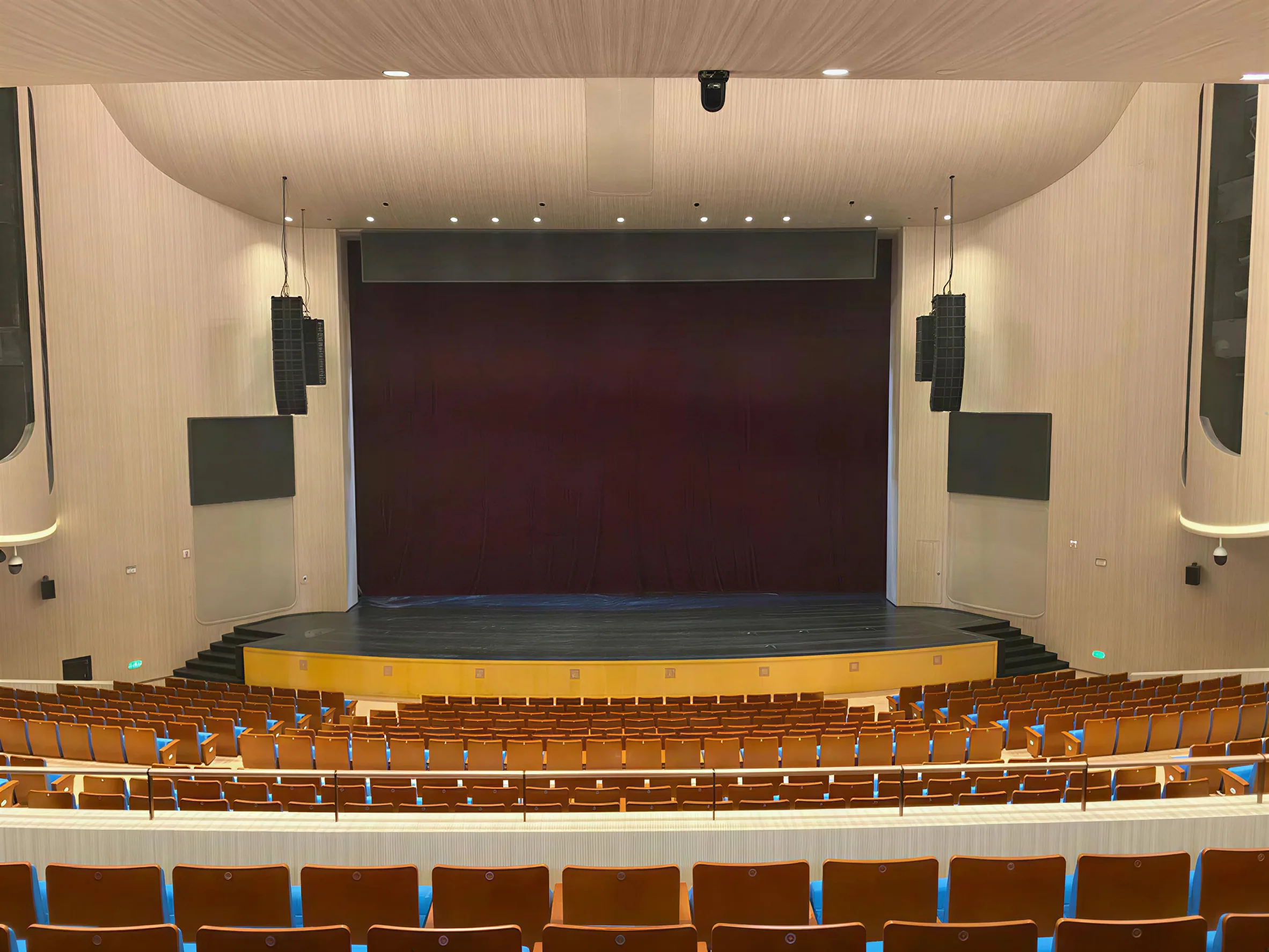
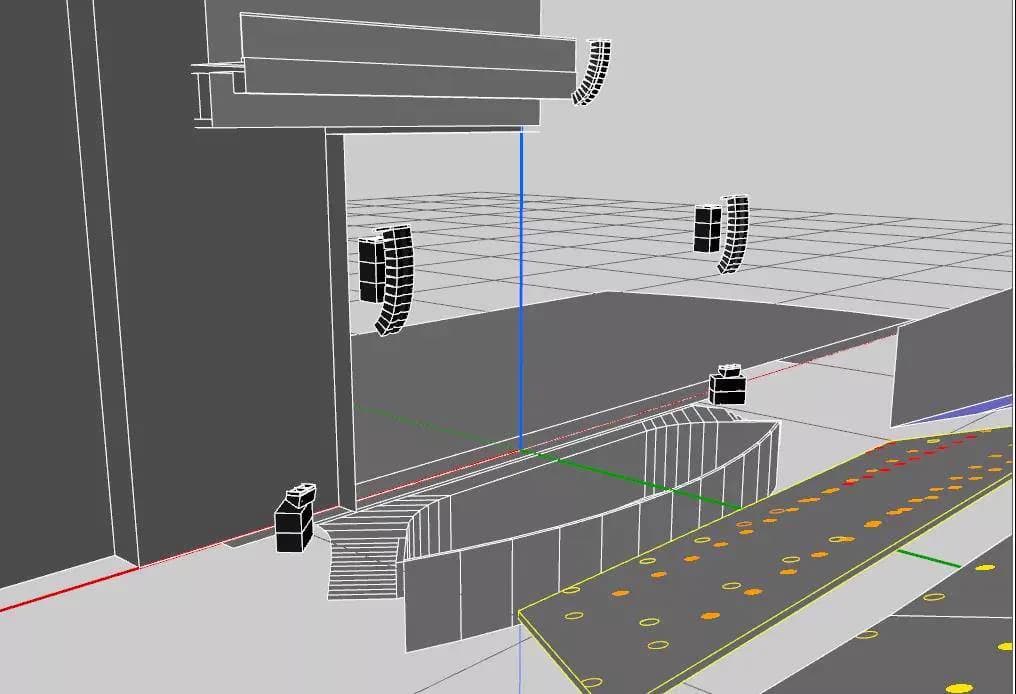
For amplified theatrical events, we engineered a high-SPL, phase-coherent main reinforcement system based on suspended dual 10-inch line arrays, distributed center fill, cardioid flyable subwoofers, stage-lip front fills, networked DSP amplifiers, and a 96-channel digital mixing environment.
The result is a venue that can move between natural symphonic bloom and amplified theatrical precision without visual compromise, because the active network is concealed within the architecture rather than imposed onto it.
| Parameter | Value | Notes |
|---|---|---|
| Input Stage | 24x Omnidirectional Mics | Suspended above the performance area to capture direct sound energy for active acoustic regeneration. |
| Processing Engine | Dual-Redundant DSP | Sub-2-millisecond latency and convolution-based spatial synthesis matched to the physical room response. |
| Output Array | 142x Micro-Coaxial Loudspeakers | Distributed across the ceiling and lateral bulkheads to create a seamless variable acoustic field. |
| Main Reinforcement | Dante AoIP Touring PA | Line arrays, cardioid subwoofers, front fills, networked amplification, and digital control in one unified AVL backbone. |
04. Heavy-Duty Stage & SIL3 Safety Compliance
Acoustic purity is rendered useless if stage mechanics introduce vibration or mechanical noise. The theater's heavy-duty stage system was therefore engineered to handle massive dynamic loads for complex theatrical scene changes while operating in near silence.
We integrated an automated spiral-lift motorized stage platform system, supported by a mechanical control architecture designed around SIL3 safety mandates. Overhead rigging and understage systems were treated as mission-critical infrastructure, not auxiliary theater equipment.
To protect the pristine acoustic environment, hydraulic drives, winch motors, and tracking systems were rigorously isolated from the building's structural slab using custom-engineered elastomeric dampeners.
05. Measured Acoustic Parameters & Final Commissioning
The integration of bespoke architectural treatments, an advanced electroacoustic network, and silent stage machinery resulted in a world-class venue that performs exactly as simulated. The final commissioning data, verified by independent acoustic consultants, exceeded international touring standards.
Reverberation Time (RT60) Verification
The venue exhibits an incredibly flat frequency response across both operational modes.
| Frequency Band (Hz) | Baseline (Theatrical) | Target (Symphonic) | Measured (Symphonic) |
|---|---|---|---|
| 125 Hz | 1.25s | 1.90s | 1.88s |
| 250 Hz | 1.22s | 1.85s | 1.82s |
| 500 Hz | 1.20s | 1.80s | 1.81s |
| 1000 Hz | 1.18s | 1.80s | 1.78s |
| 2000 Hz | 1.15s | 1.75s | 1.72s |
| 4000 Hz | 1.05s | 1.60s | 1.58s |
Critical Performance Metrics
| Parameter | Value | Notes |
|---|---|---|
| Speech Transmission Index (STI) | 0.76 STI | Measured in theatrical mode using passive acoustics only. |
| Background Noise Criterion | 15 NC | Measured with HVAC active and stage machinery in motion. |
| Maximum SPL (Main PA) | 118 dB(A) | Continuous measurement at the Front of House mix position. |