
01. The Engineering Challenge: The Chaos of Critical Operations
A Global Command Headquarters is the nerve center of any major enterprise or government agency. The primary challenge in designing this specific 4,500-square-meter operations floor was twofold: Cognitive Overload and Information Security.
In an open-plan command center, the cumulative noise from hundreds of operators, cooling systems, and constant communications creates a chaotic acoustic environment. This high noise floor drastically accelerates operator fatigue and increases the margin for critical human error. Conversely, in the adjacent glass-walled "War Rooms," sensitive crisis-management discussions risked being overheard by the general floor, violating strict security protocols.
The client required a solution that provided crystal-clear immediate communication within specific operational "pods," absolute speech privacy between different departments, and a unified, zero-latency visual data distribution system that could survive any single point of failure.
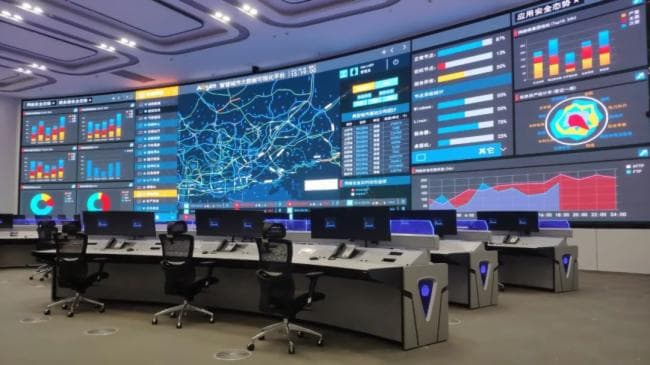
Main operational floor featuring the 32-meter curved LED canvas and modular operator pods with localized acoustic containment.
02. Speech Privacy Engineering & Acoustic Mitigation
To solve the acoustic contradictions of the space, TYN ACOUSTICS implemented a three-tiered approach: Absorption, Blocking, and Covering (The ABCs of Acoustic Privacy).
1. High-Performance Absorption Fabrication
Standard acoustic drop ceilings were insufficient for the target noise reduction coefficient (NRC). Leveraging our Foshan manufacturing hub, we custom-produced a hybrid ceiling system:
- Micro-Perforated Metal Cassettes:Backed with 50mm high-density hydrophobic fiberglass. These panels provided an exceptional NRC of 0.95, specifically targeted at absorbing frequencies between 500Hz and 4000Hz (the human voice spectrum).
- Acoustic Baffles:Strategically suspended above high-traffic corridors to disrupt sound propagation paths.
2. Active Sound Masking System
To achieve true speech privacy without building physical walls, we engineered a spatially zoned Active Sound Masking System.
- The Network:We deployed an array of 240 downward-facing sound masking emitters installed discretely within the ceiling plenum.
- The Curve:The DSP generators produce a continuously shifting, non-repeating broadband sound (a precise hybrid of pink and brown noise). This curve is meticulously tuned to match the frequencies of human speech.
- The Result:The system gently raises the ambient background noise floor to exactly 45 dBA. This effectively masks cross-room conversations, reducing the Radius of Distraction from 15 meters down to just 3.5 meters. Operators can hear their immediate team clearly, but conversations outside their pod become unintelligible murmurs.
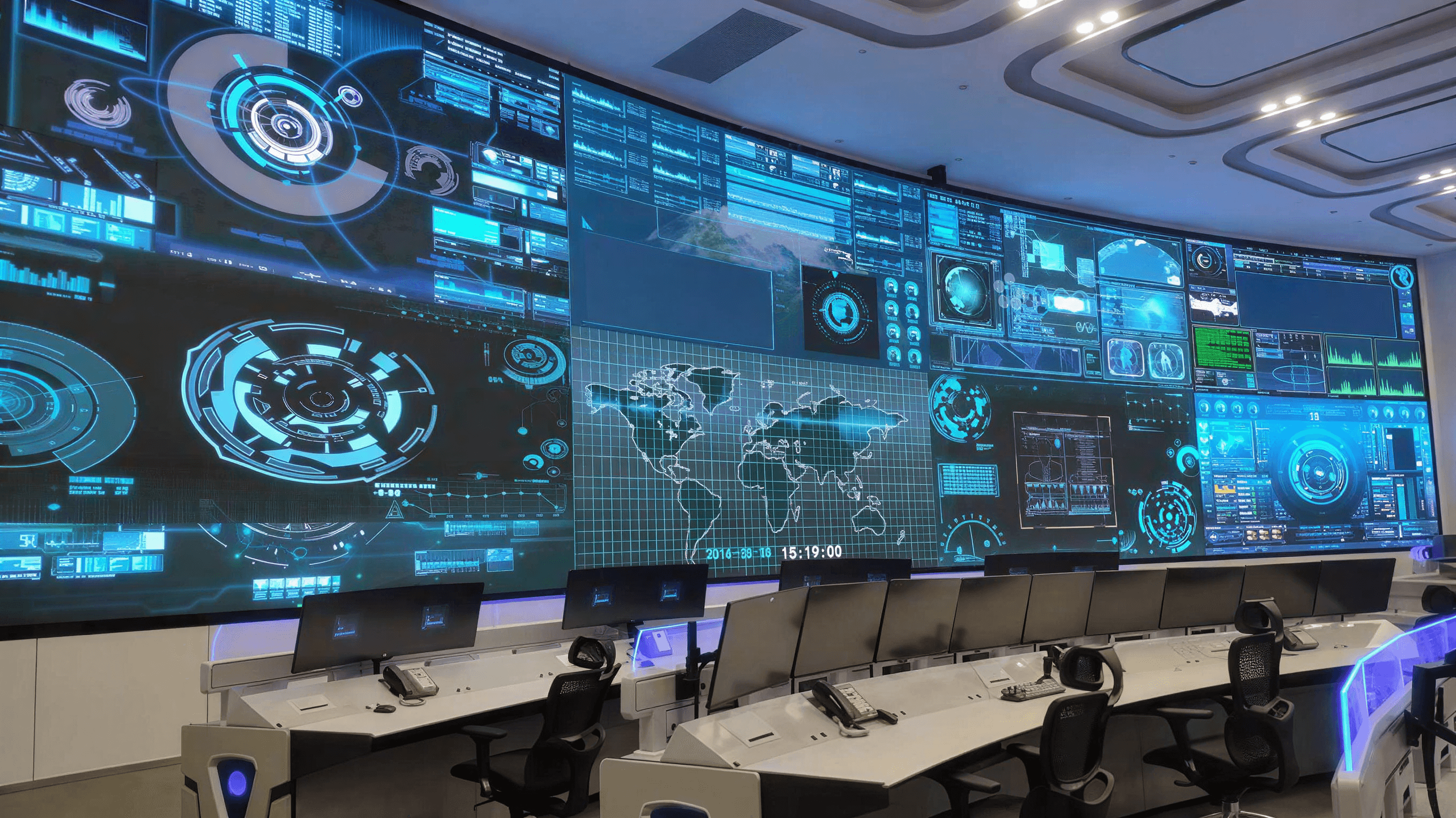
Detail of the micro-perforated metal cassettes and localized sound-masking emitters for departmental speech privacy.
03. The Unified AVL Network: SDVoE vs. Dante AV Integration
In a command environment, a one-second delay in a video feed or a dropped audio alert is unacceptable. We moved away from traditional matrix switchers and implemented a fully Unified AVL Network over a 100G fiber-optic backbone.
Uncompressed Video via SDVoE
For the massive 32-meter curved LED video wall (1.2mm pixel pitch) and hundreds of operator displays, we utilized SDVoE (Software Defined Video over Ethernet) technology.
- Why SDVoE? Unlike highly compressed H.264/H.265 streams, SDVoE delivers mathematically flawless, uncompressed 4K60 4:4:4 video with strictly sub-millisecond latency.
- Transceivers: 128x SDVoE Fiber Endpoints allow any source (satellite feeds, thermal imaging, data dashboards) to be routed to any display instantly.
Mission-Critical Audio via Dante
Audio routing (alarms, intercoms, and video conferencing feeds) is handled entirely via Dante AoIP.
Dante seamlessly coexists on the same fiber infrastructure as the SDVoE video streams, managed through strict QoS (Quality of Service) switch configurations. This unified approach drastically reduced cabling weight, failure points, and thermal output in the server rooms.
04. Centralized Fail-safe Architecture
Command Headquarters cannot afford downtime. The entire AVL system architecture was designed around N+1 Redundancy and Centralized Fail-safe Control.
- Redundant Network Core:The system utilizes dual-core spine-and-leaf network switches. If the primary core switch fails, the secondary takes over within milliseconds via hitless failover protocols.
- Redundant DSP & Power:All audio processing mainframes feature dual power supplies fed by separate UPS (Uninterruptible Power Supply) grids.
- Centralized GUI:Despite the immense complexity of the backend, the user interface provided to the Shift Commanders is remarkably intuitive. Custom-programmed touch panels allow for instant scenario recalls (e.g., "DEFCON 2," "Global Briefing," "Night Mode") which simultaneously trigger video wall layouts, audio routing, and intelligent lighting presets.
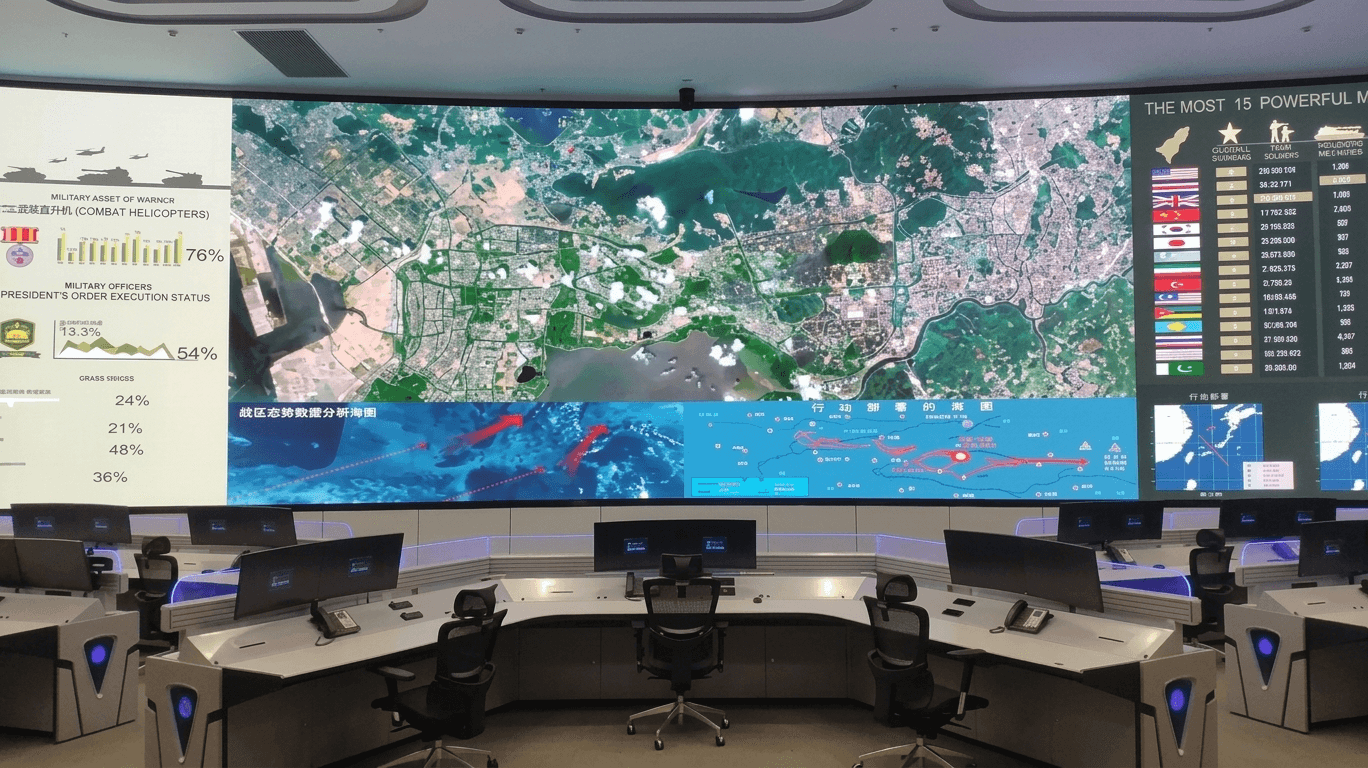
Custom-programmed touch interface allowing for instantaneous global scenario recalls and redundant network management.
05. Measured Parameters & Certification
The facility underwent rigorous testing by independent security and acoustic auditors prior to handover.
Acoustic Privacy & intelligibility Metrics
| METRIC | TARGET | MEASURED VALUE | STATUS |
|---|---|---|---|
| Privacy Index (PI) - Between Pods | > 95% (Confidential) | 98.2% | PASS |
| Speech Transmission Index (STI) - Inside Pods | > 0.70 | 0.76 | PASS |
| Ambient Sound Masking Level | 45 dBA (+/-0.5 dBA) | 45.1 dBA | PASS |
| Reverberation Time (RT60) | < 0.6s @ 500Hz | 0.52s | PASS |
Network & Video Performance Metrics
| METRIC | SYSTEM REQUIREMENT | MEASURED PERFORMANCE |
|---|---|---|
| Video Latency (Source to Glass) | < 1 frame (16ms @ 60Hz) | < 0.1ms (SDVoE Standard) |
| Audio Latency (Dante Network) | < 2ms | 1.0ms |
| System Failover Time | < 50ms | 12ms |