Project Introduction
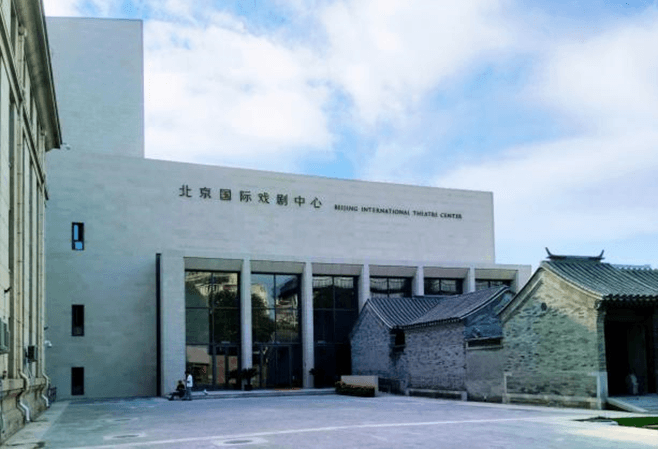
The Beijing International Theatre Center, located on the east side of the Capital Theatre on Wangfujing Street, is an expansion project for the Beijing People's Art Theatre. The project broke ground on December 27, 2018, and entered trial operation on September 2, 2021.
With a total construction area of approximately 23,000 m², it consists of four underground levels and three above-ground levels. The center houses one 699-seat medium-sized drama theatre, the Cao Yu Theatre, one 350-seat small theatre, the Renyi Small Theatre, and three rehearsal halls.
Function and Acoustic Design Targets
The Cao Yu Theatre is a dedicated venue for drama performances, also catering to small-scale variety shows. It offers superior viewing conditions and is designed primarily for natural sound performances.
Primary acoustic indicators include a mid-frequency full-occupancy reverberation time of 1.10±0.10s, background noise not exceeding the NR-25 noise evaluation curve, and no identifiable acoustic defects such as echoes, multiple echoes, sound focusing, or resonance at any position within the auditorium during performances.
Original Architectural Design and Ray Analysis
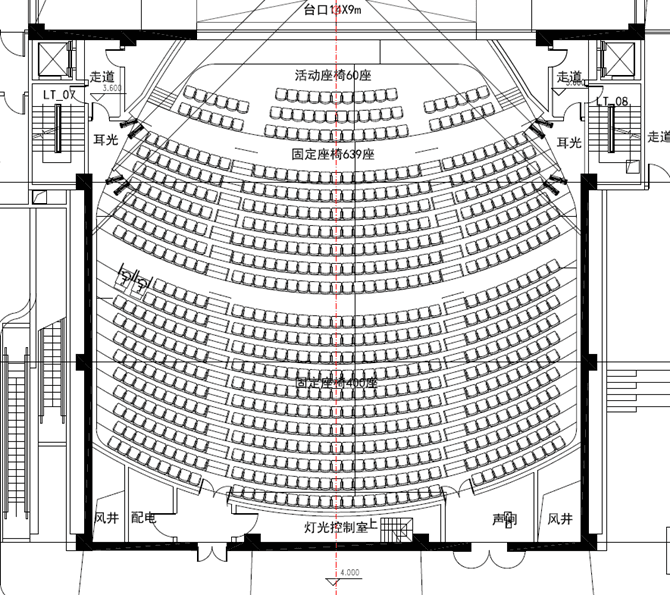
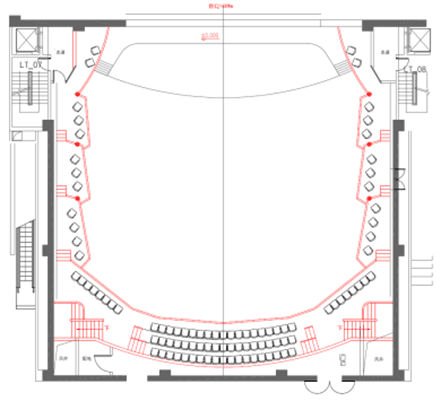
The Cao Yu Theatre is the core venue of the Beijing International Theatre Center. The original auditorium measured 22m in length and 24m in width, featuring only stall seating with no balconies, and had a maximum capacity of 699 seats.
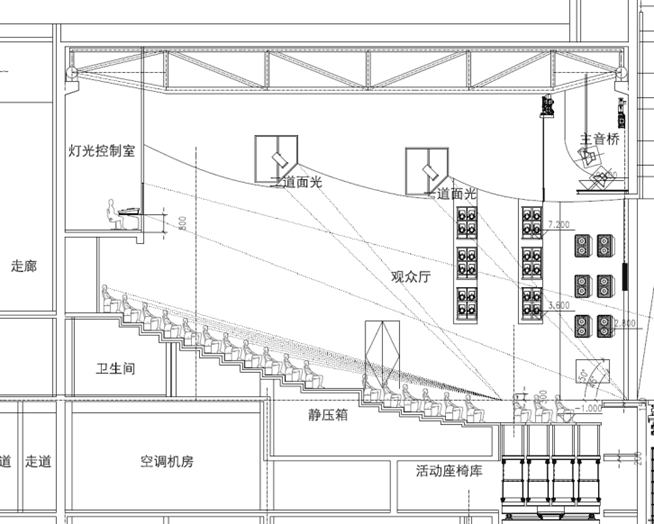
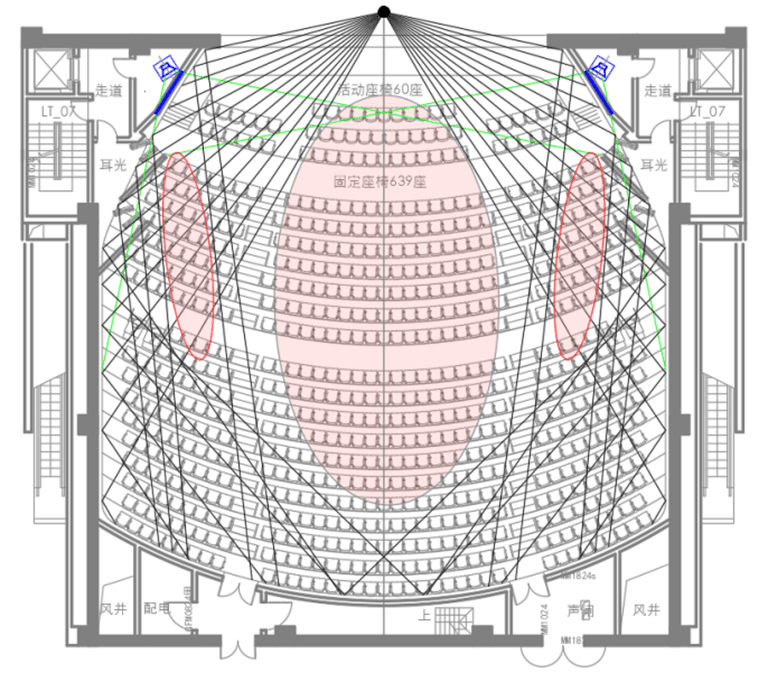
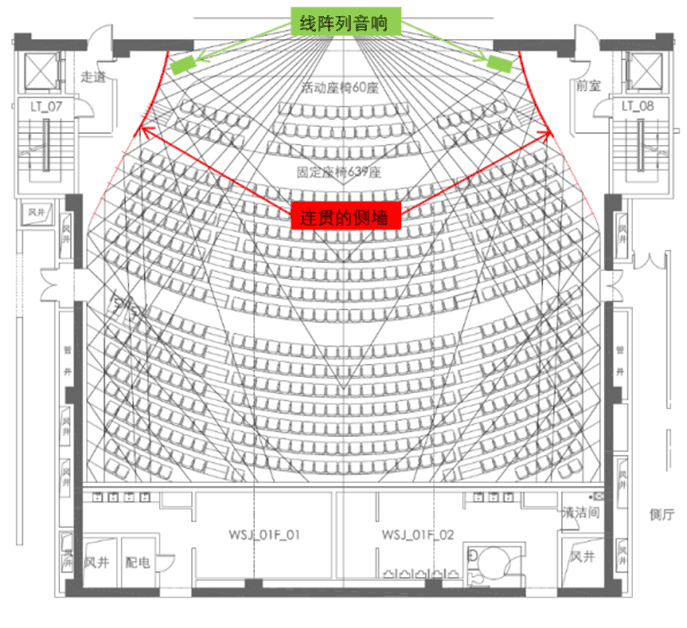
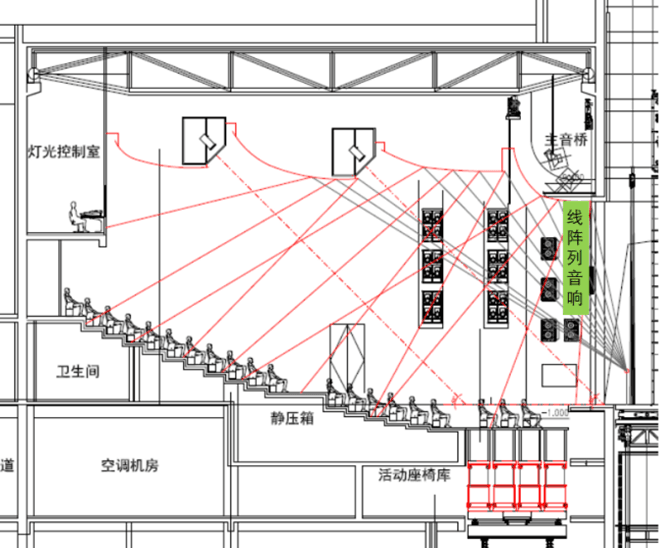
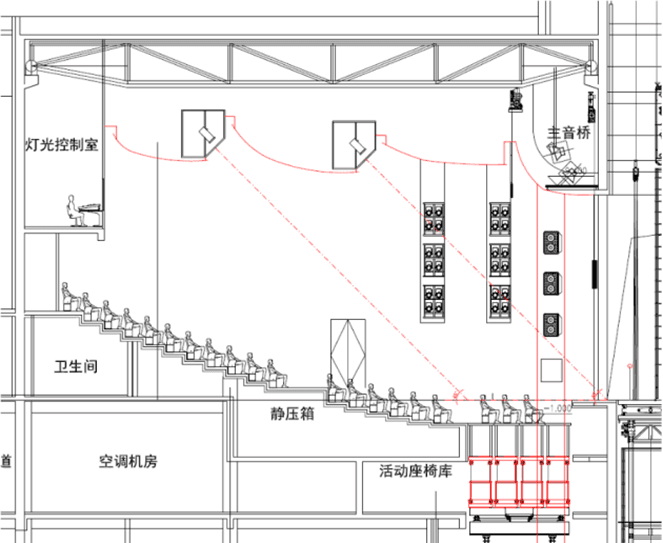
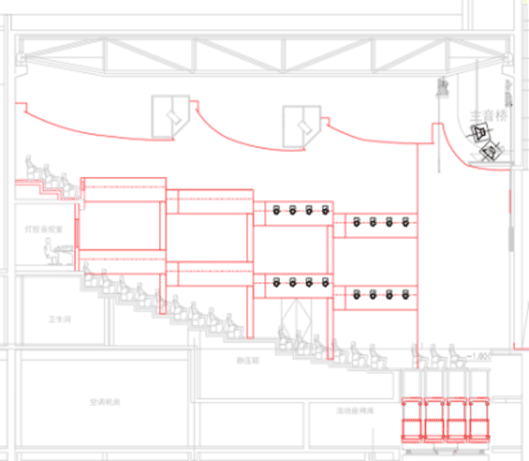
While the completed version maintained the 699-seat capacity, row spacing was increased to enhance audience comfort. Since the ceiling shape in the original section was schematic, detailed section sound ray analysis was deferred to the interior design stage. Plan-view analysis indicated that suboptimal proscenium shaping and speaker opening positions left most seats without early side-wall reflections.
Shape Improvement Schemes 1 and 2
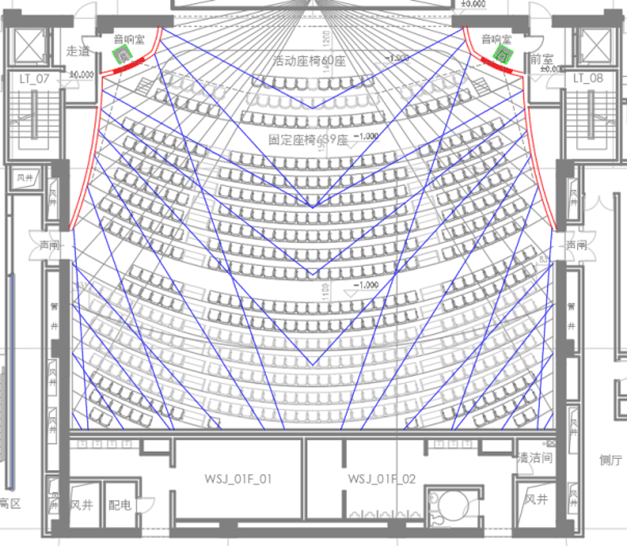
The acoustic team proposed four volumetric improvement schemes. Schemes 1 and 2 required minimal civil engineering changes by adjusting the proscenium side wall shapes, with speakers configured in either surface-mounted or concealed formats.
In Scheme 1, the proscenium side walls were made slightly convex to ensure sound ray coverage for the front and middle sections of the stalls. Side wall openings for concealed speakers were also eliminated to prevent absorption of early sound energy.
In Scheme 2, concealed speaker openings were adjusted to positions that do not interfere with sound reflection, parallel to incident sound rays.
Scheme 3: Raised Side Seating
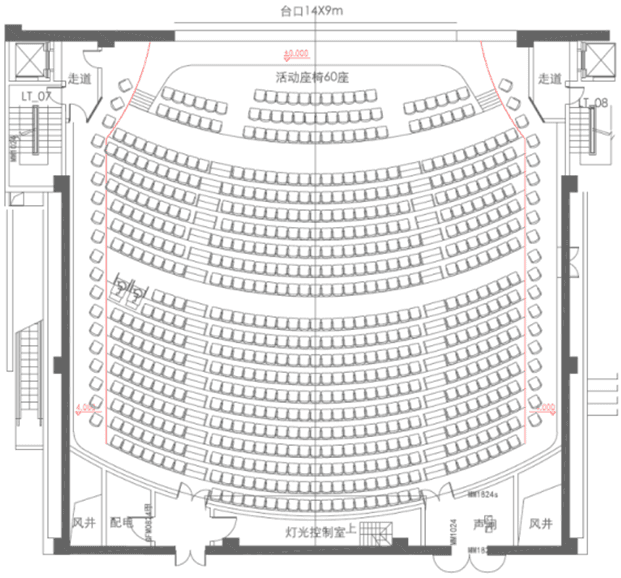
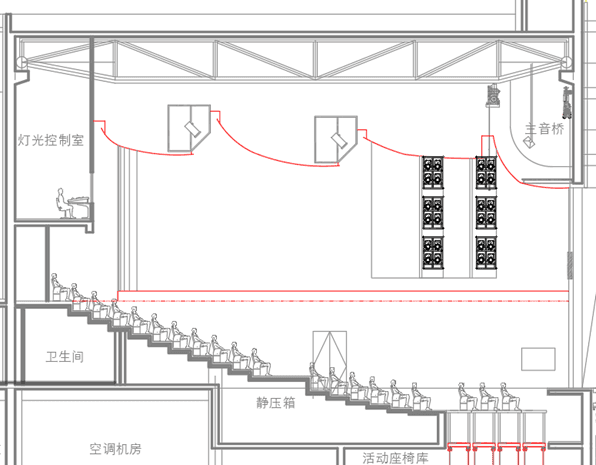
Schemes 3 and 4 were more comprehensive and better aligned with acoustic requirements. By raising the side areas of the stalls, the width was reduced from 24m to 20m, improving intimacy by reducing the Initial Time Delay Gap.
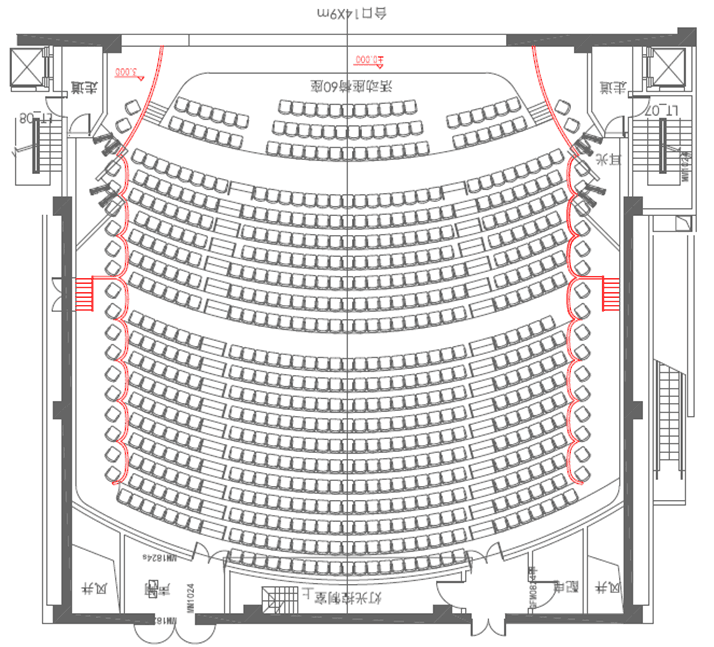
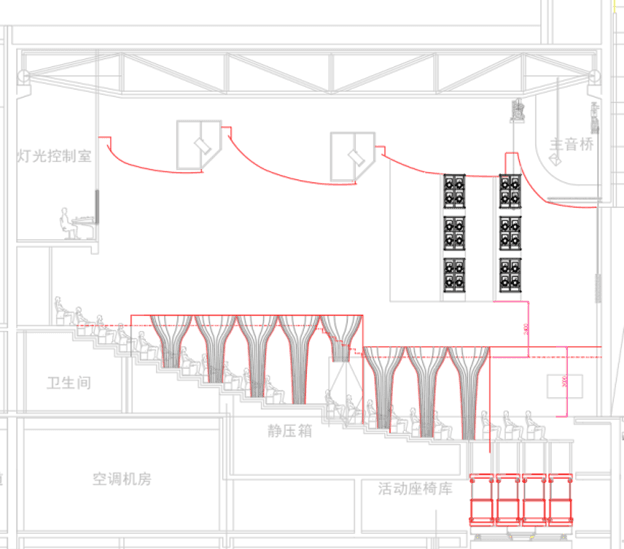
Scheme 3-1 raised the stall sides horizontally. Scheme 3-2 used a stepped, bud-shaped box configuration, again narrowing the room width to 20m while strengthening enclosure around the stage.
Scheme 4: Added Balcony and Side Balconies
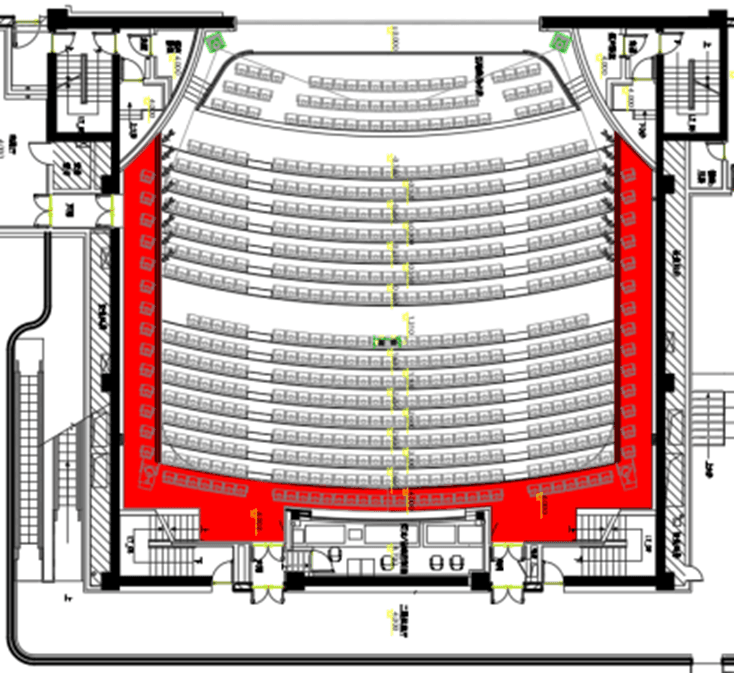
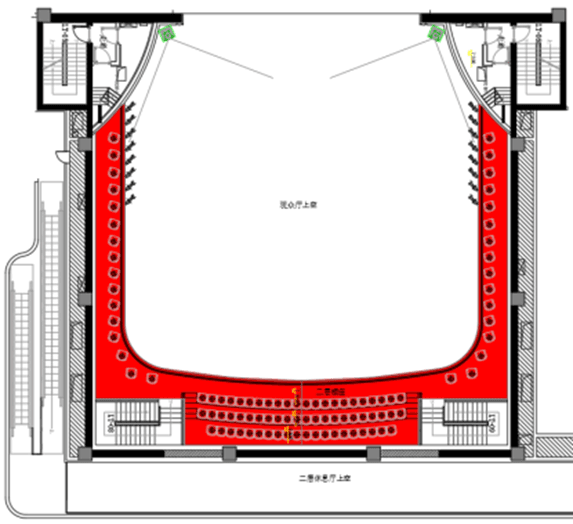
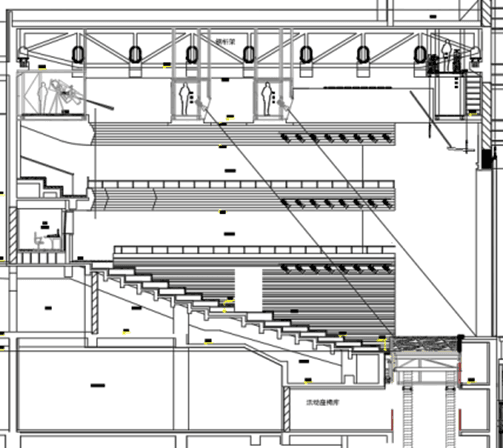
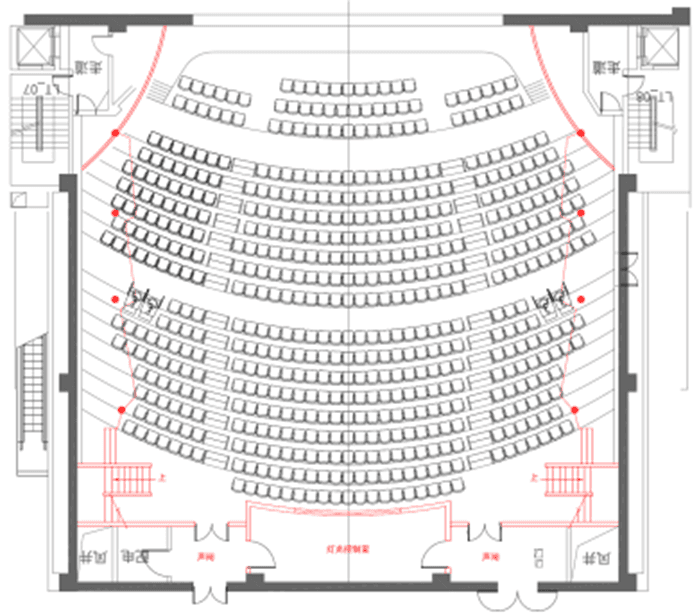
Scheme 4 raised the side seating and added a balcony level with side balconies. The side seating in the stalls and balconies was designed to embrace the stage, enhancing enclosure and strengthening the connection between actors and audience.
Scheme 4-1 raised the side seats horizontally and added a balcony level. Scheme 4-2 followed a similar strategy but used stepped side boxes.
Adopted Scheme and Construction Drawings
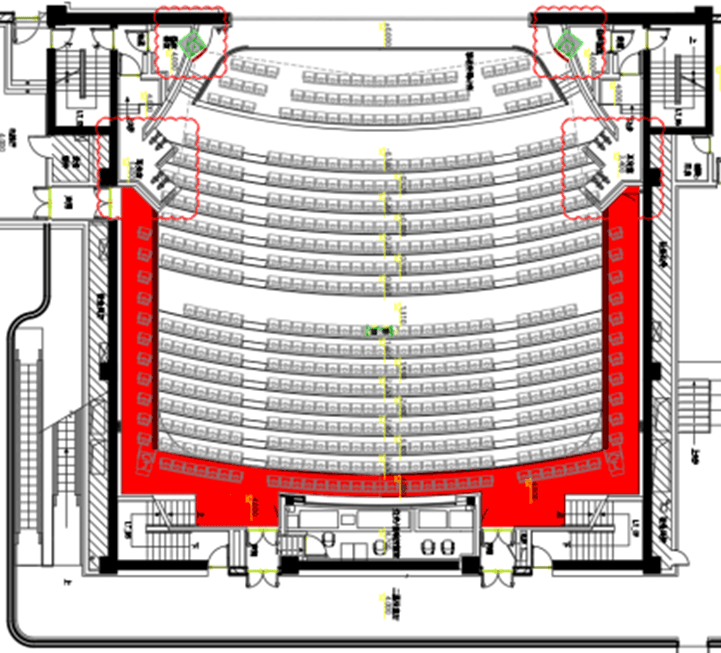
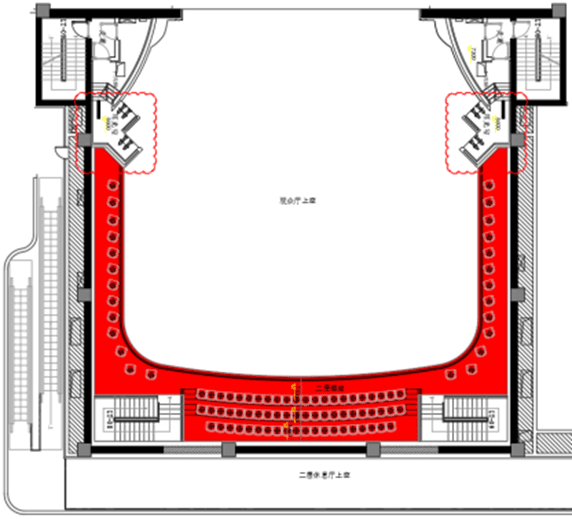
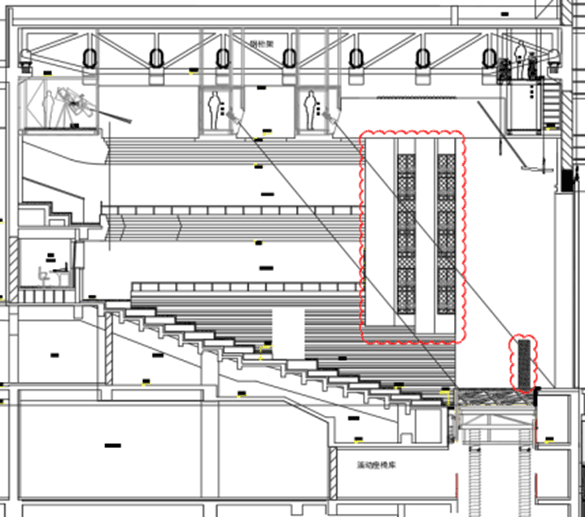
The architectural team prioritized acoustic requirements from design through completion, and Scheme 4-1 was ultimately selected.
In the late construction drawing stage, requirements for concealed speakers and lighting were reintroduced. To mitigate the resulting sound absorption, the acoustic team fine-tuned the proscenium side wall shape so opening surfaces were as perpendicular as possible to the speaker axes, minimizing opening area.
Interior Acoustic Intent and 3D Ray Analysis
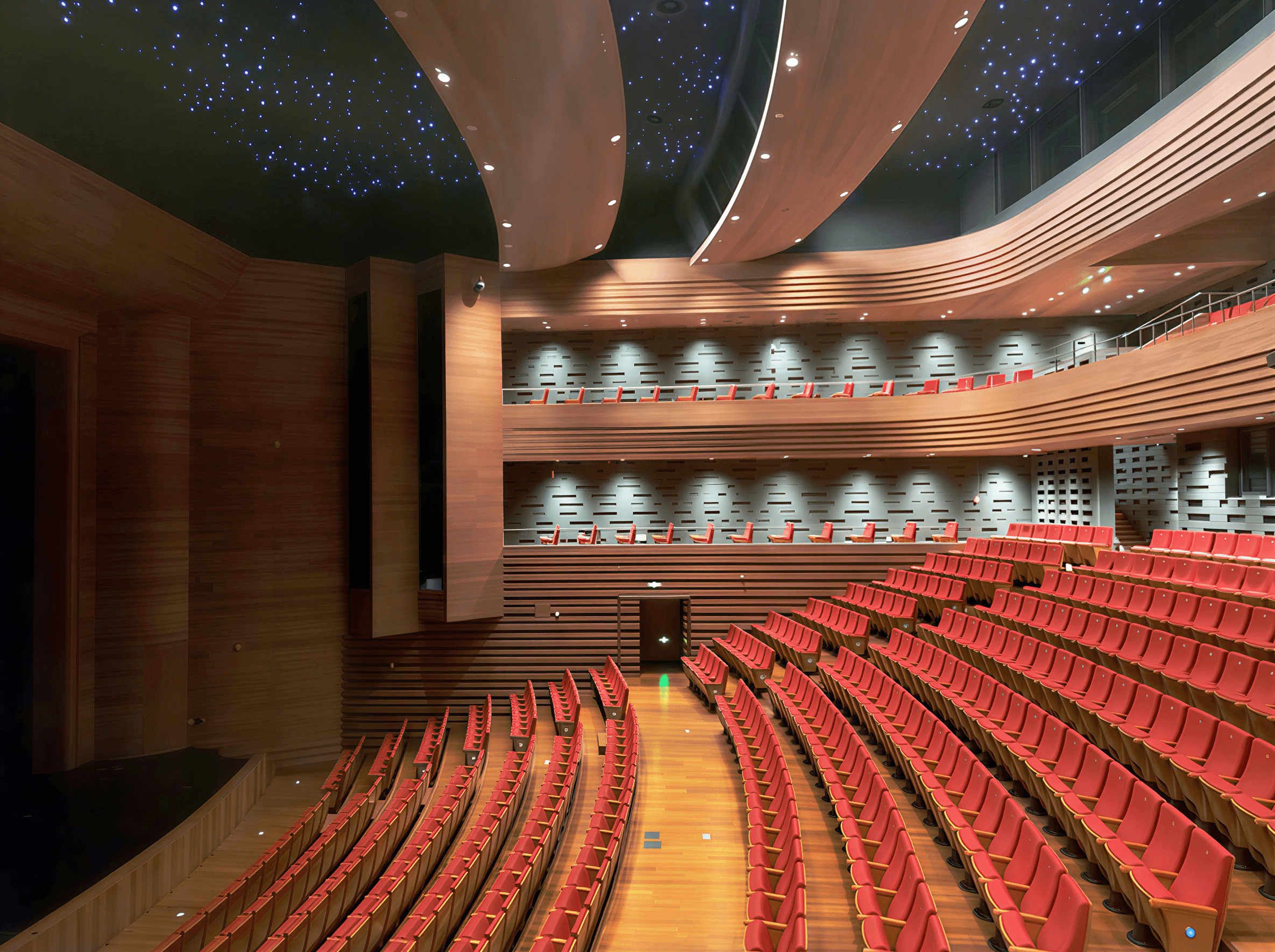
The interior decoration incorporated elements of Beijing's Hutongs, using a staggered gray brick and wood style to highlight local cultural characteristics. The darker background also helps focus audience attention on the actors.
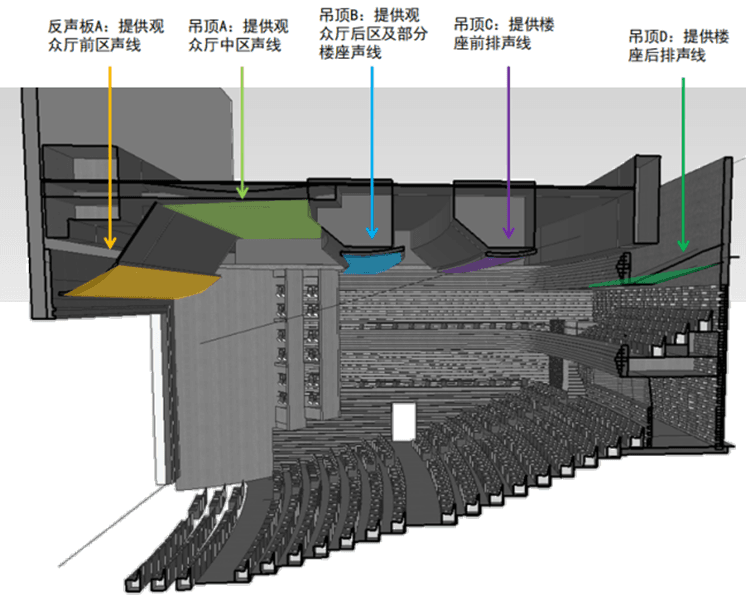
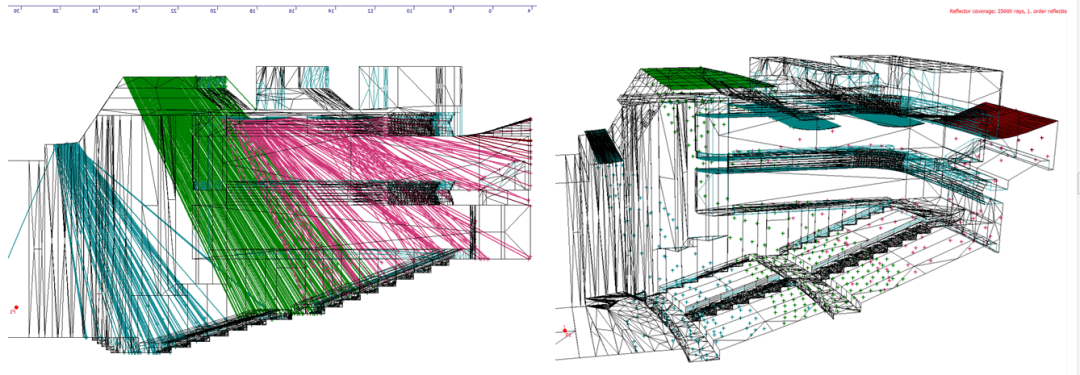
After the interior decoration scheme was initially defined, the acoustic team assessed the function of each reflective panel and ceiling surface. More than ten sound ray analyses were carried out as the decorative design evolved.
Ray-Path Refinement
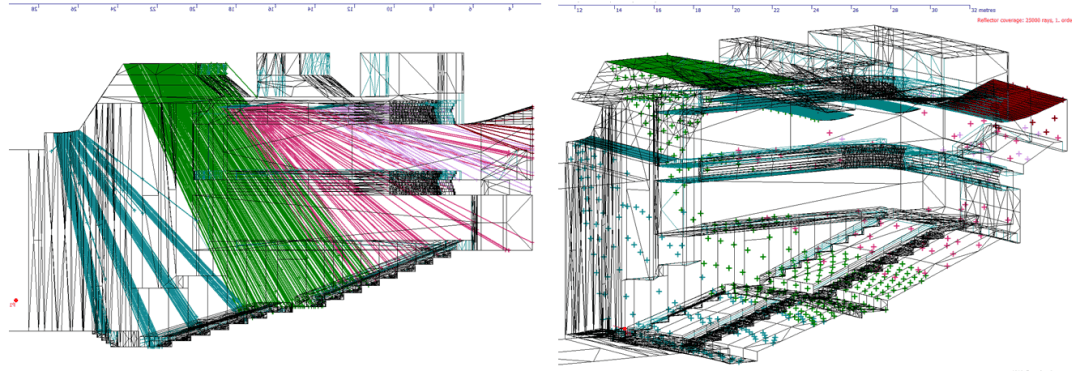
As shown in the initial analysis, issues included a blind zone between reflective panel A and ceiling A, potential flutter echo between ceiling A and the stalls, excessive overlap between ceiling A and ceiling B, and ineffective zones for ceilings B and C.
The curvatures and angles of panel A and ceiling C were adjusted to resolve these issues and improve reflected sound coverage across the auditorium.
Computer Simulation and Absorption Layout
The original RT target was 1.2±0.10s under full-occupancy conditions, requiring no additional absorption and preserving sufficient loudness for natural sound. Later, the client requested a reverberation time matching the Capital Theatre, so the target was adjusted to 1.1±0.10s full occupancy.
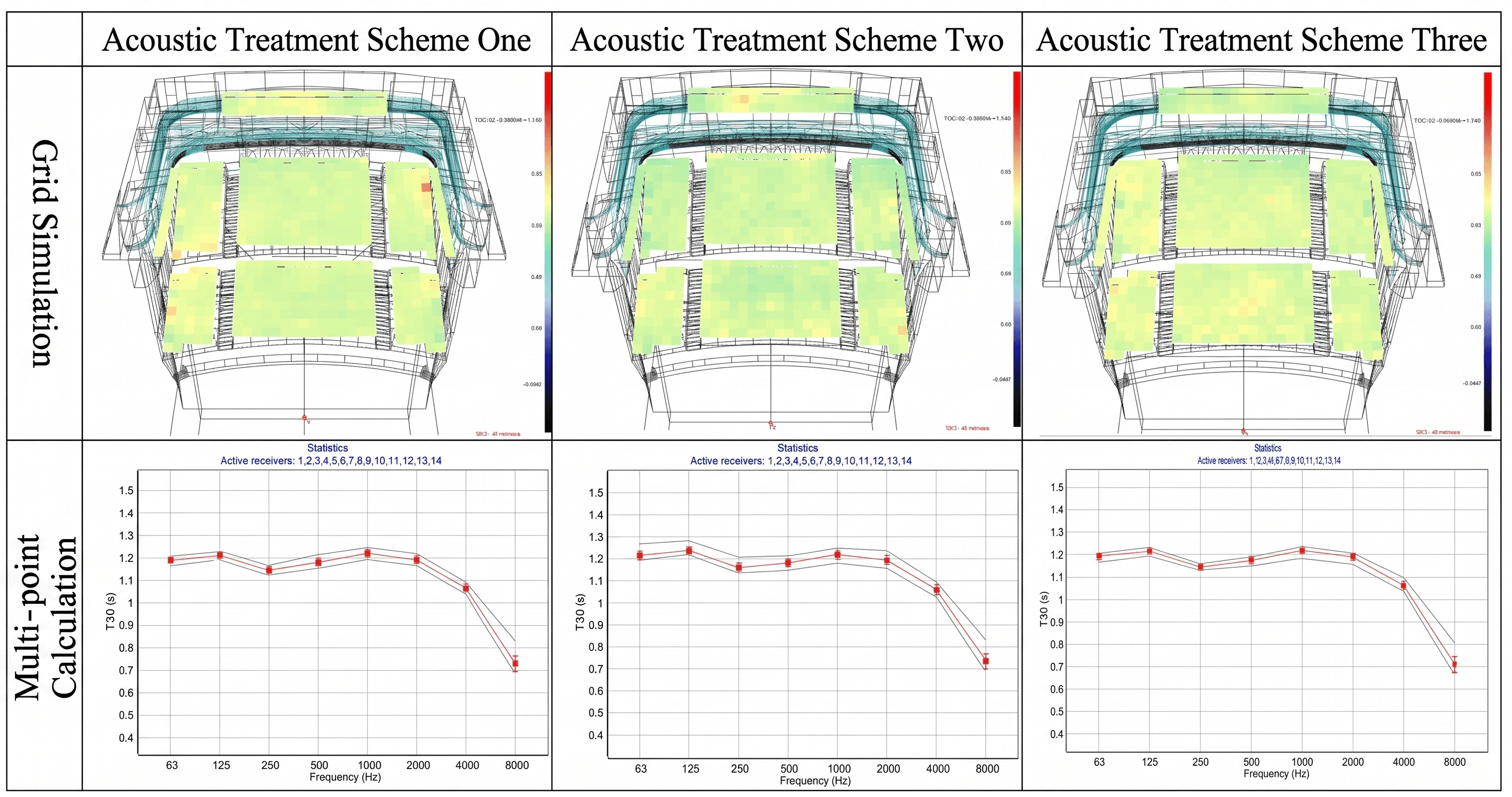
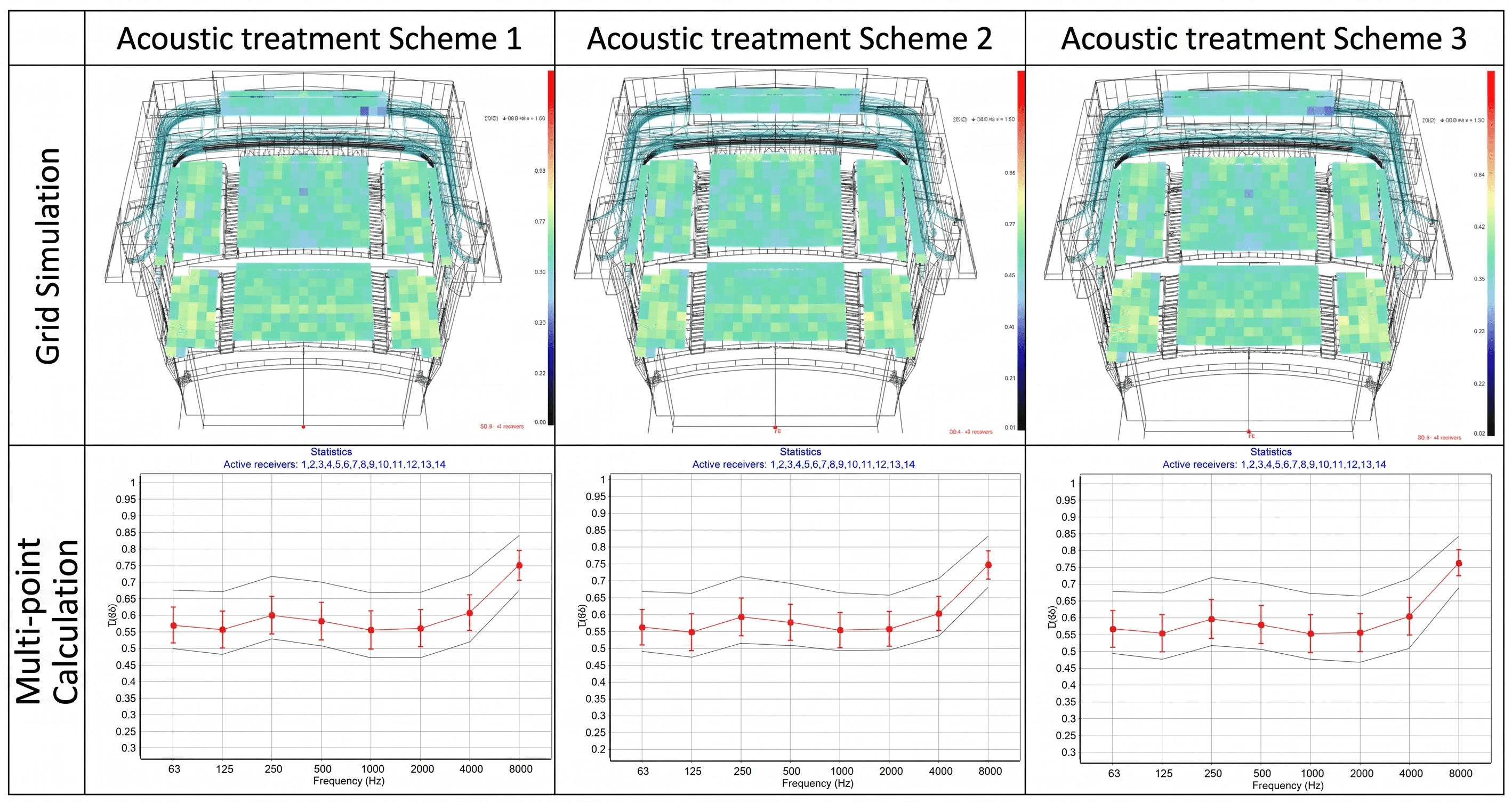
To achieve this without altering volume, absorption was necessary. To minimize negative impacts on clarity and loudness, absorption was placed on surfaces reached only after first or multiple reflections, and the options were evaluated using ODEON grid and multi-point analysis.

Reverberation Time T30 Comparison
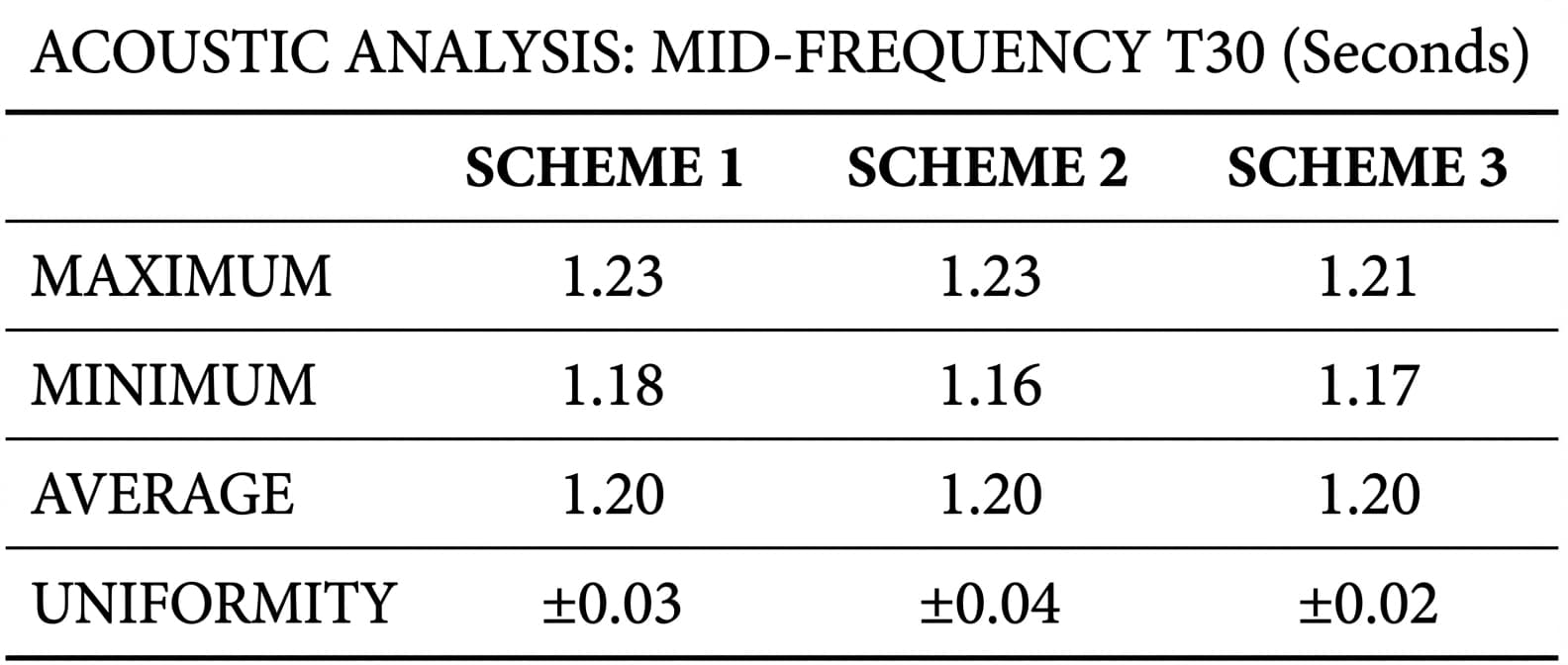
Simulation showed that placing absorption on the rear balcony wall, Scheme 1, required the smallest area at approximately 80 m², while Schemes 2 and 3 required approximately 86 m².
For reverberation uniformity, both grid and multi-point calculations showed Scheme 3 to be the best, with approximately ±0.02s uniformity. Scheme 2 performed comparatively worse.
Strength Factor G Comparison
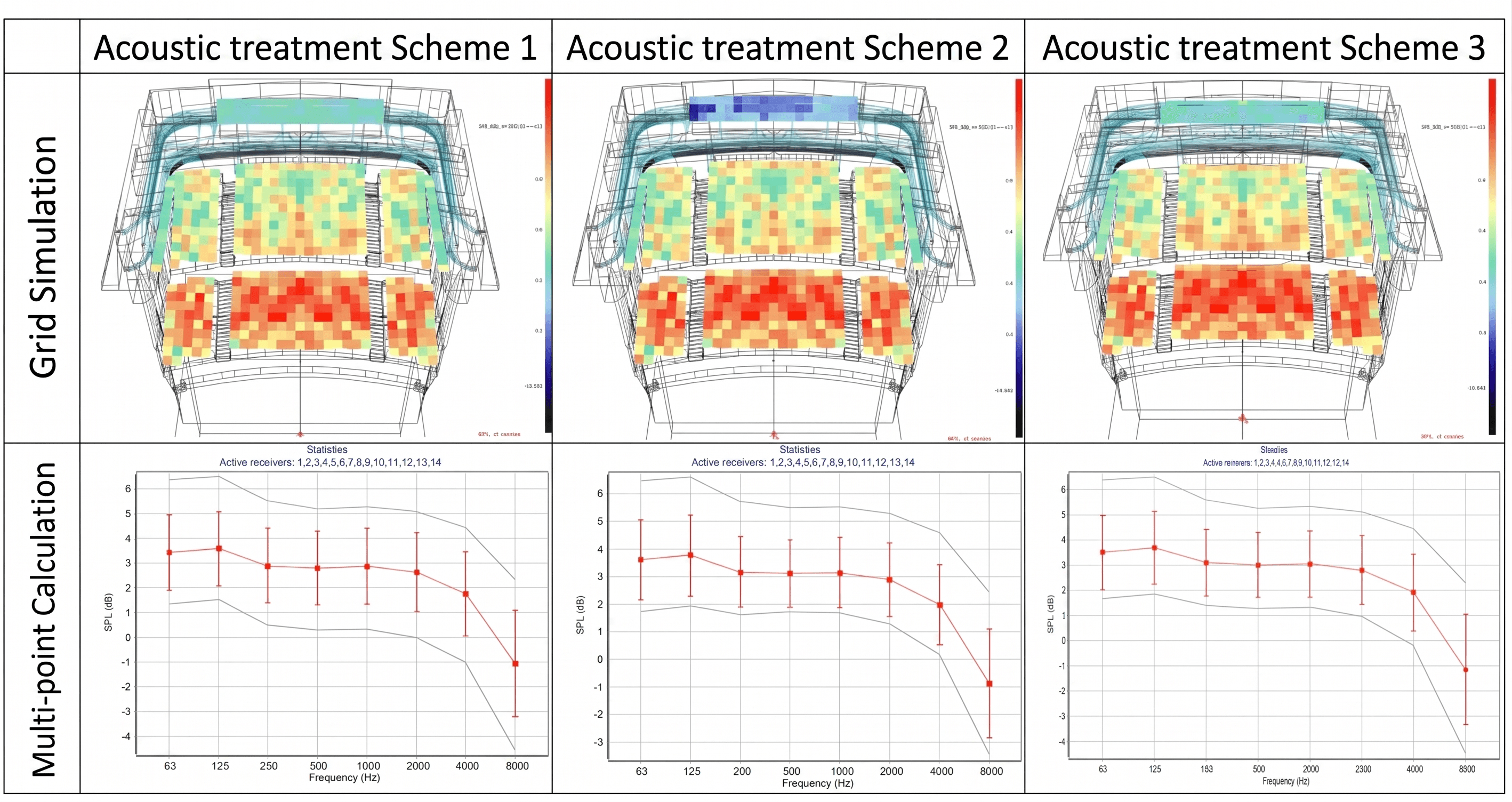
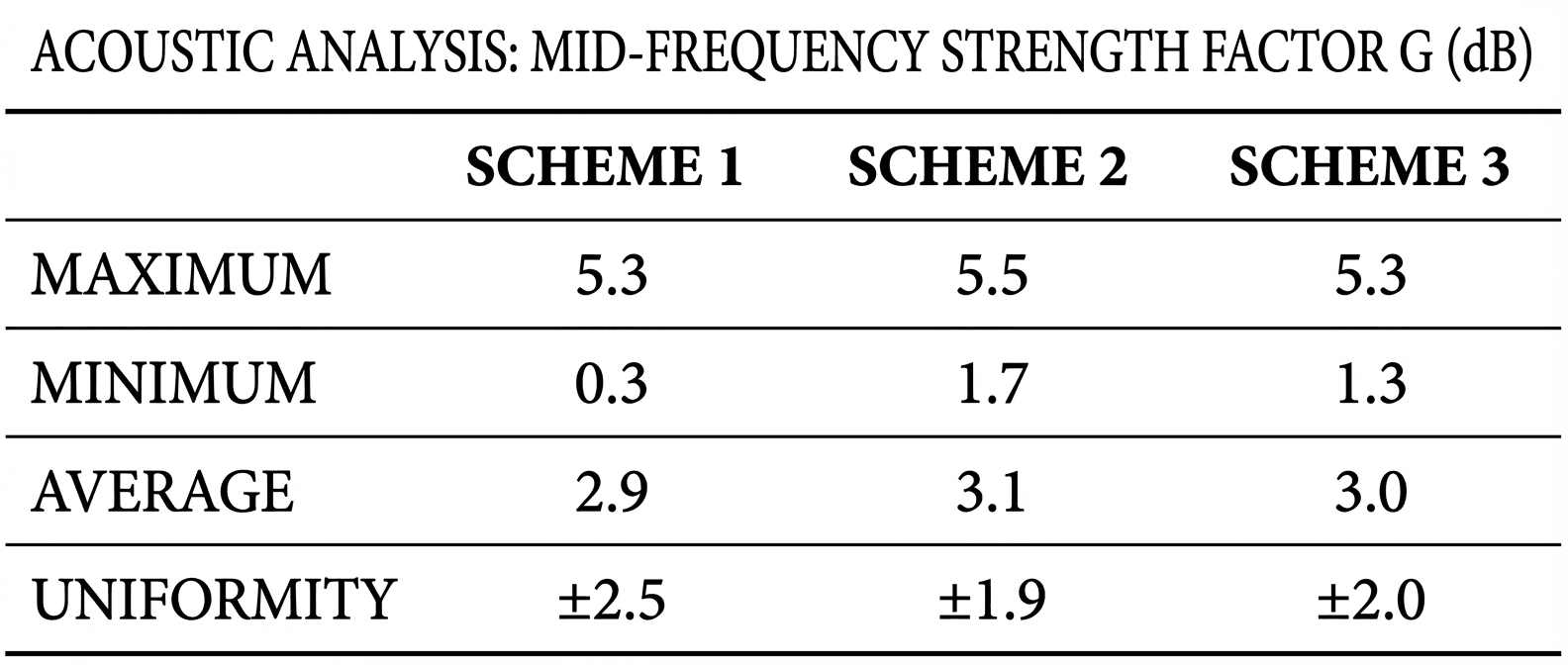
As the absorption location changed, the distribution of Strength Factor G also shifted. Grid simulation showed that all three schemes had similar G-values in the stalls, while Scheme 1 produced significantly lower values in the balcony.
Multi-point calculations showed similar results. Schemes 2 and 3 improved the minimum G-values by more than 1dB compared with Scheme 1, and optimized G uniformity from ±3dB to ±2dB.
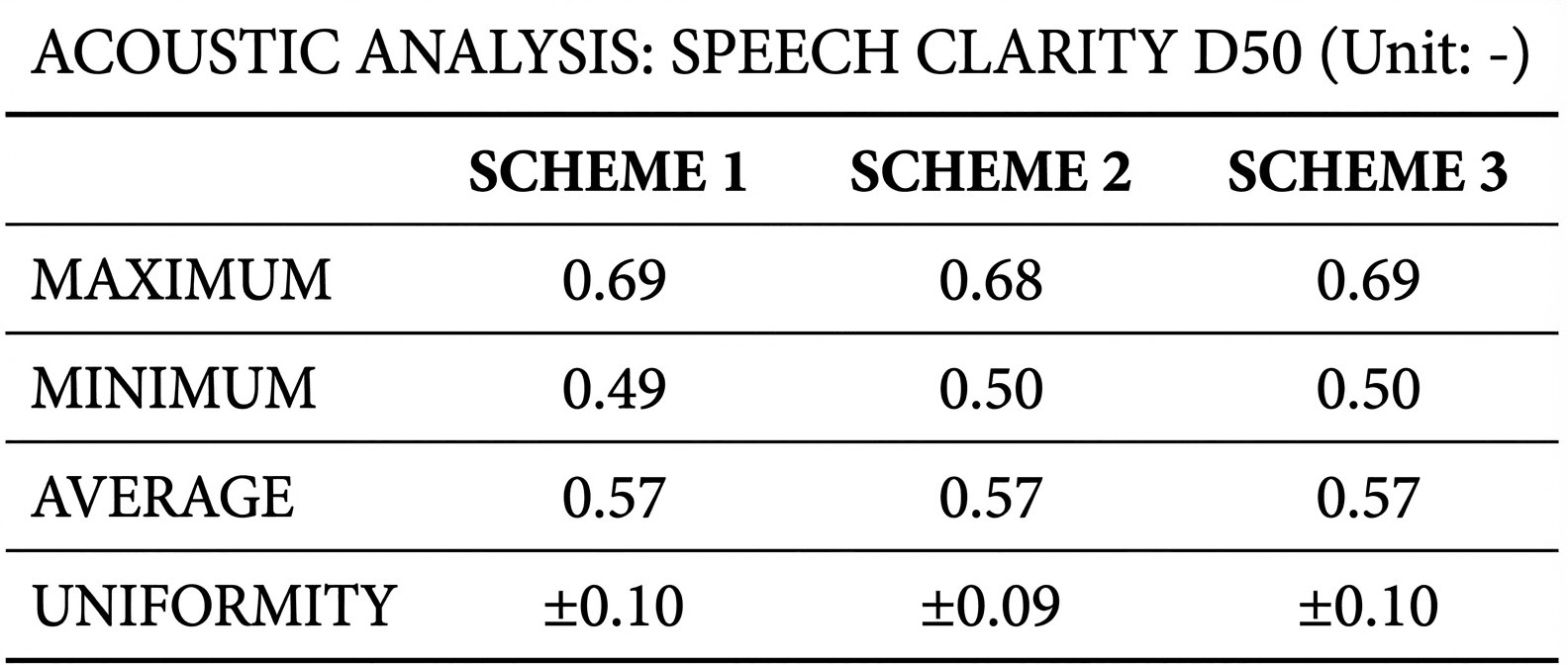
Definition D50 Comparison
The overall impact on Definition D50 was not significant across the three schemes, although some balcony and stall grid points showed slight differences.
The multi-point calculations were similar to the grid simulation. The D50 values of Schemes 1, 2, and 3 were largely consistent, while Scheme 2 provided the most uniform distribution.
Measured Acoustic Results
Scheme 1 was excluded due to low G-values in the balcony. Between Schemes 2 and 3, Scheme 3 was ultimately selected for the absorbent layout to accommodate the installation of starry sky ceiling lights.
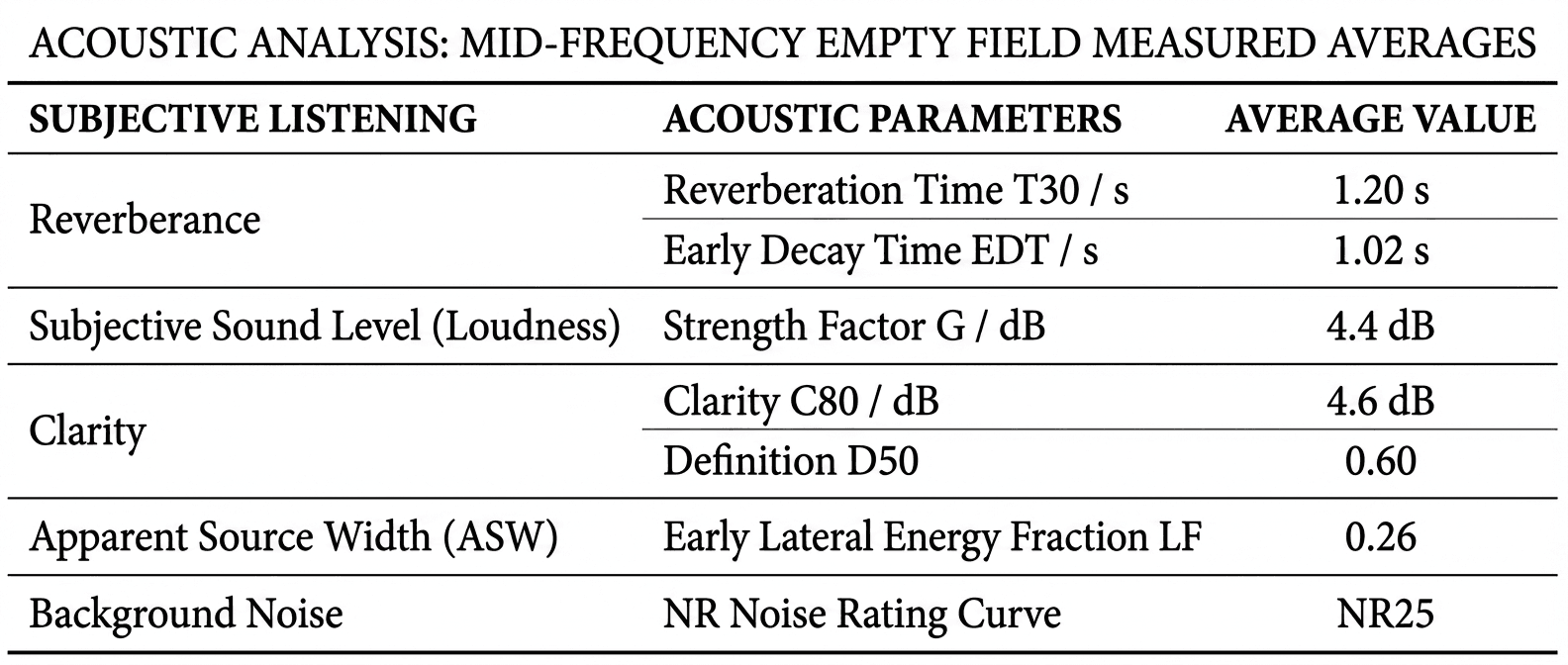
LYN ACOUSTICS conducted unoccupied acoustic testing at the Cao Yu Theatre on July 5, 2021, with stage curtains, scenery, and HVAC systems operational. Parameters were measured according to GB/T 36075.1-2018. T30 and D50 closely matched simulations, while G-values differed by 1.4dB, consistent with Beranek's research on calibration differences. Overall, the acoustic design fully met the requirements.
Completion Photos
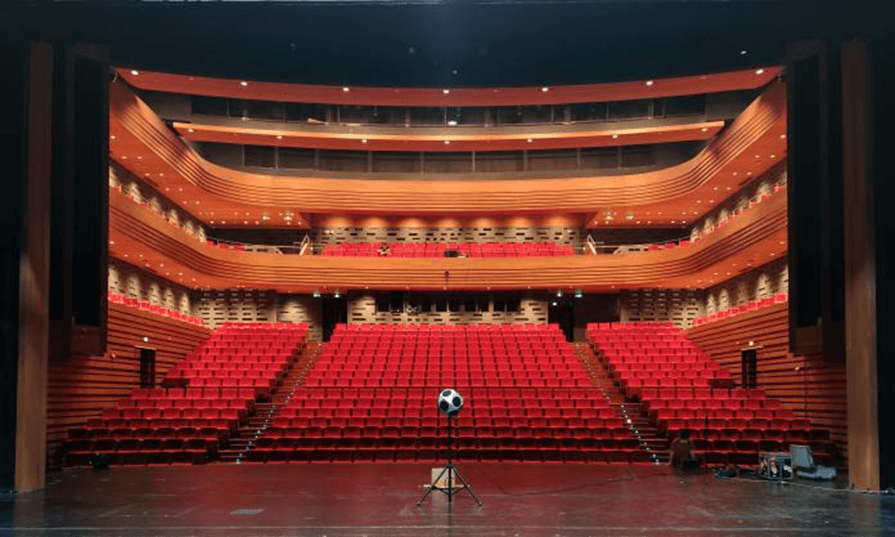
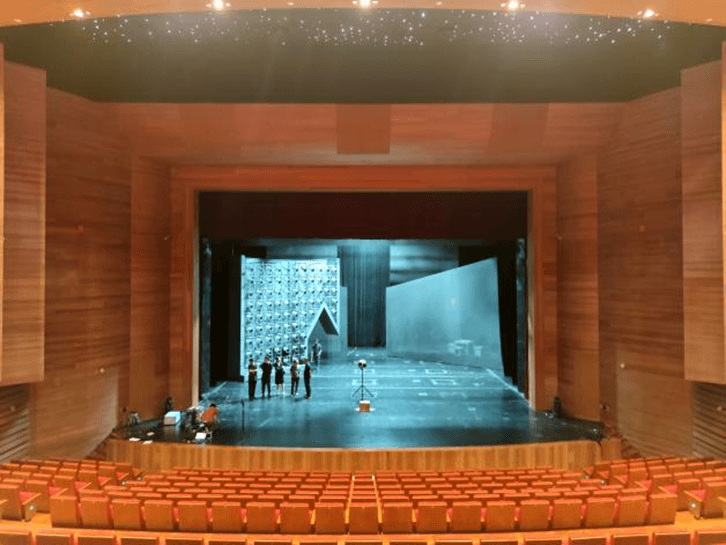
Post-completion photographs show the final auditorium and balcony conditions, with the intimate room geometry and gray brick and wood interior language supporting the Cao Yu Theatre's drama-focused acoustic identity.