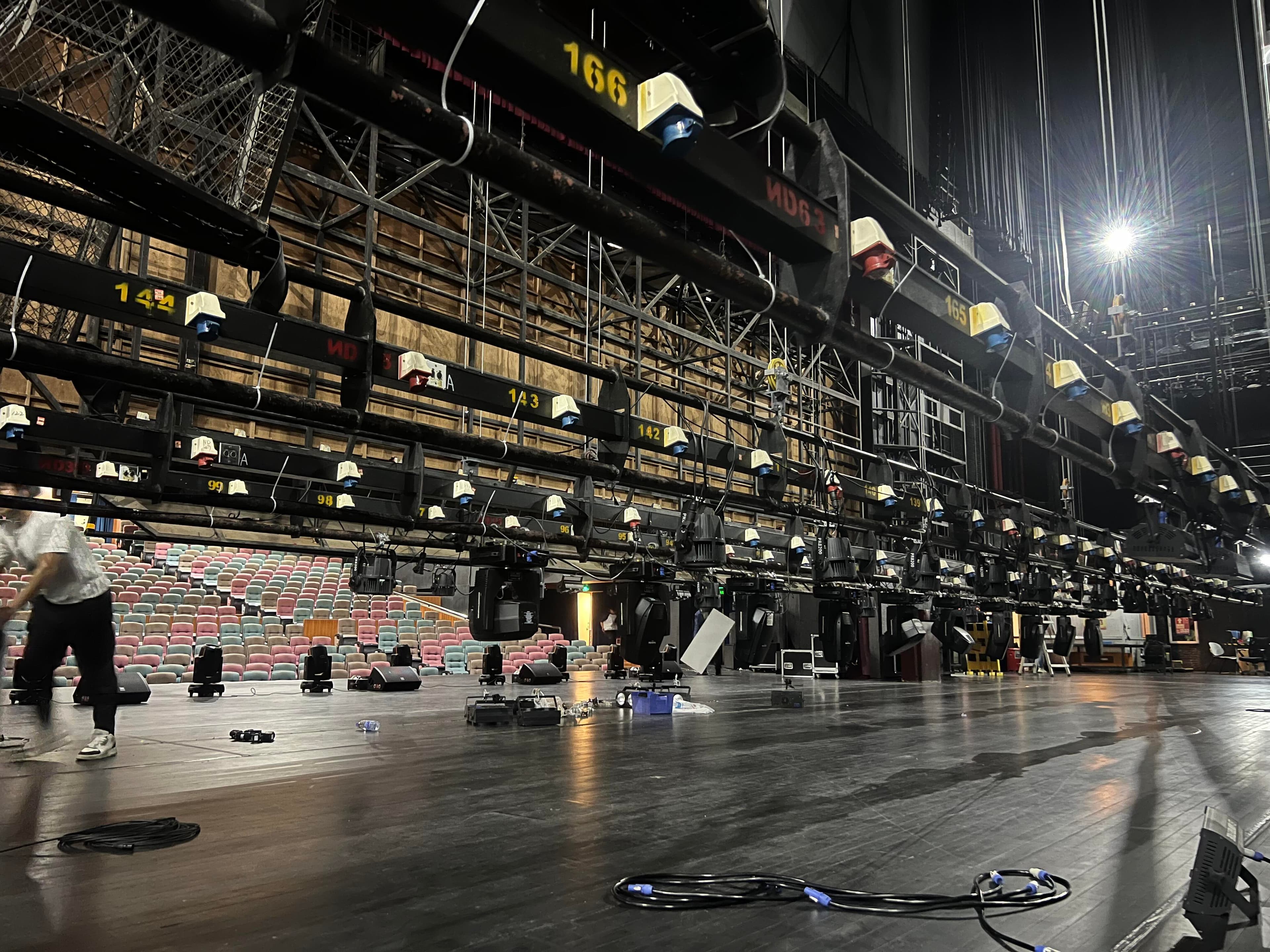

01. Executive Summary
Modern venues no longer suspend simple theatrical scenery above the audience. They suspend massive acoustic instruments, immersive audio arrays, and automated architectural systems that must move with millimeter-level precision under SIL3-grade safety logic.
The shift from static performance rooms to deeply dynamic venues has transformed stage engineering. Acoustic shells, banners, canopies, immersive line arrays, and flown subwoofers are now expected to reconfigure continuously for symphonies, conferences, amplified concerts, and hybrid productions.
That operating model creates a harsh reality: extreme suspended mass plus high-frequency dynamic motion above audiences leaves no room for casual integration between acoustics, machinery, controls, and life-safety systems.
Core Thesis
SIL3 should not be treated as a machinery-only compliance checkbox. In modern theaters, it must become the shared safety language that governs stage automation, AVL infrastructure, and fire-life-safety interlocks as one coordinated system.
- The payload above the stage is an acoustic instrument, not generic scenery, so morphology and coordinate accuracy matter as much as lifting capacity.
- No single point of failure is acceptable when heavy acoustic elements and speaker arrays move over performers and spectators.
- Commercial value comes from eliminating catastrophic rework, legal exposure, and operational downtime while preserving artistic flexibility.
1.1 From Static Rooms to Deeply Dynamic Systems
The commercial success of a multipurpose theater now depends on how quickly it can reconstruct its spatial identity. A room may host a symphony one night, a corporate launch the next morning, and a high-SPL pop show that evening.
To support that range, designers increasingly rely on heavy variable-acoustic devices, immersive loudspeaker matrices, automated banners, and moving canopies suspended directly over the performance zone. These systems are no longer passive background infrastructure. They are active mechanical participants in the show architecture.
1.2 SIL3 as the Highest Handshake Protocol
Traditional fall protection and static safety rules do not fully address the system complexity of modern venues. SIL3 provides the functional-safety framework needed to coordinate mechanical fault handling, electrical anomalies, and emergency overrides at the whole-system level.
- A mechanical fault must be able to trigger immediate safe-state behavior across machinery, audio, and control infrastructure.
- A fire event must silence the main PA path and elevate evacuation messaging without depending on fragile best-effort network commands.
- All subsystems must be designed from the concept phase to communicate inside the same high-integrity safety logic.
1.3 The Integrator's Mission
Acoustic consultants pursue absolute positional accuracy and ultra-low background noise. Machinery engineers prioritize redundancy, braking force, and conservative control behavior. The integrator's role is to translate between these opposing logics and resolve them into one defensible architecture.
That mission is not abstract. It directly protects investor value by preventing catastrophic accidents, preserving the performance quality of suspended acoustic systems, and avoiding late-stage redesign when hidden interdisciplinary conflicts surface during commissioning.
02. The Acoustic & Electroacoustic Payload
Before mandating SIL3 control behavior, stakeholders must understand what is actually moving overhead: not generic rigging loads, but precision acoustic payloads whose geometry and spatial coordinates define the listening experience.
2.1 Variable Acoustics as Heavy Precision Payloads
Modern acoustic shells and canopies are often built from dense, high-mass assemblies so they can support the long reverberation times and reflective behavior demanded by orchestral performance. Individual modules can weigh many tons and still require frequent deployment and storage during a busy programming calendar.
From a machinery viewpoint, the instinct may be to judge success by whether the load is safely supported. From an acoustics viewpoint, that is insufficient. If multi-point hoisting introduces differential tension and the shell deforms, joints open, low-frequency energy leaks out, and the carefully modeled sound field collapses.
- Safety redundancy alone is not enough; synchronous motion control must preserve rigid geometry during travel and suspension.
- Panel deformation is not a cosmetic issue; it directly changes reverberation behavior and low-frequency retention.
- Movement frequency matters because repetitive deployment cycles accelerate fatigue and raise the consequences of control drift.
2.2 Three-Dimensional Positioning of Immersive Systems
Immersive electroacoustic systems fundamentally increase the demands placed on stage automation. A venue may now fly five to seven array hangs, subwoofers, and support clusters whose real-world coordinates must match acoustic prediction models with very high repeatability.
A one-degree error in tilt or a small error in XYZ position can break high-frequency coverage and destroy the 'what you see is what you hear' premise of immersive design. Re-hoisting is therefore not approximate repositioning. It is acoustic field reconstruction by mechanical means.
03. Machinery & Control Architecture for SIL3
Once the true nature of the payload is understood, the logic behind heavy machinery CAPEX becomes clear. The owner is not buying simple hoists. The owner is buying a self-diagnosing safety architecture built around the principle of no single point of failure.
3.1 Redundancy at the Hardware Layer
SIL3 assumes that any single mechanical component can fail. For heavy acoustic payloads, that assumption translates into systematic redundancy across braking, position tracking, and load supervision.
- Independent double brakes ensure that the load can still lock safely if one brake path fails or loses power.
- Dual encoders cross-check motor and drum position so the system can detect slip, drift, or loss of coordinate certainty in real time.
- Wear gaps, holding torque, and sensor disagreement must be continuously monitored rather than checked only during maintenance windows.
This same redundancy also serves performance quality. The dual-verification logic that prevents uncontrolled motion is the same logic that preserves repeatable positioning for acoustic arrays and variable-acoustic modules.
3.2 Millisecond Closed-Loop Safety Control
The intelligence of a SIL3 system lives in the safety PLC and the certified communication chain around it. Slack-wire detectors, overload cells, overspeed switches, and other sensors must be scanned in millisecond cycles so dangerous states are intercepted before they become physical incidents.
Safety-critical commands cannot rely on general-purpose best-effort traffic. Emergency stop, lockout, and safe-state transitions must travel through high-integrity industrial safety buses designed to remain trustworthy even in the presence of interference, delay, or packet disruption.
3.3 SIL3 as a Due-Diligence Shield
Commercial Translation
Reducing dangerous failure probability to SIL3 territory is not only an engineering milestone. It is also the owner's strongest technical proof of due diligence during audits, insurance negotiations, and post-incident legal review.
In other words, the value of redundancy is measured not only in avoided injuries, but in avoided claims, avoided shutdowns, and preserved lender and insurer confidence over the life of the venue.
04. The Integration Nexus
The most dangerous mistake in modern theater delivery is treating audio, machinery, and fire safety as adjacent systems instead of interlocked systems.
4.1 Fire & Life Safety vs. Main PA
A peak-level concert presents the clearest life-safety conflict. If the main PA is delivering extreme SPL while a fire event occurs, evacuation instructions can be completely masked unless the entertainment path is forced silent instantly.
For that reason, a SIL3-minded integration strategy rejects soft assumptions about ordinary network mute commands. Hardwired, safety-compliant relay logic between the fire command path and the main PA path is the only defensible way to guarantee that emergency voice messages take priority.
4.2 Network Topology: Isolation and Convergence
Audio transport and machinery safety traffic may share a project, but they cannot be allowed to share risk. High-bandwidth A/V streams are optimized for throughput and low latency, whereas safety traffic is optimized for absolute command certainty.
- Safety commands need their own protected path, whether through strict VLAN and QoS segregation or fully separate backbone infrastructure.
- A burst of media traffic must never delay or corrupt an emergency stop or safe-state command.
- The integrator must define those rules at the core-switch and architecture level, not after installation.
4.3 Dynamic Soundscape Reconstruction
Integration is not only about emergency behavior. It also enables better art. When a flown array moves in height or angle, the audio DSP should receive live position data and update delay, timing, and spatial imaging models automatically.
The same dual-redundant encoder data used for fall protection can therefore serve a second mission: feeding real-time XYZ and orientation coordinates to the DSP so the sound field remains coherent as the mechanical state changes.
05. Resolving Physical & Environmental Conflicts
Even the most elegant control logic must ultimately survive the hard constraints of catwalks, grids, acoustic envelopes, and equipment rooms. This is where many high-spec venues accumulate their most expensive hidden risks.
5.1 Mechanical Noise vs. Acoustic Background Noise
Top-tier halls may require background noise targets as severe as NC-15 or NR-20, yet SIL3-rated hoists are inherently industrial devices. Cooling fans, brake engagement, and drive mechanics all create noise sources that can destroy the atmosphere of a delicate performance if they remain inside the acoustic envelope.
- One path is deep equipment customization: quieter motors, acoustic enclosures, and softer braking behavior.
- The stronger path is architectural isolation: move winch rooms outside the hall envelope and leave only passive pulley elements over the room.
- The integrator's job is to refuse the false choice between safety and silence.
5.2 Catwalk Space, Load, and Dynamic Shock
The overhead volume of a venue is finite while the ambitions of modern productions are not. Audio wants more hangs, video wants massive displays, and machinery wants larger SIL3-grade hoists with redundant cabling and safety hardware.
Static weight calculations are not enough. Emergency braking on a multi-ton payload can generate dynamic shock loads that distort catwalk structures or excite structural resonance if they were designed only for nominal suspended mass.
5.3 Eliminating Rework Economics
Cross-disciplinary BIM coordination is therefore not just a coordination luxury. It is a financial control mechanism. Detecting clashes and load conflicts before steel is cut costs weeks; discovering them after acoustic ceilings and finishes are complete costs months and potentially millions.
06. Commissioning, Validation & Lifecycle Handover
A SIL3 venue cannot be handed over as a black box. Owners need proof, not promises, that the integrated system behaves safely under stress and remains maintainable over decades.
6.1 Joint Site Acceptance Testing
Certification of individual components does not validate the integrated venue. Joint Site Acceptance Testing should simulate difficult scenarios under realistic load, including loss of power during motion, emergency stop under heavy descent, and fire-alarm takeover while the entertainment system is operating at extreme level.
Only after the system survives those deep-water tests without ambiguity should the owner accept it for commercial operation.
6.2 Independent Third-Party Audit
An independent assessor is essential. Third-party review of safety logic, wiring compliance, certified communication paths, and system stability provides the owner with a defensible acceptance record that extends beyond the integrator's own assurances.
6.3 Digital Handover and Predictive Maintenance
Lifecycle value appears after opening day. Unified diagnostic dashboards can expose brake wear, safety-bus health, payload status, and speaker-system condition so venue teams move from reactive repairs toward predictive maintenance planning.
That shift lowers OPEX, reduces dangerous manual inspections, and helps preserve both uptime and safety integrity through the venue's full service life.
07. Conclusion
Investing in SIL3-grade integration is not a sunk cost. It is the technical foundation of safe, commercially competitive, future-ready stage infrastructure.
By treating SIL3 as the highest handshake protocol across machinery, AVL, and fire-life-safety systems, owners can prevent catastrophic failures, preserve acoustic intent, and avoid extreme retrofit costs later in the project.
The strategic takeaway is straightforward: future tender documents should require stage machinery, AVL interlocks, and fire-safety interfaces to comply with SIL3 or equivalent functional-safety logic as a disqualification-level baseline, not a value-engineering afterthought.