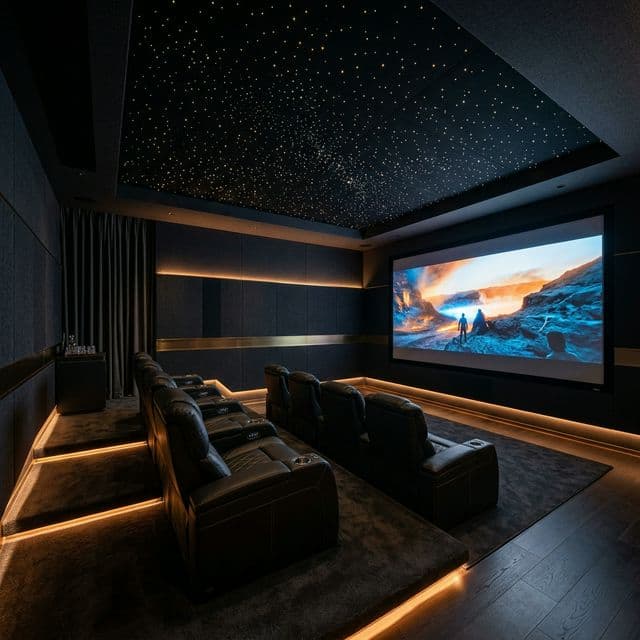

The Engineering Challenge: The Small-Room Modal Paradox
Converting a raw concrete basement shell into an acoustically perfect, STC-70 isolated cinematic sanctuary is a task that defies simple interior design. The primary challenge was mathematically neutralizing severe low-frequency room modes inherent to small-room acoustics.
In spaces under 100 square meters, low frequencies do not act like rays; they act like pressure waves. Without precise structural calculation, the basement would suffer from "bass boominess" and "acoustic nulls" that would render even the most expensive audio equipment useless.
TYN ACOUSTICS was tasked with engineering a total solution: from raw slab calculations to a unified 9.4.6 spatial audio deployment, all while maintaining the obsidian-inspired, ultra-minimalist luxury aesthetic.
Room Dimension & Standing Wave Calculation
The foundation of any reference-grade cinema is its physical geometry. Before constructing the acoustic shell, we utilized the Rayleigh equation to calculate the axial, tangential, and oblique modes of the raw space.
The raw concrete dimensions (7.0m × 5.4m × 3.4m) were perilously close to square multiples. We mathematically recalculated the finished internal dimensions to align with Sepmeyer's Golden Ratio (1 : 1.28 : 1.54), ensuring that the resonant frequencies are evenly distributed across the spectrum.
Fundamental Axial Modes
Soundproofing: The "Room-in-Room" Architecture
A 115dB(C) cinema system in a residential villa requires extreme isolation. We deployed a strict Box-in-a-Box decoupled architecture achieving an impenetrable STC-70.
The cinema floor is a 100mm reinforced concrete slab poured over high-density structural acoustic isolation pucks, leaving a 50mm air gap between the cinema floor and the villa's foundation.
The walls consist of three layers of variable-density acoustic drywall, sandwiched with viscoelastic damping compound (Green Glue), which converts sound vibrations into trace amounts of heat.
Acoustic Treatment & Material Layout
To meet THX and Dolby Atmos standards, we targeted a strict 0.35s RT60 across the spectrum.
A 400mm-deep False Baffle Wall was constructed behind the acoustically transparent screen to Eliminate SBIR. On the rear walls, we deployed CNC-milled 1D/2D QRD diffusers to shatter late reflections into a lush, diffuse soundscape.
Deep membrane bass traps were tuned specifically to 33Hz and 51Hz (the calculated primary room modes) to suck out excess low-end energy, providing "tight," surgical bass response in every seat.
The 9.4.6 Audio-Visual Ecosystem
The Obsidian Sanctuary features a reference-grade 9.4.6 spatial audio configuration, utilizing world-class components to push the boundaries of residential cinema.
To achieve perfectly even bass, we utilized four massive subwoofers placed at the midpoints of the four walls, actively cancelling out each other's standing waves via precise DSP time-alignment.
The 180-inch 2.35:1 micro-perforated Stewart Filmscreen is illuminated by a native 4K laser projector, calibrated to deliver 100 nits of peak brightness for mastering-level HDR content.
Smart Environment: The Invisible Interface
A reference-level room must be simple to operate. The entire cinema is unified under a centralized Smart Automation System.
Selecting a film initiates a hardware sequence: the projector fires, lights dim via DALI gateways, and the HVAC system drops to a silent "low-velocity" mode to maintain the NC-15 noise floor.
Oversized, acoustically lined Z-ducts allow for massive air volume movement at a very low velocity, providing perfect climate control while remaining completely inaudible on high-sensitivity microphones.
Detailed Bill of Materials & Equipment List
| Parameter | Value | Notes |
|---|---|---|
| Resilient Isolation Clips (RSIC) | 180 pcs | 25kg capacity/clip |
| Viscoelastic Damping Compound | 12 Buckets | Green Glue equivalent |
| High-Density Mineral Wool | 150 m² | 60kg/m³, Class A |
| Custom 2D QRD Diffusers | 8 Modules | CNC Milled Solid Oak |
| Membrane Bass Traps | 4 Units | Tuned to 33Hz/51Hz |
| Acoustic Transparent Fabric | 85 m² | Guilford of Maine |
| Projection System | Native 4K Laser, 3000Lm | JVC DLA-NZ9 |
| Projection Screen | 180" 2.35:1 MicroPerf | Stewart Filmscreen |
| AV Processor | Discrete Atmos / Dirac Live | Trinnov Altitude 16 |
| Amplification | Multi-Ch High-Current | McIntosh / ATI |
| LCR Speakers | Reference Studio Monitors | Meyer Sound Acheron |
| Subwoofers | 4x 18" Dual-Opposing | JL Audio Gotham |
| Smart Automation | Unified IP/DALI Controller | Control4 EA-5 |
| Calibration | Phase & Timing Alignment | Smaart v9 / Dirac |