
01. Introduction
Early theatrical performances were held outdoors or semi-outdoors and relied entirely on sunlight, but once theater moved indoors and into the night, stage lighting had to emerge.
Early theatrical performances were held outdoors or semi-outdoors, relying solely on sunlight as the single light source. However, as performance venues moved indoors or took place at night, stage lighting began to emerge.
Often, several questions linger in one's mind: "Is it really necessary for a theater to arrange so many lighting fixtures on the stage and in the auditorium? Does a performance truly need that much lighting? Is it really necessary to position them in so many different directions? Why don't we just use stage lighting to simulate the simplest daylight? Wouldn't that be the closest to nature and the most cost-effective investment?"
With these questions in mind, we will trace the answers from the perspective of a beginner in stage lighting design.
02. Common Lighting Methods
Under sunlight, photographs taken with front lighting, side lighting, and backlighting give completely different impressions. Especially when light shines directly and perpendicularly onto the subject's face, not only is it difficult for them to keep their eyes open, but the face also appears flat and unremarkable due to the lack of shadows.
Next, we will introduce two classic single-point lighting methods that can make a portrait look more three-dimensional and attractive.
2.1 Rembrandt Lighting: The Classic Method for Single-Point Side Lighting
Rembrandt lighting is a unique lighting effect in portrait photography. Its basic lighting effect is the formation of a triangular light patch on the front part of the subject's face, surrounded by shadows from the brow bone and the bridge of the nose, as well as the dark area of the cheekbone. For that reason, it is also called triangle lighting.
It originated from the portrait oil paintings of the famous Dutch painter Rembrandt during the Renaissance. Rembrandt lighting uses strong light-and-dark contrast to enhance the subject's three-dimensionality, resulting in an image with rich layers, full of vitality, and far from dull.
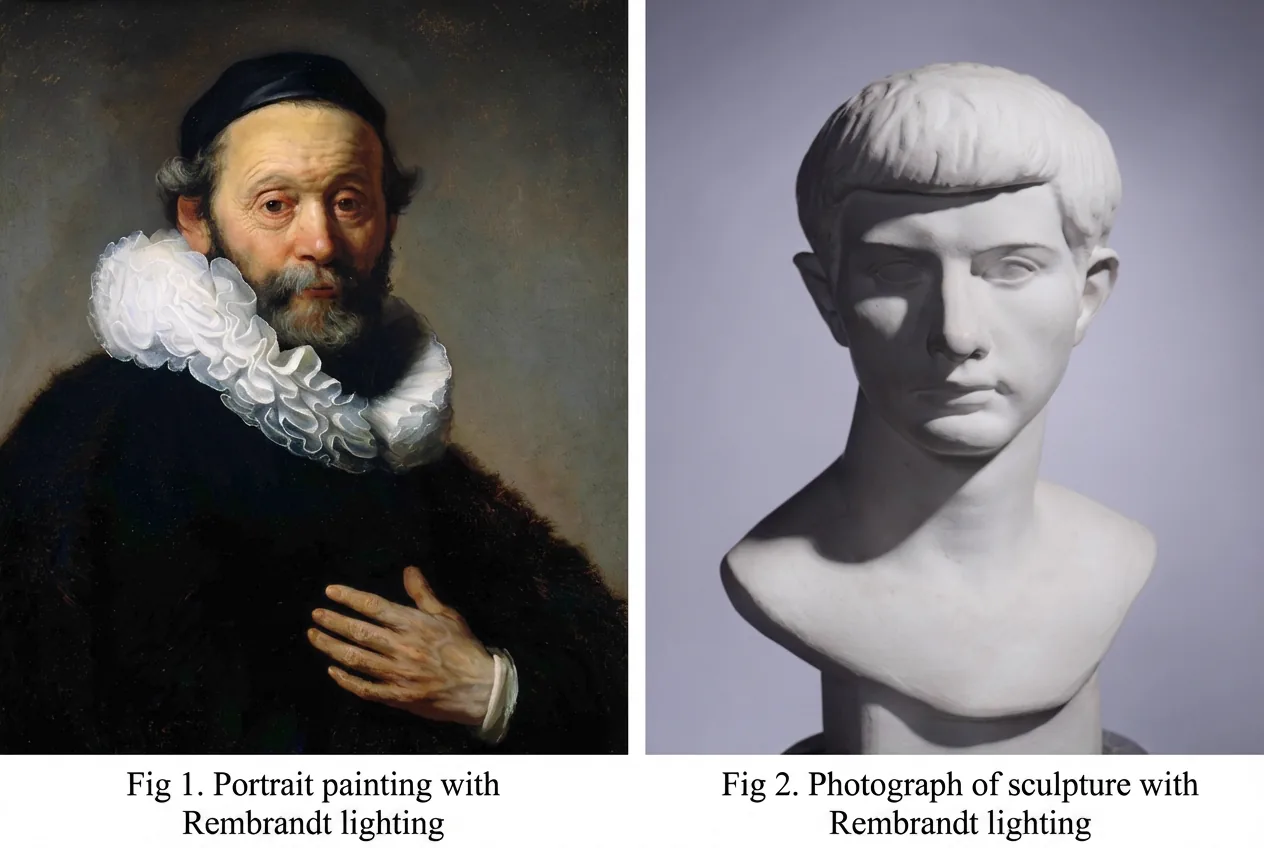
Figure 1
Rembrandt-style portrait reference.
2.2 Butterfly Lighting: The Classic Method for Single-Point Front Lighting
The common setup for butterfly lighting involves placing the main light source directly above and slightly in front of the subject's face, projecting downward onto the face and casting a butterfly-shaped shadow below the nose. Shadows are also created on the cheeks and chin, making the chin look sharper and the face appear thinner.
This lighting method is commonly used in Hollywood movie sets when photographing beautiful female stars, so it is also known as beauty lighting. Changes in the subject's shape, tone, and color are primarily expressed through subtle variations in lighting tone.
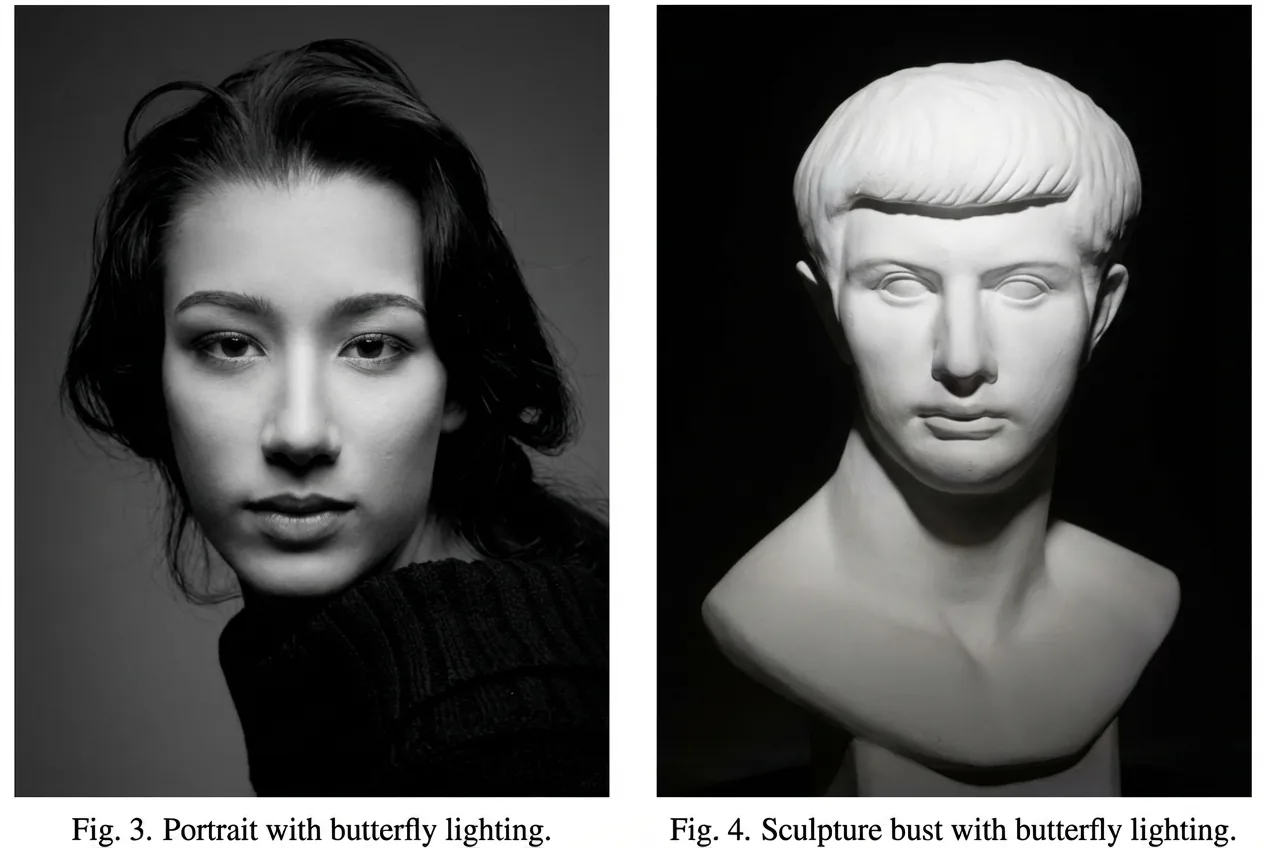
Figure 2
Butterfly-lighting reference portrait.
2.3 Optimization of Multi-Point Lighting
Ability to Finely Adjust Various Parts of the Picture
The problem with the two classic single-point lighting methods above is the inability to adjust different parts of the frame.
- What if the background is too dark or too bright?
- What if the subject's outline is blurry?
- What if the shadows are too bright or too dark?
- The most classic butterfly-lighting photo is the portrait of Audrey Hepburn; compared with single-point lighting, fill lights were added on both sides, which softened the side shadows.
- If the background is darkened a little and a rim light is added from behind, the outlines of the shoulders and other areas become clearer and brighter.
In order to finely adjust all parts of the frame, the combination of multi-point lighting angles must be considered. For example, when Rembrandt lighting is improved into a combination of multi-point side-lighting positions, it requires a key light, fill light, rim light, and background light. When butterfly lighting is improved into a combination of multi-point front-lighting positions, it requires a key light, fill light, rim light, and background light. The positions and functions of those fixtures are shown in the corresponding diagrams and tables below.
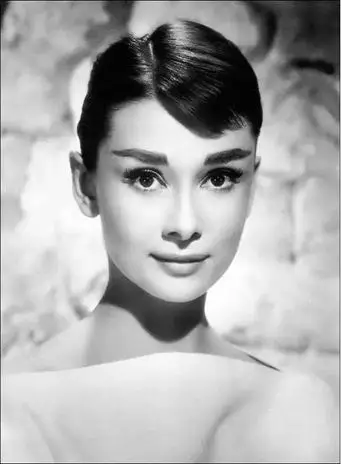
Figure 5
Audrey Hepburn with butterfly lighting.
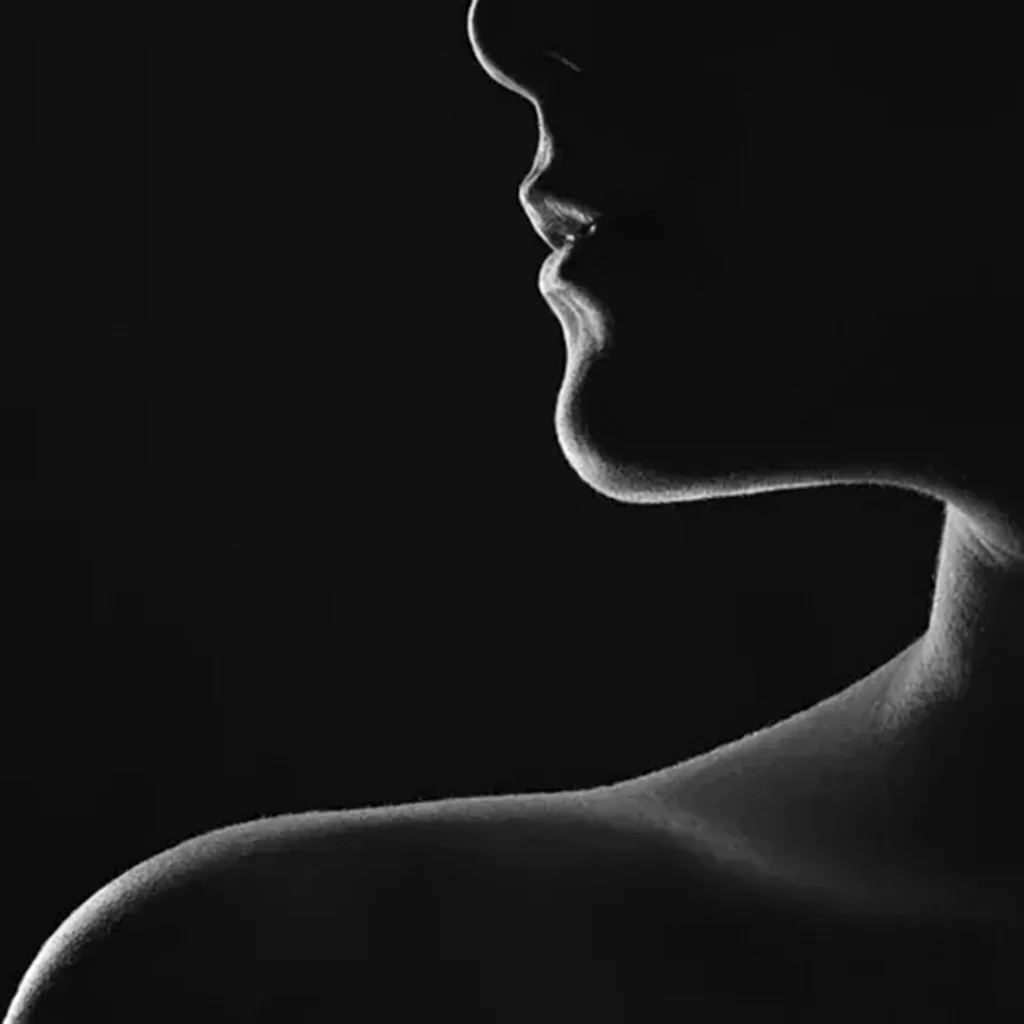
Figure 6
Portrait with perfect rim light.
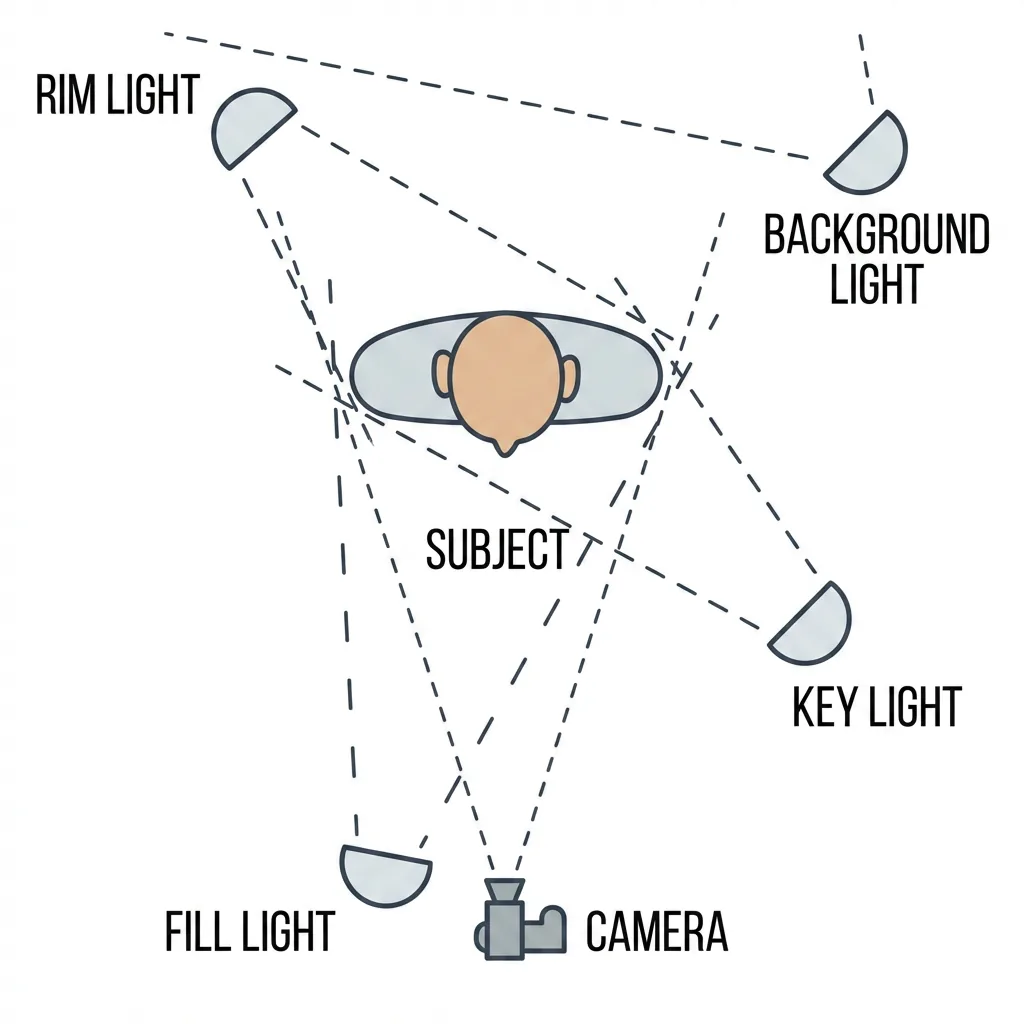
Figure 7
Schematic diagram of the multi-point position combination for side lighting.
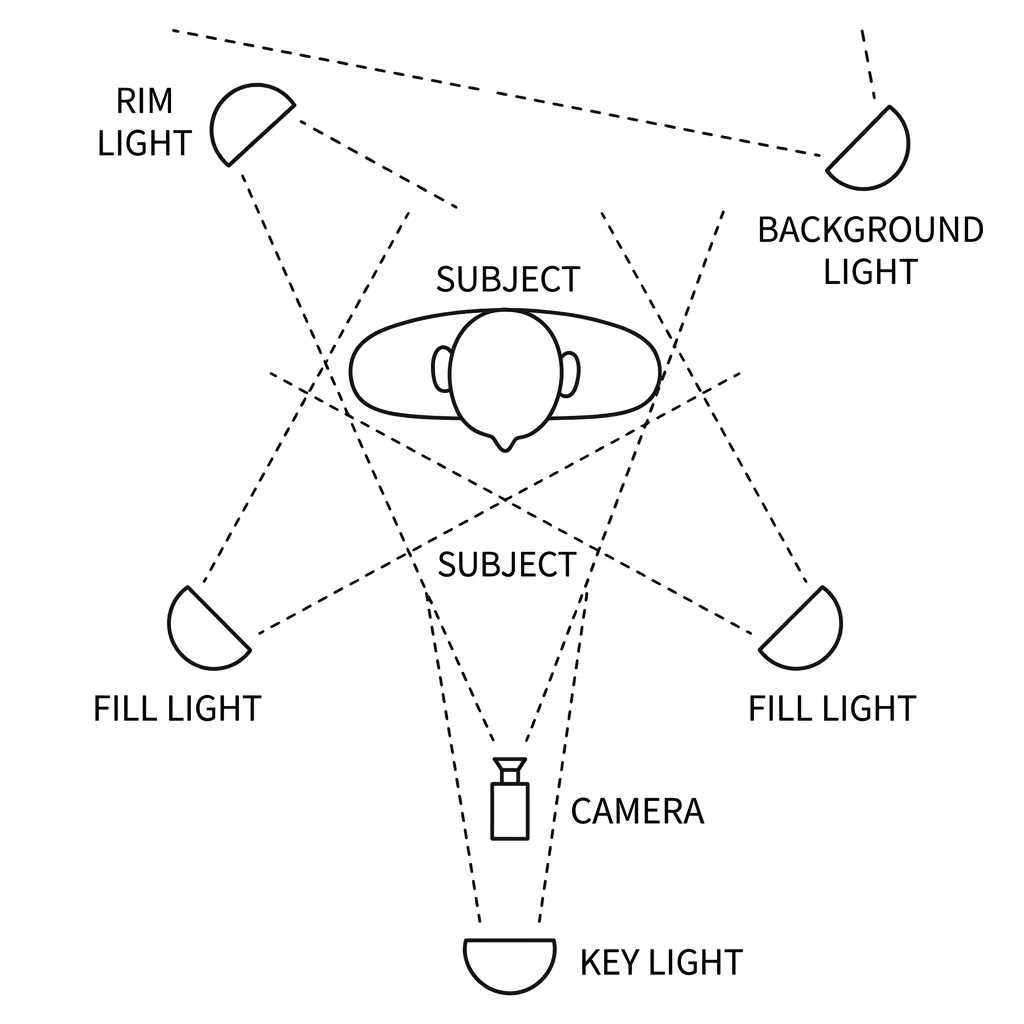
Figure 8
Schematic diagram of the multi-point position combination for front lighting.
Table 1. Light Position Combinations for Side Lighting Effects
Light position combinations for side-lighting effects as provided by the source article.
| Name | Position | Corresponding Stage Light Position | Function |
|---|---|---|---|
| Key Light | Located at the upper front-side | Slap Light (Ear Light) | Forms a triangular light patch on the face |
| Fill Light | Located directly in front | Front Light (Face Light) or Balcony Light | Adjusts the brightness and darkness of shadows |
| Rim Light | Located at the rear-side | Backlight | Makes the subject's outline clearer |
| Background Light | Located at the rear-side | Cyclorama Top/Ground Light | Adjusts the brightness and darkness of the background |
Table 2. Light Position Combinations for Front Lighting Effects
Light position combinations for front-lighting effects as provided by the source article.
| Name | Position | Corresponding Stage Light Position | Function |
|---|---|---|---|
| Key Light | Located at the upper front | Front Light (Face Light) | Casts a butterfly-shaped shadow below the nose |
| Fill Light | Located at the front-side | Slap Light (Ear Light) | Adjusts the brightness and darkness of side shadows |
| Rim Light | Located at the rear-side | Backlight | Makes the subject's outline clearer |
| Background Light | Located at the rear-side | Cyclorama Top/Ground Light | Adjusts the brightness and darkness of the background |
2.4 The Purpose of Multi-Point Lighting
As can be seen from the two lighting methods above, lighting primarily includes key light, fill light, rim light, and background light.
From an optical perspective, the purposes of configuring stage lighting are as follows:
- Light projected from the front is primarily for illumination, supplemented by modeling. The direction of the key light is determined by the needs of the subject and viewpoint.
- Light projected from the side is primarily for modeling, supplemented by illumination. It serves to assist and supplement the key light, acting as a modifier.
- Light projected from behind is primarily for contour modeling, making the boundaries of the outline clear and bright.
- Lighting ratio is the contrast ratio between light and shadow areas; adjustments can be made according to creative demands to achieve the desired effect.
Classifying these lights based on projection direction yields front projection light, side projection light, back projection light, background light, and related common stage-lighting positions. The corresponding common stage-lighting positions are shown in Table 3.
2.5 Additional Fixtures Are Needed for Large Scene Illumination
- The lighting methods described above are also known as area lighting and are generally used for illuminating smaller scenes.
- If the scene is large, it can be broken down into several smaller areas for lighting.
- Because the performance area of a theater stage is large, with many people and props, area lighting must be combined into large-area illumination.
- Depending on illuminance, projection angle, and the size of the stage performance area, a large number of corresponding stage lights must be configured.
- In addition to front projection light, side projection light, back projection light, and background light, top light must also be added to stage lighting.
- Adding top light can improve the basic illuminance and key lighting of the stage area, enhance the contour brightness of the hair and shoulders, and more importantly reduce the mottled shadows cast by moving figures onto the stage and adjacent figures or props, avoiding distraction to the audience.
- Theater stage floors are mostly black, which should also be intended to minimize the interference of shadows.
03. Description and Function of Lighting Positions on a Proscenium Stage
To configure stage lighting properly, one must understand the common lighting positions for stage fixtures.
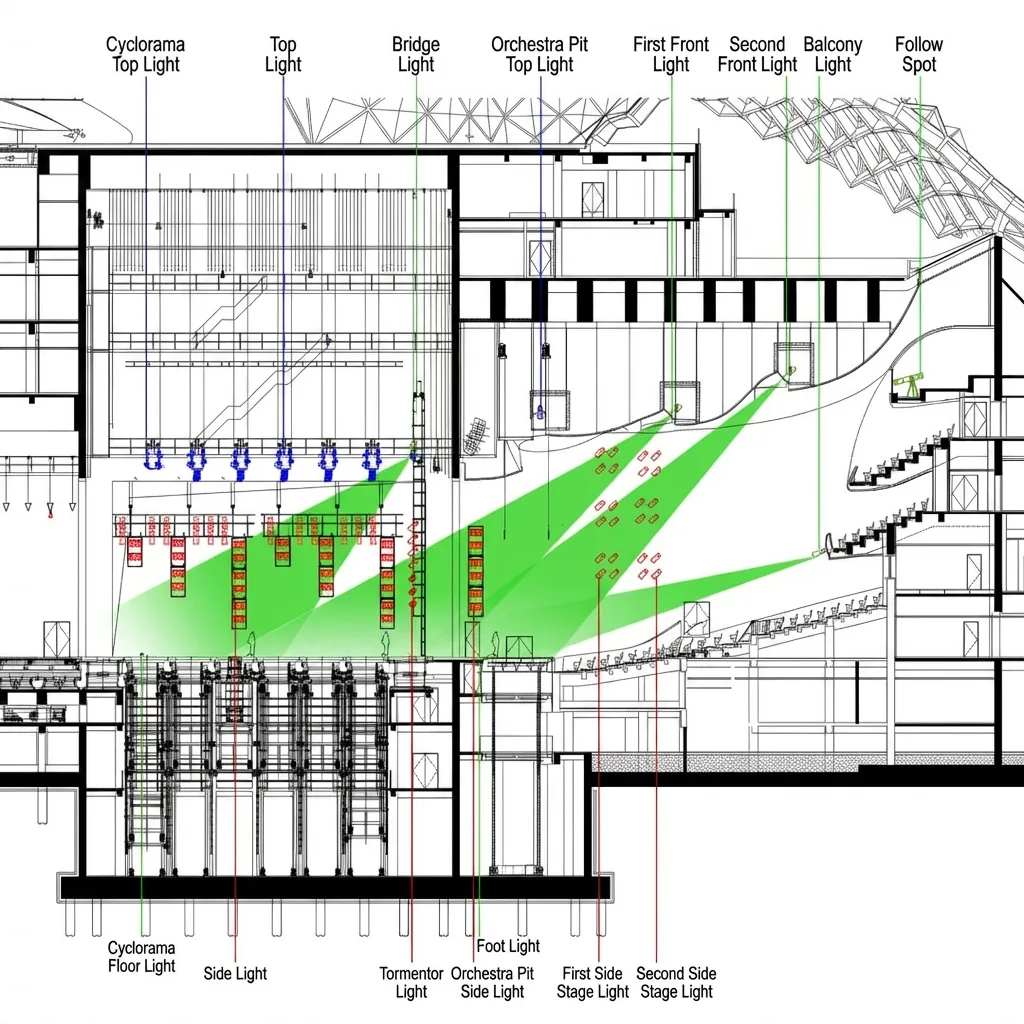
Figure 9
Schematic diagram of front projection light.
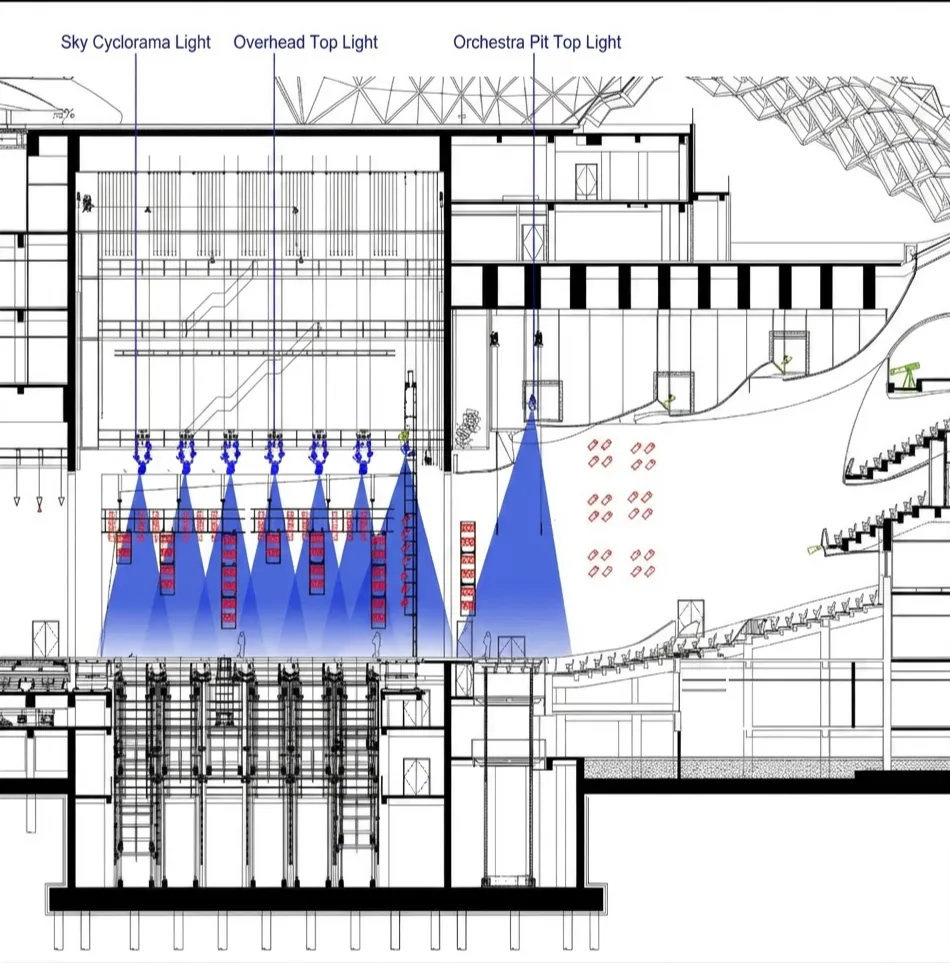
Figure 10
Schematic diagram of top projection light.
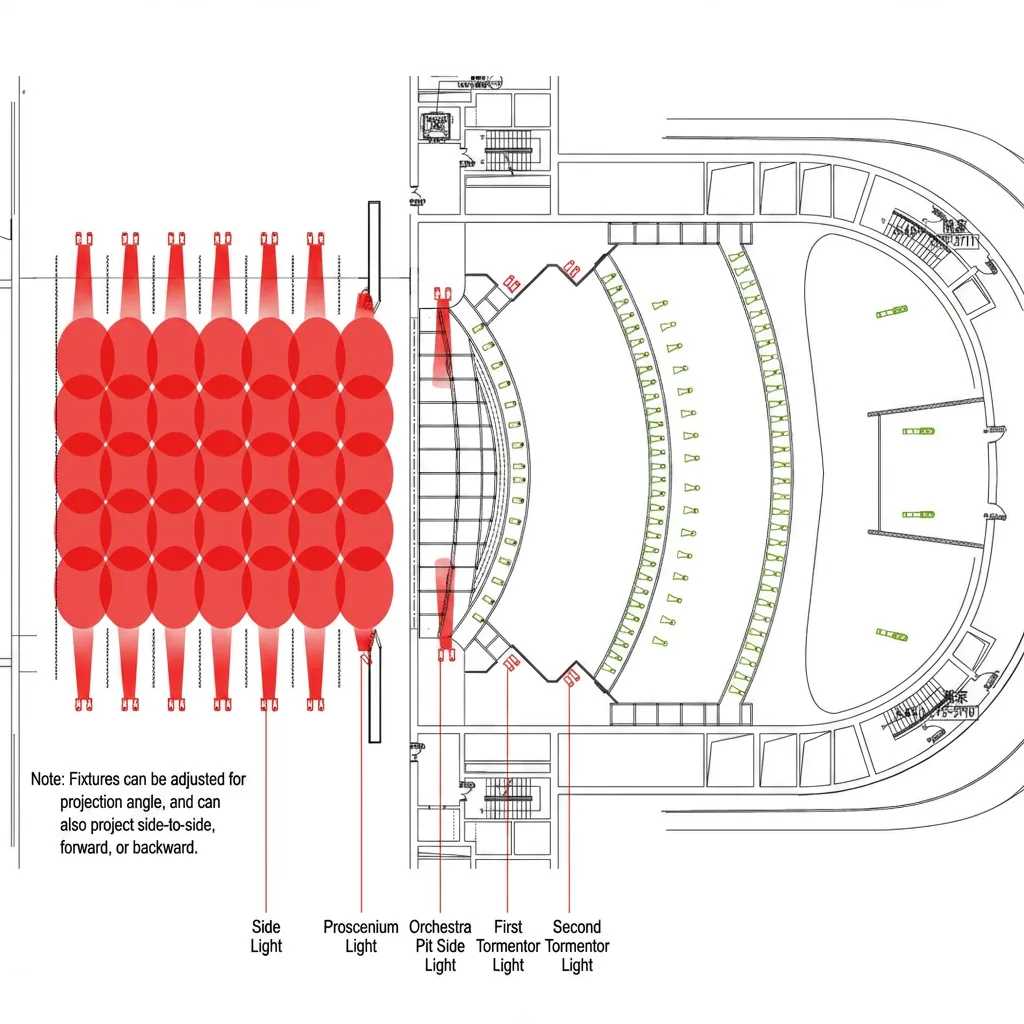
Figure 11
Schematic diagram of side projection light.
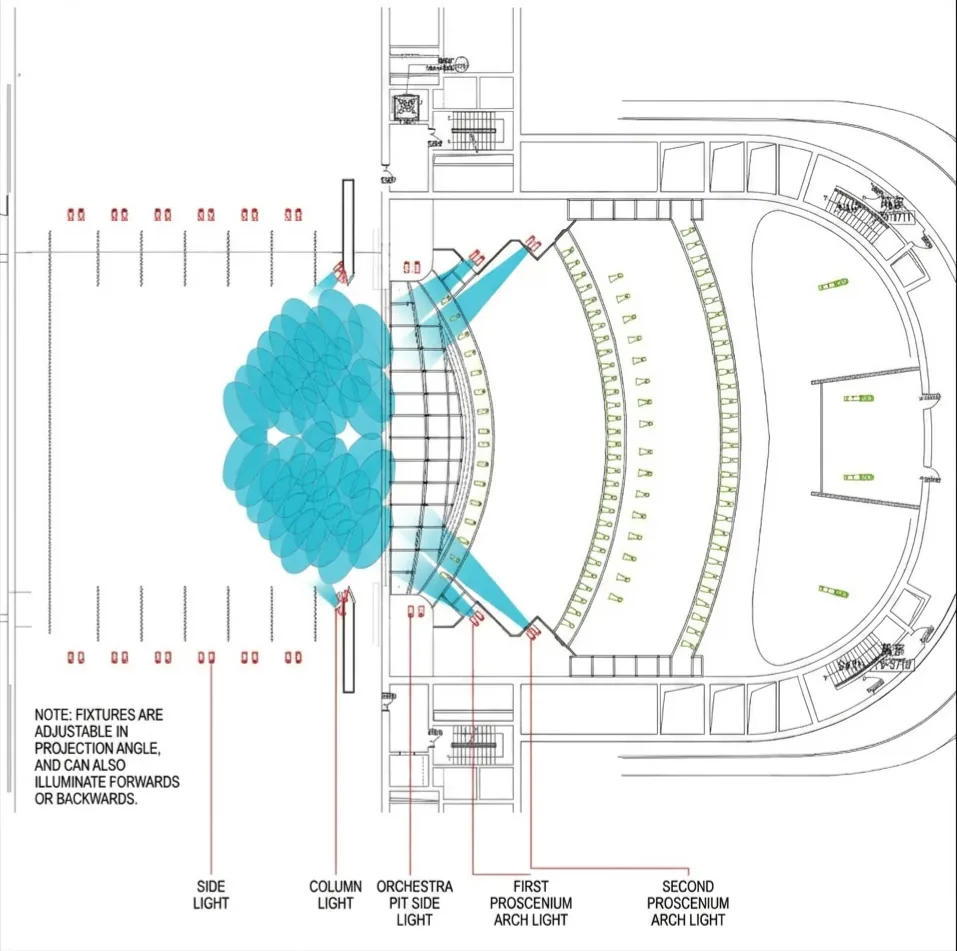
Figure 12
Schematic diagram of front-side projection light.
Table 3. Description and Function of Lighting Positions on a Proscenium Stage
A working reconstruction based on the source article's discussion of front projection light, top light, side light, front-side light, backlight, background light, and footlights.
| Lighting Position | Projection Direction | Primary Function | Note |
|---|---|---|---|
| Front Light | From the audience side toward the stage | Primarily for illumination | Supports facial visibility and basic scenic readability |
| Top Light | From above the stage | Raises basic illuminance and key lighting | Also helps reduce distracting shadows from moving performers |
| Side Light | From the sides of the stage | Primarily for modeling | Acts as assistance and supplement to the key light |
| Front-Side Light | From a diagonal front-side direction | Combines illumination and shaping | Useful when straight front light alone feels too flat |
| Backlight | From behind the performer | Primarily for contour modeling | Makes the outline boundary clear and bright |
| Background Light | Toward scenery or cyclorama | Controls the brightness of the background | Used to support scenic tone and depth |
| Footlight | Low-angle upward projection from the front of the stage | Supplementary low-angle illumination | The source article notes that some theaters still use it as a temporary or genre-specific supplement |
Note: What is listed in the table is only a conventional description of stage lighting. The functions of stage lighting differ in different theatrical genres, and some light positions may be temporarily added.
For example, intelligent lights may be placed around the stage, or fixtures may be hung in front of side-balcony railings as an extension of slap lights. When the author visited the Komische Oper Berlin in Germany, they also saw the installation of two rows of footlights. Nothing is absolute, and one should not rigidly adhere to conventions.
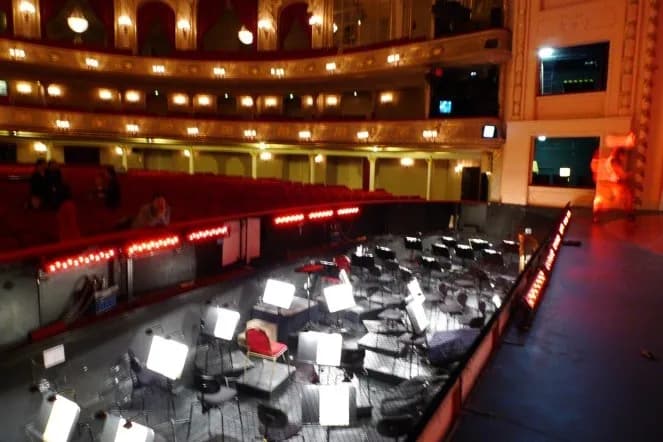
Footlight Example A
Two rows of footlights at the Komische Oper Berlin.
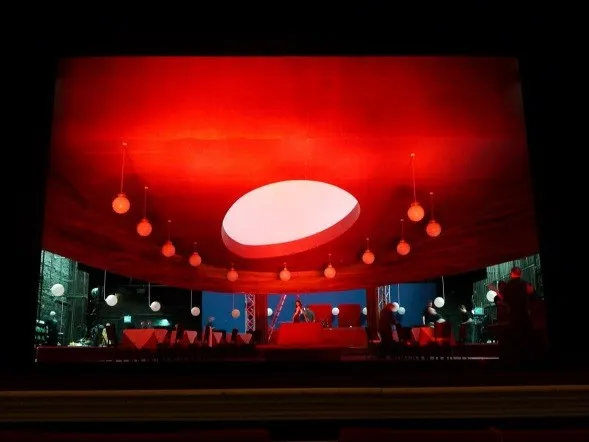
Footlight Example B
Projection effect of the footlights at the Komische Oper Berlin.
04. Functions of Stage Lighting
In the over two-thousand-year history of theater, with the development of light sources and control technologies, the function of stage lighting has evolved from initial illumination to artistic lighting. Specific functions are manifested in the following aspects:
4.1 Illuminating Characters and Scenes on Stage
Illuminating characters and scenes on stage is the primary basic task of stage lighting.
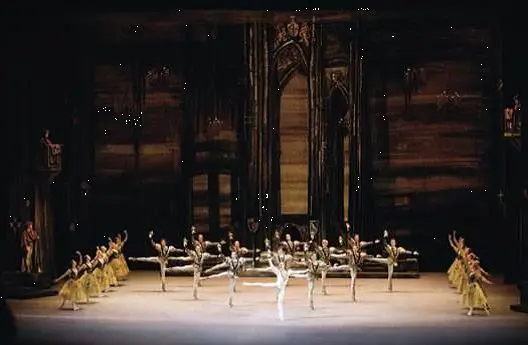
Figure 13
Stage illumination effect.
4.2 Highlighting Focal Points and Guiding the Audience's Line of Sight
By controlling changes in light spots and movement (follow spots), it can highlight focal points and guide the audience's line of sight.
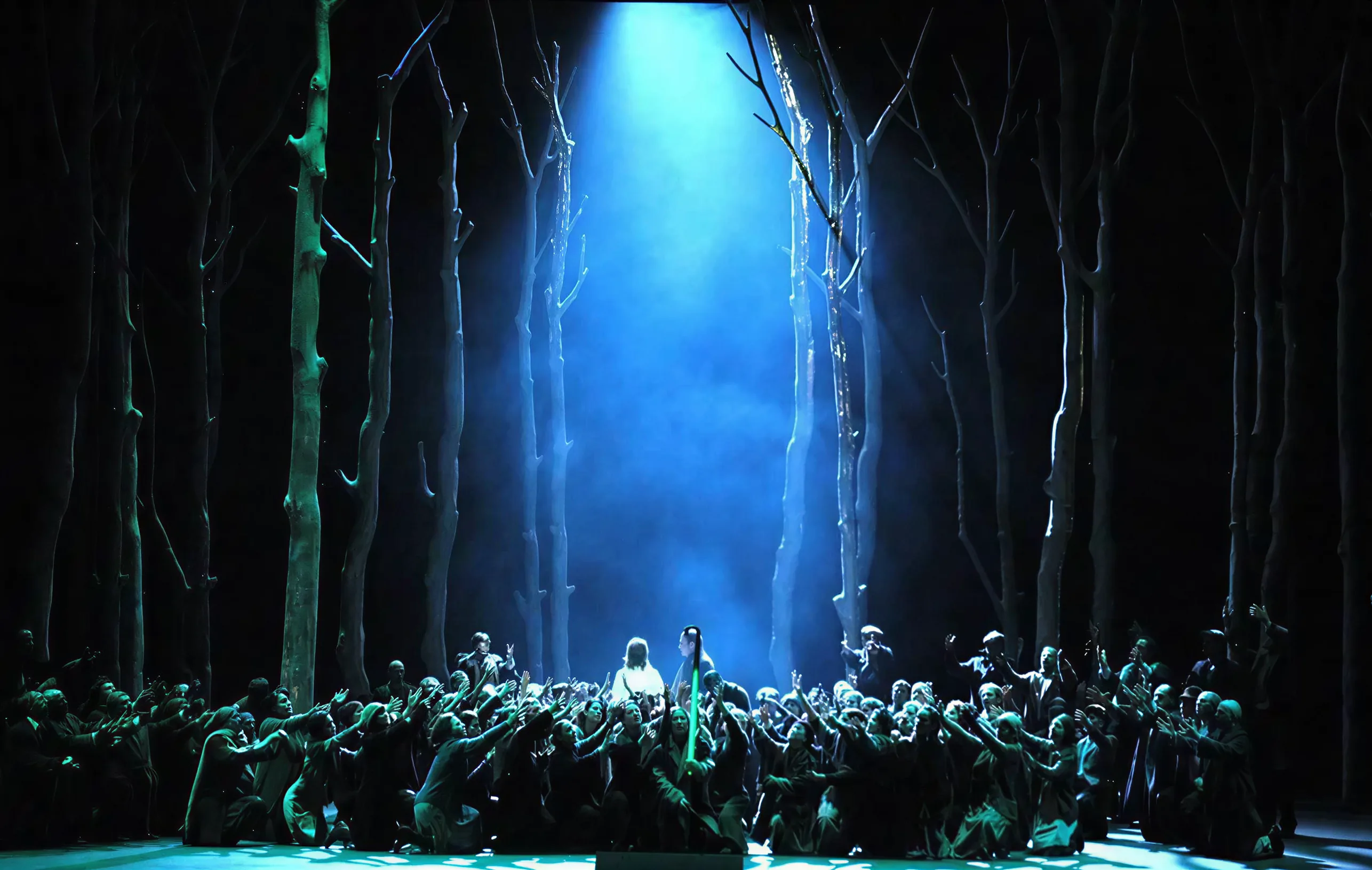
Figure 14
Beam projection effect highlighting focal points.
4.3 Molding the Emotional Changes of Characters
By controlling changes in light color, lighting can mold the emotional changes of characters.
For example, in the Wuju opera "Yao Ji Xiang Hun" directed by Shen Bin, the lighting shifts from a festive red base tone to a cold tone, serving to reinforce the plot of the story.
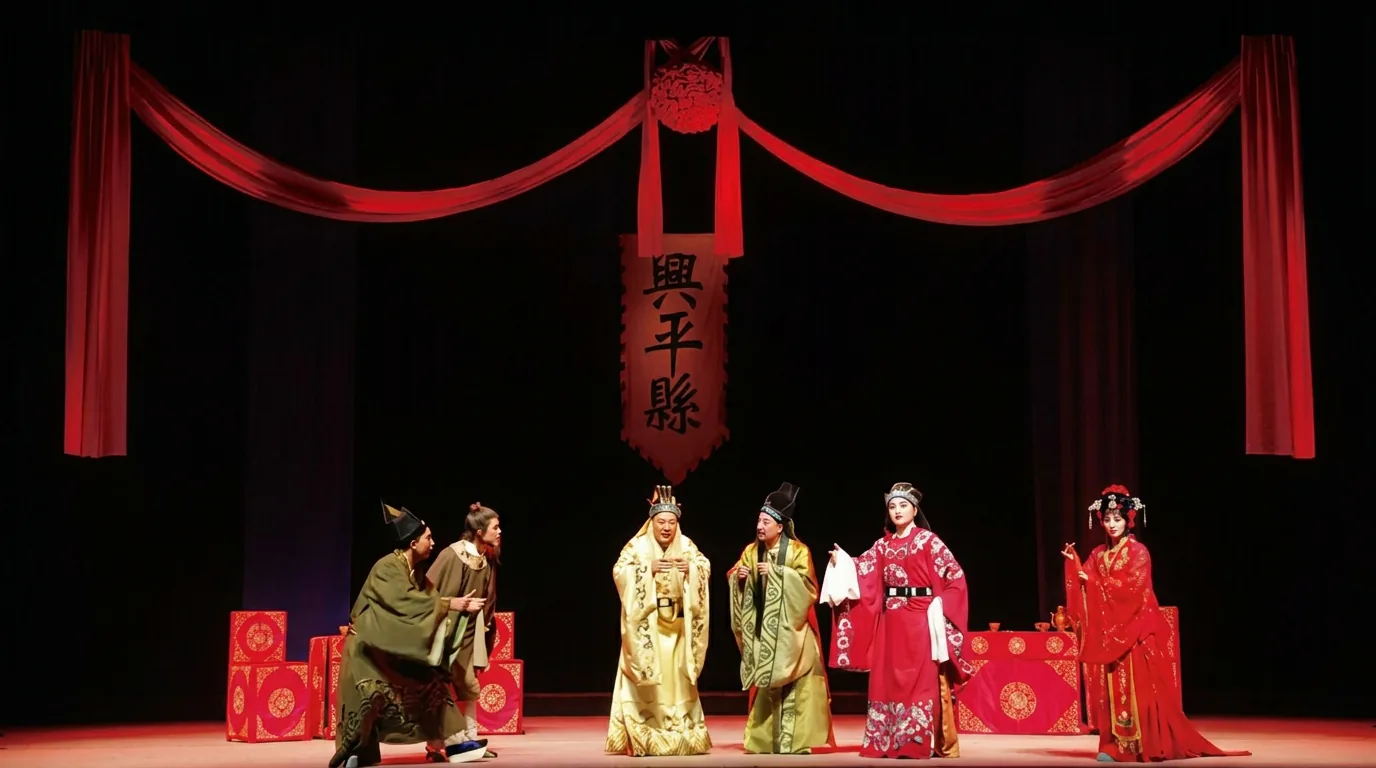
Figure 15
The festive red base tone in the play "Yao Ji Xiang Hun".
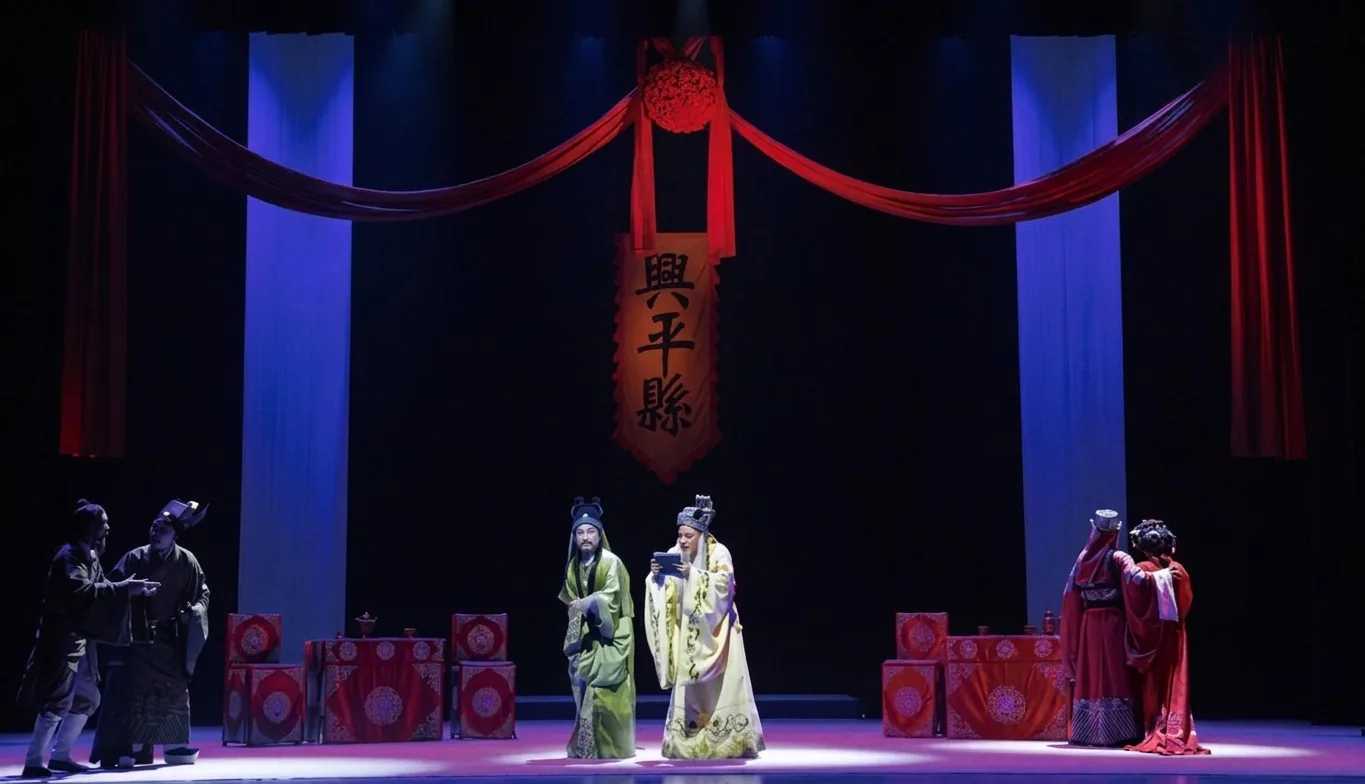
Figure 16
The cold tone after a plot twist in "Yao Ji Xiang Hun".
4.4 Creating the Time and Space Atmosphere Required by the Plot
By controlling changes in color, intensity, and patterns, lighting creates the time and space atmosphere required by the plot.
- For instance, regarding the shift between day and night, bright lighting allows the audience to clearly realize that the current plot is taking place during the day, whereas dim lighting reminds the audience that the time has shifted to dusk or night.
- Lighting can also reflect seasonal changes: during a winter scene, cold tones are used to portray severe winter cold, while blindingly bright light represents the scorching heat of the summer sun.
- Lighting can project patterns resembling a lake onto the stage, simulating a scene of people boating on a lake.
4.5 Creating Dynamic Illusions
Stage lighting can create dynamic illusions such as wind, rain, thunder, lightning, water, fire, clouds, fog, flying birds, swimming fish, moving vehicles, and ships, etc.
05. Basic Parameters of Luminaires
Some frequently mentioned parameters of stage luminaires must be mastered.
5.1 Electric Power
Electric power refers to the work done by the current per unit time and serves as a physical quantity used to express the rate of electrical energy consumption. The power of an electrical appliance equals the electrical energy it consumes in one second.
The unit is the watt, abbreviated as W.
Electric power is equal to the product of the voltage across a conductor and the current passing through it (P=U·I).
5.2 Luminous Flux
Luminous flux is the light intensity passing through a surface per unit of time, usually represented by Φ.
In theory, its unit is equivalent to the electrical unit watt, but because vision is also related to the color of light, standard light sources and normal visual-acuity metrics use the lumen, abbreviated as lm.
5.3 Luminous Efficacy
Luminous efficacy is the ratio of the luminous flux emitted by a light source to the power consumed, and its unit is lumens per watt (lm/W). To emit the same luminous flux, the less power a light source consumes, the higher its luminous efficacy.
A higher luminous efficiency value indicates a stronger ability of the lighting equipment to convert electrical energy into light energy; that is, providing the same brightness, the lighting equipment is more energy-efficient.
5.4 Illuminance
Light intensity refers to the energy of visible light received per unit area, simply called illuminance, with the unit Lux or lx. It is used to define the strength of light and the degree to which a surface area is illuminated.
According to the research cited by the source article, under general fluorescent lighting conditions without glare, the illuminance most satisfying to human vision lies between approximately 1500 and 3000 lux.
5.5 Color Temperature
Color temperature is a unit of measurement used to express the color components contained in light, with the unit K (Kelvin). The color temperature of a light source is determined by comparing its color with the color presented by a (theoretical) blackbody under thermal radiation (equivalent to a standard color card).
When heated, a blackbody gradually turns from black to red, turns yellow, turns white, and finally emits blue light. The Kelvin temperature when the color of the light source matches that of the blackbody is the color temperature of that light source. Light with a color temperature < 3300K gives a warm feeling and is called warm-colored light; light > 5300K gives a cold feeling and is called cool-colored light; 3300~5300K is considered intermediate-colored light.

Figure 17
Kelvin temperatures presented by thermal radiation of a blackbody.
5.6 Color Rendering Index (CRI)
The degree of fidelity with which a light source renders the colors of objects is called color rendering, commonly referred to as the Color Rendering Index (Ra). A light source with high color rendering reproduces colors better, meaning the colors we see are closer to the true colors of objects; conversely, the color deviation we see will be relatively large.
Color rendering refers to the color relationship displayed between an object's true color (its own hue) and a standard light source color temperature (5000K or 6500K daylight), where a light source with Ra > 90 is considered a standard light source.
A light source with an Ra value of 100 means the color an object displays under its light is identical to that under a standard light source.
The International Commission on Illumination (CIE) lists recommended standards for color rendering based on different purposes (national standard recommendations are similar): places requiring precise color contrast need an Ra of 90~100; for general lighting, an Ra of 80~90 is sufficient; in rooms or spaces occupied for extended periods, the lighting source's color rendering index (Ra) should not be less than 80.
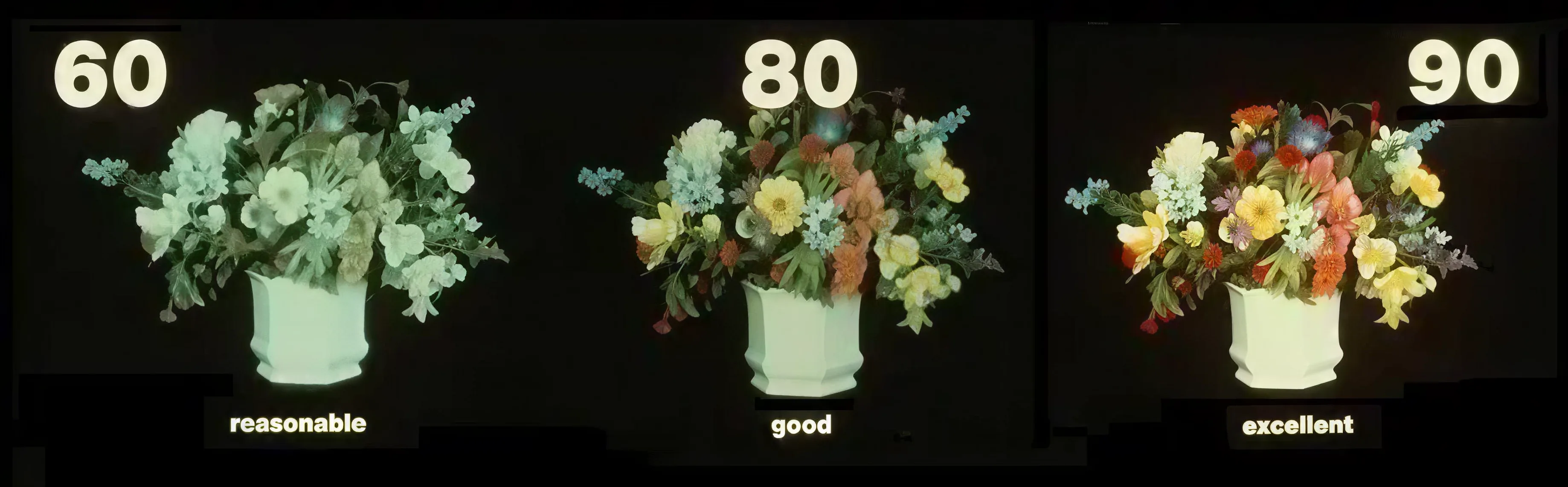
Figure 18
Flowers under illumination with different color rendering indices.
06. Evolution and Development of Stage Light Sources
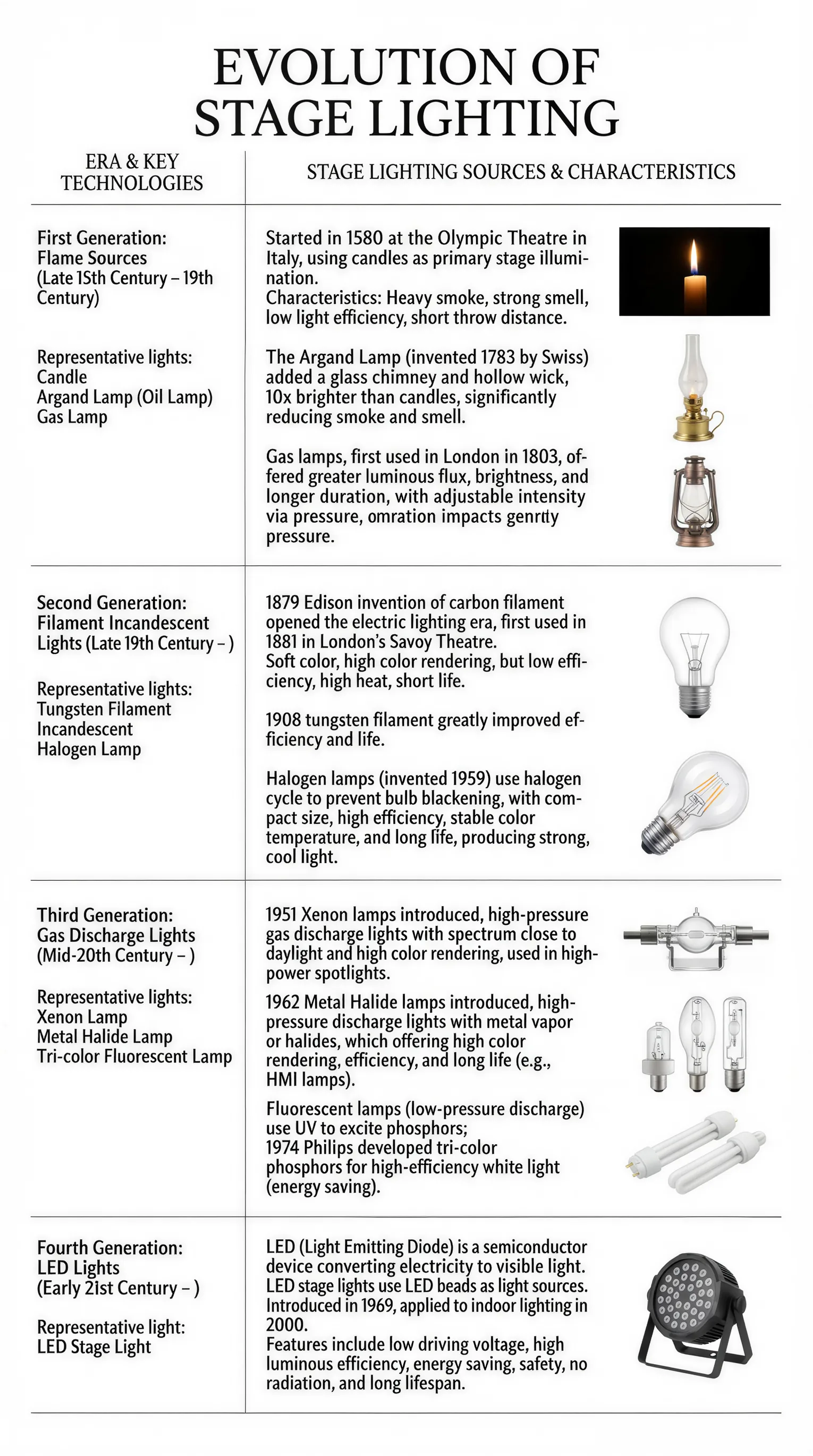
Table 4
Evolution and development of stage light sources.
07. Optical Technical Characteristics of Various Light Sources
Understanding the optical technical characteristics of various light sources can enhance our grasp of the trends in light-source development.
Table 5. Optical Technical Characteristics of Various Light Sources
Comparative data reproduced from the source article.
| Light Source | Color Temperature (K) | Color Rendering Index (Ra) | Luminous Efficacy (lm/W) | Lifespan (h) |
|---|---|---|---|---|
| Incandescent Lamp (Tungsten) | 2700-3300 | 100 | 8-20 | 1000 |
| Halogen Lamp | 2700-3300 | 100 | 12-35 | 2000 |
| Gas-discharge Lamp (Tri-phosphor Fluorescent) | 2700-6700 | >=78 | 55-105 | 1000-20000 |
| Metal Halide Lamp | 5000-6000 | 65-80 | 66-108 | 4000-10000 |
| Dysprosium Lamp | 6000 | >=80 | >=75 | 500-3000 |
| Xenon Lamp (Short-arc) | 6000 | 85-90 | 85-120 | 500-1500 |
| LED Lamp | >=3000 | >=80 | 85-200 | >=15000 |
Note: Data may vary across different reference materials; this table mainly references Wikipedia. For items not found on Wikipedia, other materials like Baidu Baike and Entertainment Technology were referenced. With technological advancements, the data above may have been improved.
08. Classification of Common Stage Lighting Fixtures by Light Form
Common stage lighting fixtures include: spotlights, soft lights, beam lights, floodlights, profile spots, batten lights, downlights, PAR cans, projection magic lanterns, intelligent moving heads, follow spots, etc. The vast variety can be confusing, so they must be clearly categorized. Classification of common stage lighting fixtures by light form is shown in Table 6.
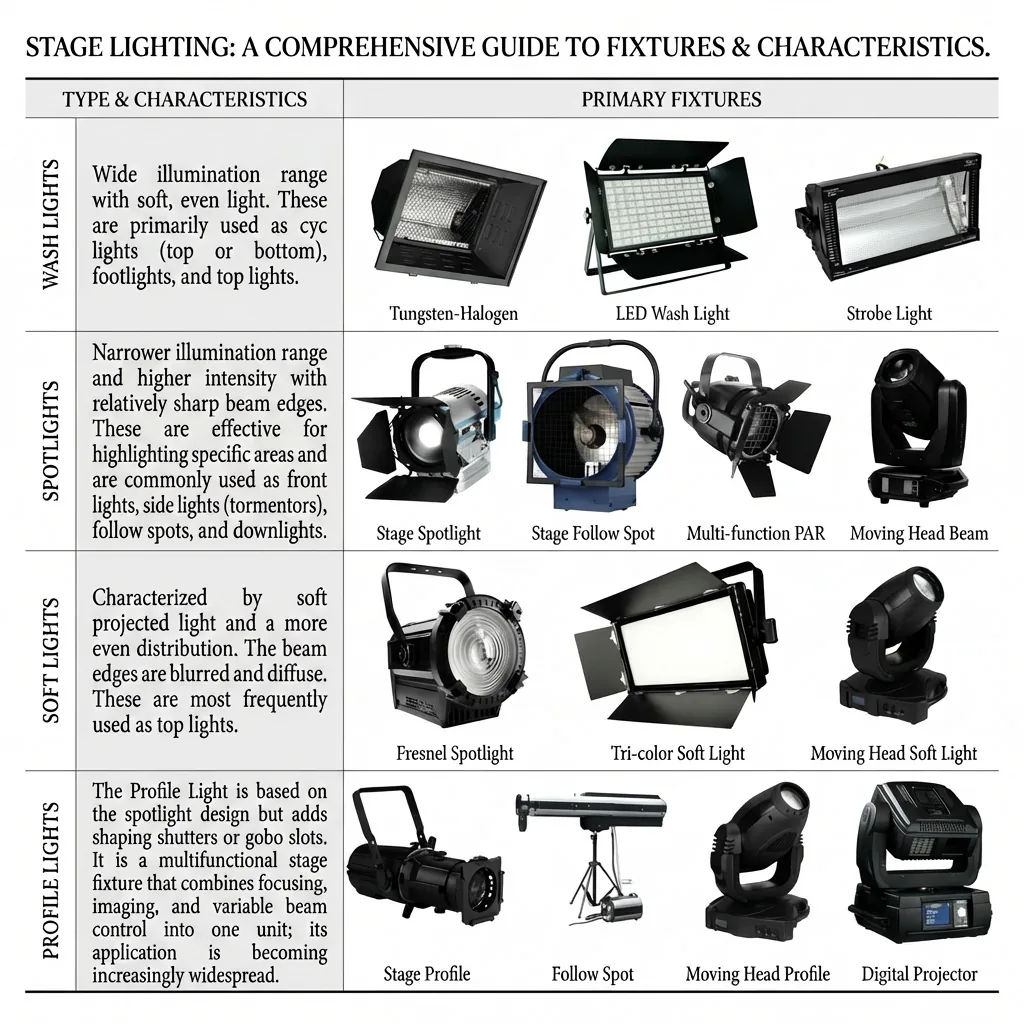
Table 6
Classification of common stage-lighting fixtures by light form.
With technological development, many fixtures are now rarely used, such as iodine-tungsten lamps, strobe lights, and certain stage beam lights(focal temperatures were too high, easily causing fires), etc.
Multifunctionality and intelligentization represent the developmental trends of stage lighting fixtures; profile spotlights are gradually replacing stage spotlights due to their multifunctionality, while intelligent moving heads are increasingly used because they can automatically control the angle of the fixture.
Thanks to good energy efficiency and technological advancement, LED light sources are progressively replacing other light sources, except for high-power follow spots (LED power is relatively low and cannot meet the luminous intensity required for long distances).
Initially, stage lighting was solely used for stage illumination, adjusting light intensity and throw distance, but it has now evolved to incorporate changes in brightness, dynamic patterns, 3D stereoscopic effects, and more. The functions and control technologies of fixtures are constantly innovating and progressing; traditional analog control has been replaced by digital, intelligent, and networked control. To achieve safety, high efficiency, energy savings, cost reduction, and colorful effects, stage lighting fixtures are continuously innovating and optimizing, adopting new light sources, luminaire structures, and optical path designs, etc.
09. References
- Baidu Wenku, "Basic Concepts of Lighting"
- Baidu Baike, "Electric Power," "Illuminance," "Color Temperature," "Color Rendering Index"
- Incandescent light bulb, Wikipedia
- High-intensity discharge lamp, Wikipedia
- https://www.colortell.com/5970.html, "About Light Source Spectrum, Color Temperature, and Color Rendering"
- Mastering Photography Lighting Notes, "Introduction and Application of Twelve Basic Lighting Methods"
- Photography Master Wu's Self-Taught Guide, "Classic Lighting Analysis: Can You Still Call Yourself a Photographer if You Can't Light?"
- Chen Jiajun, "Differentiation and Explanation of Proscenium Stage Lighting Positions", Zhushengge WeChat Official Account
- China Academic Journal Network, "Analysis of the Functions and Roles of Stage Art Lighting in Stage Performance Art"
- Liu De'an, "Current Development Status of Performing Arts Lighting Fixtures in China", Entertainment Technology, Issue 5, 2017
- Jiang Weikai et al., "Development and Trends of Stage Lighting Fixture Technology", Entertainment Technology, Issue 7, 2016
- Hc360 Audio and Lighting Network, "Three Basic Lighting Types Needed in Stage Lighting Design"
- Liu De'an, "Reflections on Green Lighting for Stage Fixtures", Entertainment Technology, Issue 1, 2019
- Feng Dezhong, "Outline of Stage Lighting Design", China Theatre Press
- Jin Changlie et al., "Stage Lighting", China Machine Press
- Xu Ming, "Stage Lighting Design", Shanghai People's Fine Arts Publishing House
- Cultural Industry Standard of the People's Republic of China WH/T 31-2008, "Common Terminology for Stage Lighting Design"
- http://beed.asia/2016/627, "Theory Section of School Classroom Lighting Design Guide"