
01. Executive Summary
Balcony railings are supposed to protect audiences, yet in many theaters they also become one of the most persistent sources of complaints because they cut directly across the sightline to the stage.
The problem is no longer theoretical. Chinese audiences increasingly compare obstructed balcony views to watching a performance through prison bars, and venue operators have started taking drastic action when complaints spread online. In Shanghai, one theater removed seat-to-seat railings overnight after public criticism, while another operator argued that a balcony level made no commercial sense if a compliant guardrail would make the seats unsellable.
This article examines the issue in full: the current Chinese code language, the unanswered questions inside that language, the requirements of the IBC, NFPA, and other national standards, the lessons from a sectional sightline study, the real relationship between railing height and perceived safety, and a set of practical design recommendations.
1.1 Why This Issue Can No Longer Be Ignored
For a long time, complaints about balcony railings in theater buildings obstructing the audience's line of sight have persisted, not only domestically but also commonly abroad. In recent years, with the rapid development of network communication, audiences have likened the visual experience of railings blocking their view to the feeling of looking outward through iron bars from inside a prison cell, and refer to this torment as "Tears of the Iron Window". Obviously, audiences do not accept the experience of watching a play through railings. This massive increase in complaints has directly affected theater operations.
For example, shortly after the AIA Grand Theatre in Shanghai began performances, many audiences complained on Xiaohongshu about the balcony railings obstructing their sightlines. The theater operators, worried that a large number of audience complaints would negatively impact future operations, removed the railings between seats overnight and posted online "Listening to advice and sawing off the railings overnight to optimize the field of view," while also asking audiences to avoid leaning forward excessively when watching performances on the second and third floors and to pay attention to safety. During the design of the Shanghai West Bund Grand Theatre, the operating unit believed that designing higher railings would block the audience's view, making it impossible to sell tickets, which would render setting up that balcony level meaningless.
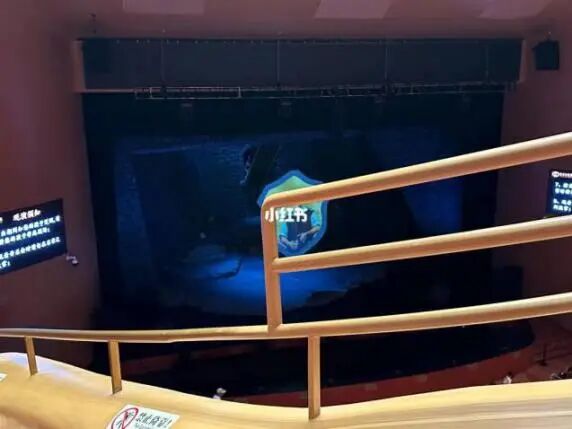
Figure 1
Railings obstructing the line of sight in a theater
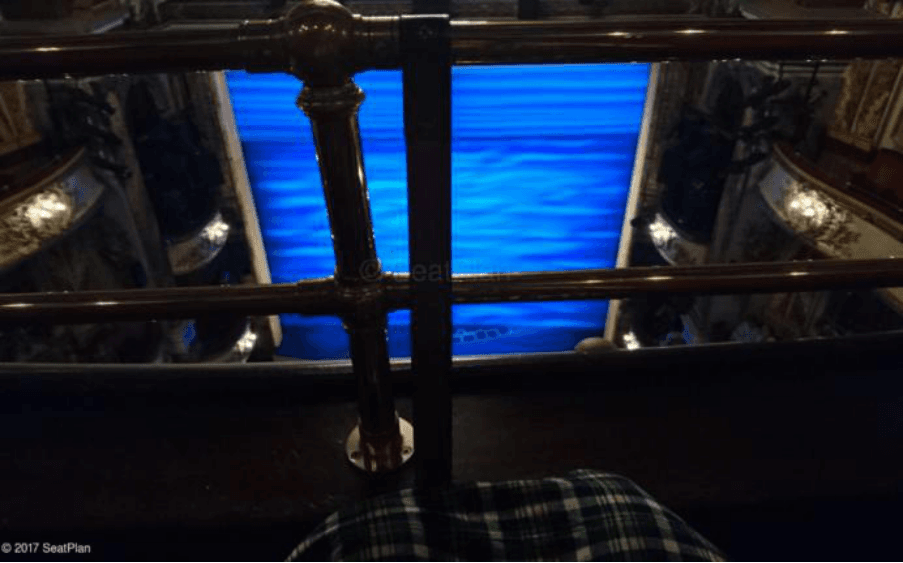
Figure 2
Railings obstructing the line of sight at the Novello Theatre [1]
02. Chinese "Standard for Design of Theatre Buildings" and Four Confusions
The requirements for auditorium railings in the Chinese industry standard JGJ 57-2016 "Standard for Design of Theater Buildings" are:
- "When the auditorium seating floor is 0.50m higher than the front row, and when the side of the seats is closely adjacent to longitudinal aisles or steps with a height difference, strong railings should be installed at the high places, and the height of the railings should not be less than 1.05m, and should not obstruct the line of sight."
- "Measures should be taken in the auditorium to protect personal safety. The height of the front row railings of the balcony and the floor box railings should not obstruct the line of sight, should not be greater than 0.85m, and the lower solid part must not be lower than 0.45m."
2.1 The Four Confusions Hidden Inside the Current Standard
Four confusions in the domestic standard:
- 1. The standard emphasizes setting up guardrails to protect personal safety while not obstructing the line of sight, but it does not propose what measures should be taken when the two conflict.
- 2. Does "railings should be set at high places" refer to the diagonal heights closely adjacent to longitudinal aisles with height differences, or the frontal heights between seats? Drawing review experts in different places have different understandings; some places require that railings with a height of no less than 1.05m must be installed both between the longitudinal aisle and the seats; while some places can accommodate installing railings with a height of no less than 1.05m only in the longitudinal aisle. In fact, to prevent falls, guardrails should be installed in front of the seats (the same row) and closely adjacent to the longitudinal aisles.
- 3. How is the height of 1.05m measured? It is not clearly defined in the code. Some theaters take a shortcut by measuring from the floor of the next row down. If the height difference between two adjacent rows of seats is 0.6m, then the height of the railing in front of the higher seat is only 1.05 - 0.6 = 0.45m. Obviously, this does not serve the purpose of safety protection, but it better meets the code's requirement of "should not obstruct the line of sight".
- 4. Generally speaking, the audience in the front row of the balcony (first and second rows) has the greatest sense of insecurity, because the height difference between the first row and the floor below is much larger than the height difference between the subsequent rows. The domestic "Code for Design of Theater Buildings" requires that "the height of the front row railings of the balcony should not be greater than 0.85m, and the height of the rear row railings should not be less than 1.05m," which is quite puzzling. Since the height of the front row railings of the balcony can be reduced to no greater than 0.85m in order not to obstruct the line of sight, and the audience in the rear rows has a relatively better sense of security, why is the railing height requirement higher (1.05m) instead?
In short, the current Chinese standard captures the problem but does not resolve its hardest design tensions: measurement logic, edge conditions, and the tradeoff between perceived safety and visual quality.
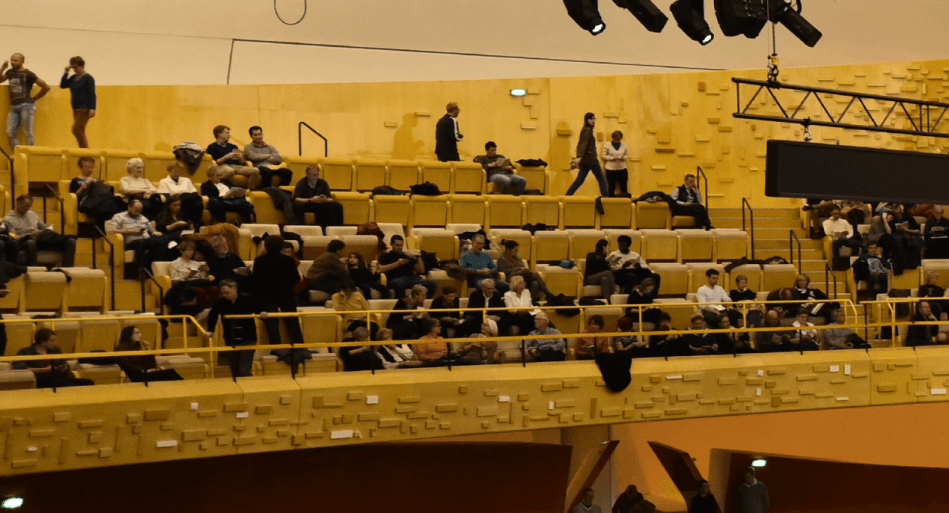
Figure 3
The side balconies of the Philharmonie de Paris only have guardrails on the 1st and 2nd rows
03. International Standards
3.1 International Building Code (IBC)
- When the seating floor is 30 inches (0.76m) higher than the ground of the front row or the lower level, and the protective railing would interfere with the line of sight of the immediately adjacent seats, the height of the installed railing should not be lower than 26 inches (0.66m).
- When the cross-aisle floor is 30 inches (0.76m) higher than the ground of the front row or the lower level, and the railing would interfere with the line of sight of the immediately adjacent seats, the height of the protective railing installed on the aisle should not be lower than 26 inches (0.66m). If the backrest height of the front row seat is 24 inches (0.61m) or more above the cross-aisle or seating floor, no protective device is required.
- If the bottom of the longitudinal aisle is more than 30 inches (0.76m) from the ground of the lower level, protective railings must be installed across the full width of the aisle. The height of the railing shall not be less than 36 inches (0.91m), and the diagonal distance between the top of the railing and the edge of the nearest tread shall not be less than 42 inches (1.07m). If a handrail is installed in the middle of a longitudinal aisle, an additional handrail should be added about 12 inches (0.30m) below the handrail, and the handrail should have sufficient strength and adhesion.
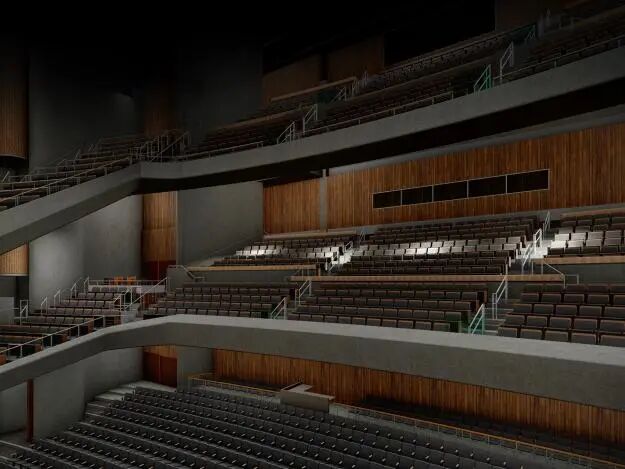
Figure 4
Adding an additional handrail when setting up a railing in the middle of a longitudinal aisle
3.2 US code requirements
The Life Safety Code (LSC) of the National Fire Protection Association (NFPA) requires:
- Generally, the height requirement for protective railings shall not be less than 42 inches (1.07 m).
- When the auditorium seating floor is 30 inches (0.76m) higher than the ground of the front row or the lower level, and the railing would interfere with the line of sight of the immediately adjacent seats, the height of the installed protective railing should not be lower than 26 inches (0.66m).
- When the distance above the seating floor is more than 30 inches (0.76m) higher than the front row or the lower level ground, handrails need to be installed in the longitudinal aisles on the sides of the seats. The handrail height should be allowed to exceed 38 inches (0.97m), but must not exceed 42 inches (1.07 m) when measured vertically from the leading edge of the tread to the top of the railing.
- If the bottom of the longitudinal aisle is more than 30 inches (0.76m) from the ground of the lower level, protective railings must be installed across the full width of the aisle. The height of the railing shall not be less than 36 inches (0.91m), and the diagonal distance between the top of the railing and the edge of the nearest tread shall not be less than 42 inches (1.07 m).
3.3 Code requirements of other countries
- In the United States, most cities follow the NFPA's LSC requirements, but some cities have different requirements; for example, Chicago requires a 30-inch (0.76m) railing.
- In Canada, it is required that the guardrail in front of the seats be at least 0.76m (30 inches).
- In the UK, the code requires a railing height of 0.80m (31.5 inches), or 0.75m (29.5 inches) but requiring the guardrail width to be at least 0.23m (slightly more than 9 inches).
- In Australia, the Building and Construction Authority (BCA) requires a protective railing height of 1m (39.5 inches), or a protective guardrail height of 0.70m (27.5 inches) but extending outwards to 1m. In New South Wales, the BCA allows a protective railing height of 0.75m (29.5 inches); if the guardrail width exceeds 0.07m (2.75 inches), the guardrail must tilt backwards (opposite to the direction of the line of sight), to prevent items placed on the guardrail from falling onto the audience below.
- Other countries use higher railings, while some choose lower railings (provided the railings are thicker).
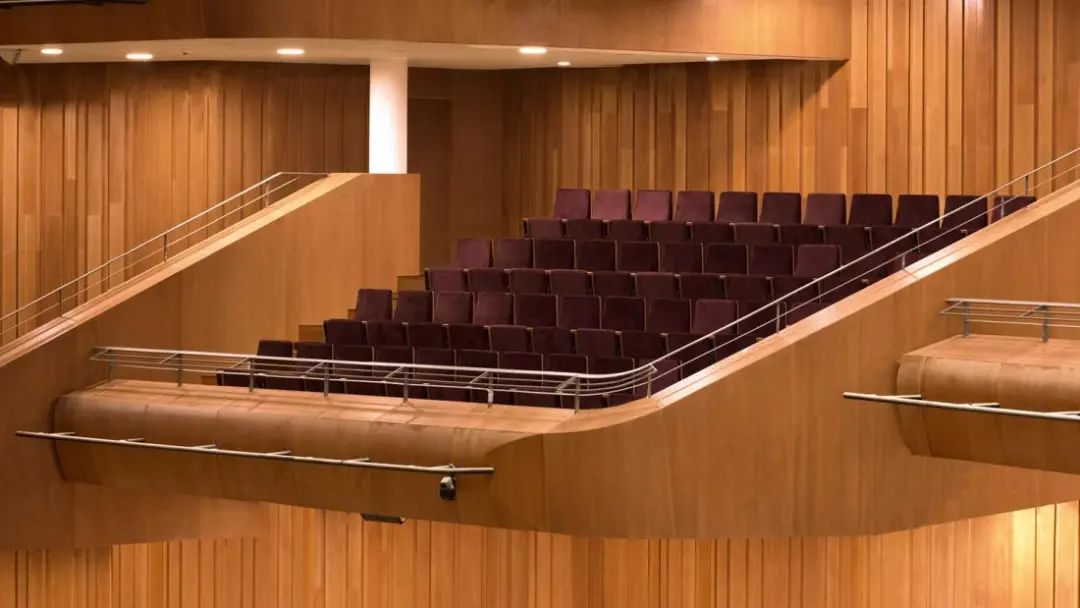
Figure 5
Widened armrests in the concert hall of the ICE Congress Centre in Poland
Summarizing international and foreign code requirements, when the auditorium seating floor is 0.76m higher than the front row and the railing would interfere with the line of sight of the immediately adjacent seats, the height of the installed protective railings is mainly divided into three tiers. The first is that it should not be lower than 0.66m. Since this requirement comes from the International Building Code (IBC), it is recognized by most countries in the world. The second is that it should not be lower than 762mm (Canada, Chicago in the USA). The third is that it should not be lower than 0.70 or 0.75m, but the width of the armrest needs to be increased (UK, Australia).
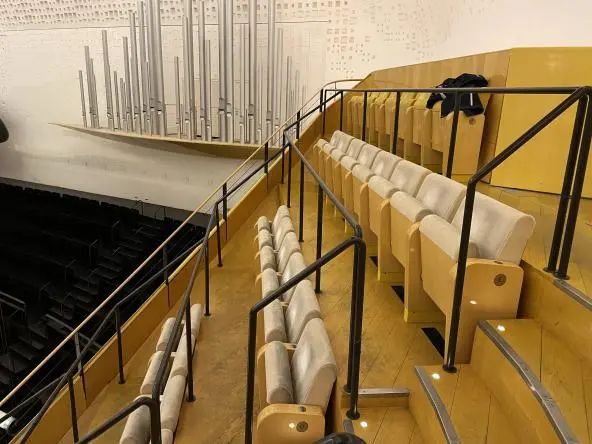
Figure 6
Balcony guardrail height of 830mm at the Philharmonie de Paris
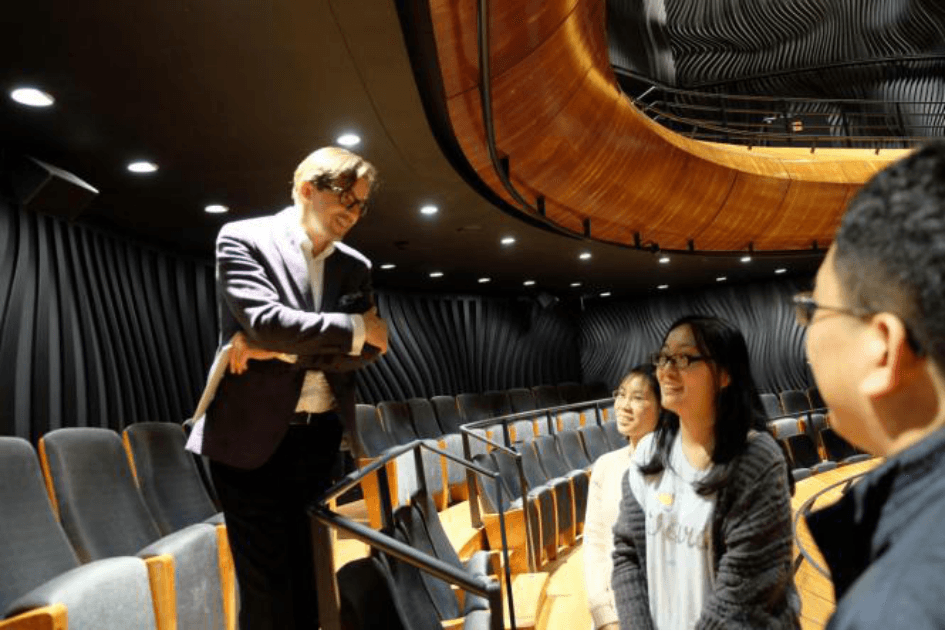
Figure 7
Balcony guardrail height of 700mm at the Katowice Concert Hall in Poland
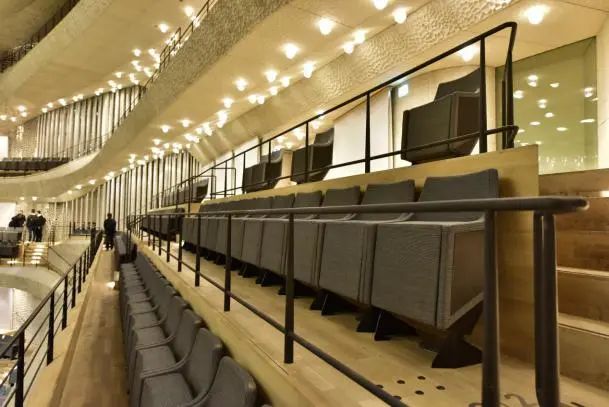
Figure 8
Balcony guardrail height of 850mm in the high-tier balcony of the Elbphilharmonie in Germany
04. Sectional Line-of-Sight Analysis Diagram of a Theater
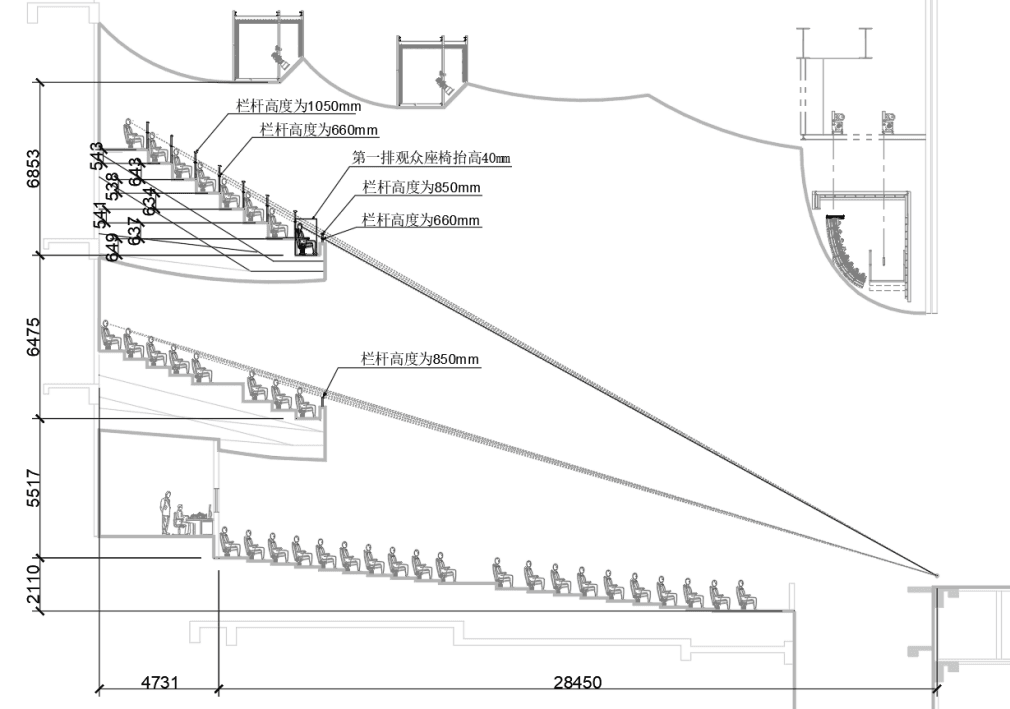
Figure 9
Sectional line-of-sight analysis diagram of a theater
Taking a 1700-seat theater in China as an example, it can be seen from its sectional line-of-sight analysis diagram (see Figure 9) that for the lower balcony, the audience's downward viewing angle is relatively small, which allows for higher front row balcony railings, and even guardrails higher than the 0.85m required by domestic codes can be used. However, for high-level balconies, the audience's downward viewing angle is larger. If the maximum 0.85m guardrail required by domestic codes is used (for safety, domestic designers generally adopt the maximum guardrail height), it will obstruct the line of sight, whereas using the minimum 0.66m guardrail required by international codes results in relatively less obstruction. Therefore, it is relatively better to adopt the railing height of no less than 30 inches (0.66m) as required by international codes.
05. Does a Guardrail Higher Than 26 Inches Lead to Insecurity?
The protective railing height of 42 inches is based on research on the height and center of gravity of 95% of humans after World War II. To avoid obstructing the line of sight, will allowing a railing height higher than 26 inches (0.66m) lead to insecurity?
Steep balcony steps and excessively low railings indeed commonly cause a sense of insecurity among people. Research shows that most concerns stem from perception, and actual incidents rarely occur. In performing arts theaters in the United States, there seem to be no incidents of falling from balconies due to drinking or audience negligence. In fact, the vast majority of falls related to balcony railings occur in stadiums, arenas, and amphitheaters, where people tend to stand, drink, reach for foul balls, and catch T-shirts shot from cannons while watching. Regarding fall accidents inside theaters, the situation is not as everyone imagines. At a Phish concert, the audience member seemingly did not fall passively but jumped off (at least that's what witnesses said). In 2013, a fall occurred at the Palace Theatre in London, but the man was pushed off by his wife "jokingly"; fortunately, he grabbed the lighting rail on the balcony face, stopping his fall. Searching Baidu for incidents of audience members falling from Chinese theater balconies yields no relevant reports, though there are accidents of actors falling from high-altitude performances and stage collapses. There have indeed been reports of audience members falling on steep stairs.
06. Measures to Improve Safety
Steep balcony steps and excessively low railings cause an audience's sense of insecurity; this feeling is caused by multiple perceptual factors rather than a single one. The height difference between rows, the height difference between the first row of the balcony and the floor below, the row spacing of the seats, the height of the railing, the width of the railing, the height of the chair back, and the height of the audience member themselves are all related factors.
6.1 Increase the height of protective guardrails on longitudinal aisles
There are indeed reports of audiences falling on steep stairs, so the IBC and the US NFPA's LSC also require a slightly higher railing height for longitudinal aisles. The specific requirements are: When the distance above the seating floor is more than 30 inches (0.76m) higher than the front row or the lower level ground, handrails need to be installed in the longitudinal aisles on the sides of the seats. The handrail height should be allowed to exceed 38 inches (0.97m), but must not exceed 42 inches (1.07m) when measured vertically from the leading edge of the tread to the top of the railing. If the bottom of the longitudinal aisle is more than 30 inches (0.76m) from the ground of the lower level, protective railings must be installed across the full width of the aisle. The height of the railing shall not be less than 36 inches (0.91m), and the diagonal distance between the top of the railing and the edge of the nearest tread shall not be less than 42 inches (1.07m).
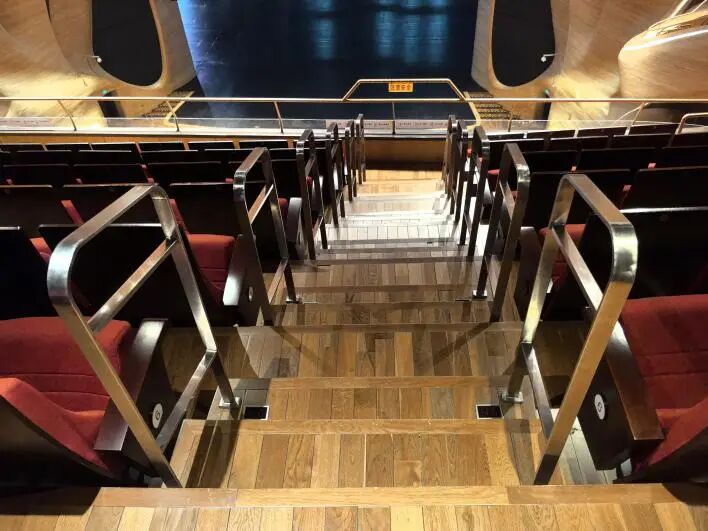
Figure 10
Heightened railings across the full width of the sides and bottom of longitudinal aisles
6.2 Increase the width of the guardrail armrest
Compared to slender railing armrests, increasing the width of the guardrail armrest can alleviate the audience's sensation of falling. However, measures must be taken to prevent wide armrests from becoming shelves where audiences place mobile phones, drinks, or wallets, to avoid items falling onto the audience below and causing injury. It is recommended to design the wide armrest as a spindle shape with a certain tilt angle, which is not conducive to placing items and minimizes the impact on the line of sight. That is, the surface of the armrest is convexly curved and sloped so that items slide off as soon as they are placed on it; reduce the cross-sectional width of the armrest in the direction of the audience's line of sight to minimize obstruction of the view.
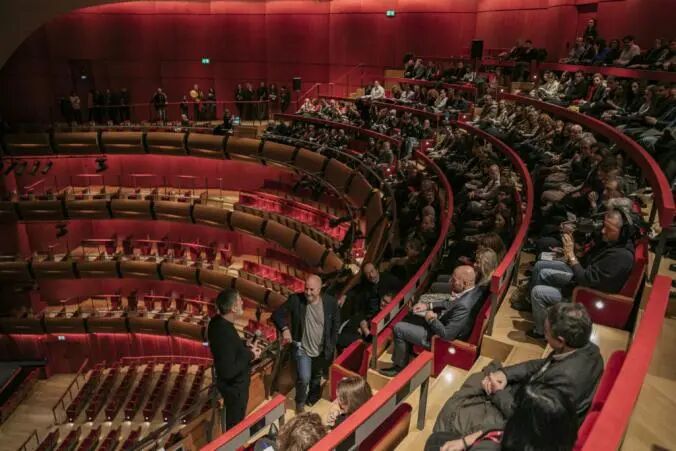
Figure 11
Balcony guardrails at the Greek National Opera
6.3 Increase the height of the chair back
Compared to the lines of a guardrail, a large-area chair back gives the audience a greater sense of security. Therefore, increasing the backrest height of the front row seats can significantly alleviate the audience's sensation of falling. Increasing the backrest height is equivalent to the lower solid part required to be set by domestic codes. How much is appropriate to increase the chair back height? The domestic code requires that the lower solid part must not be lower than 0.45m. The International Building Code (IBC) stipulates, "When the cross-aisle is more than 30 inches (0.76m) higher than the front row ground, protective devices must be provided. If the backrest height of the front row seat exceeds the cross-aisle by 24 inches (0.61m) or more, no protective device is required." Since the chair back is relatively thin and discontinuous compared to the solid structure of the building, it is recommended that if the **chair back height** is 0.61m or more above the rear floor, protective railings can be omitted.
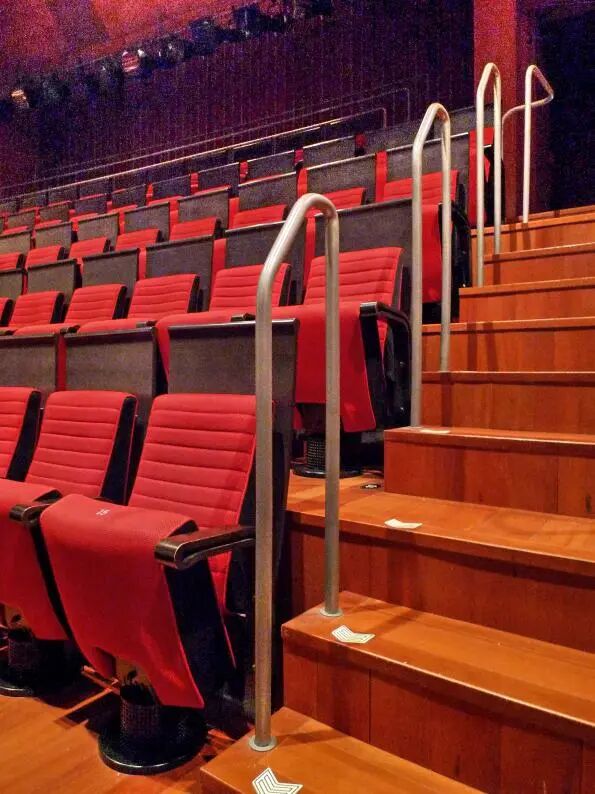
Figure 12
Heightened chair backs in the balcony of the National Centre for the Performing Arts Opera House in China
6.4 Increase safety measures for workers
The IBC and the US NFPA's LSC stipulate that to avoid obstructing the line of sight, a minimum railing height of 26 inches (0.66m) is acceptable. However, the global OSHA (Occupational Safety and Health Act) requires providing higher (42 inches) protective railings for workers, such as theater cleaning staff, lighting maintenance personnel, and ushers. How can worker safety be protected without obstructing the line of sight? International common practices are: First, strengthen safety training (such as wearing seat belts) during workers' operations, and enhance safety awareness. Second, install safety cables or rings under the front row (first and second rows) seats of the balcony to facilitate the connection of workers' safety belts. Third, install anti-fall safety brackets in front of the balcony guardrail (which must not obstruct the line of sight).
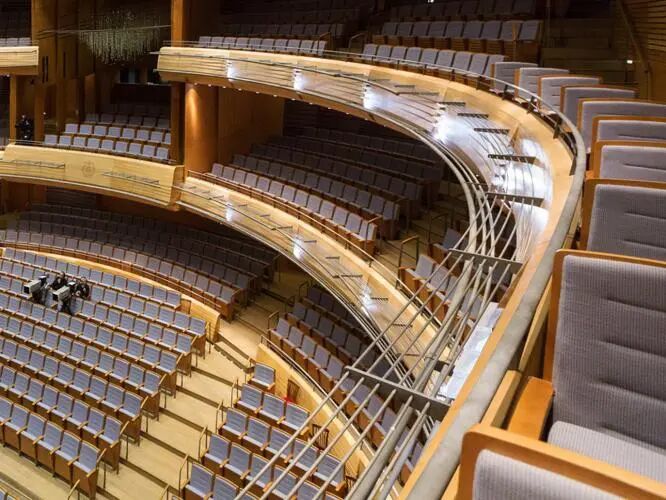
Figure 13
Anti-fall safety brackets at the Mariinsky II Theatre in Russia
07. Recommendations for Chinese Code Revision
Most countries in the world adopt the "International Building Code", and some countries have appropriate increases based on it. The differences between domestic codes and international codes are: First, the international code requires that a safety protective railing is only needed when the height difference between front and back rows exceeds 0.762m, whereas the domestic code requires it to be set when the difference exceeds 0.50m; clearly, the domestic code requirement is higher. Second, the domestic code clearly requires the height of the balcony front row railing and the floor box railing to not obstruct the line of sight, not be greater than 0.85m, and the lower solid part not be lower than 0.45m; the international code does not state this separately, but uniformly states that "When the seating floor is 30 inches (0.76m) higher than the ground of the front row or the lower level and the protective railing would interfere with the line of sight of the immediately adjacent seats, the height of the installed railing should not be lower than 26 inches (0.66m)." The domestic code requires the railing height range to be 0.45~0.85m, while the international code requires ≥0.66m. Obviously, in terms of height, the international code requirement is higher, but the domestic code adds requirements for the lower solid part, which also to a certain extent improves the audience's safety perception. Third, the international code has clear statements for longitudinal and cross aisles that are 30 inches (0.76m) higher than the front row or the lower level ground, whereas the domestic code does not. Combining the requirements of domestic and international codes, based on high standards and rigorous principles, it is recommended that the domestic code be described as:
- "Measures should be taken in the auditorium to protect personal safety. The height of the front row railings of the balcony and the floor box railings should not obstruct the line of sight, should not be less than 0.66m, and the lower solid part must not be lower than 0.45m."
- "When the auditorium seating or cross-aisle floor is 0.50m higher than the front row, railings should be set in front, and the railings should be strong, should not obstruct the line of sight, and the height should not be less than 0.66m. If the backrest is not less than 0.61m above the rear floor, and the backrest is sturdy, then there is no need to set up a railing."
- "When the auditorium seating floor is 0.50m higher than the front row, railings should be installed around the perimeter closely adjacent to longitudinal aisles or steps with height differences on the sides of the seats. The height from the nearest floor should not be less than 0.92m, and the diagonal distance between the top of the railing and the edge of the nearest tread should not be less than 1.07m. In order not to obstruct the line of sight, when setting up a railing in the middle of a longitudinal aisle or steps, an additional handrail should be added 0.30m below the railing, and the handrail should have sufficient strength and adhesion."
On February 21, 2024, the General Office of the Ministry of Housing and Urban-Rural Development issued the "Code for Design of Theater Buildings (Draft for Solicitation of Comments on Partial Revision)". The modifications related to this part are as follows: 1. Added "the height of the front row seat backrest should be appropriately raised" (but did not propose by how much); 2. Modified the railing's "height should not be less than 1.10m". Although increasing the railing height improves personal safety, it exacerbates the obstruction of sightlines.
08. References
- 1. https://seatplan.com/backstage/worst-west-end-theatre-seats/
- 2. International Building Code (IBC) — 2021
- 3. 101 Life Safety Code (LSC) formulated by the National Fire Protection Association (NFPA) — 2021
- 4. https://codes.iccsafe.org/content/IBC2021P2/chapter-10-means-of-egress
- 5. https://theatreconsultants.org/protecting-the-best-seats-in-the-house/
- 6. https://theatreconsultants.org/the-case-for-rational-balcony-design/
- 7. "Code for Design of Theater Buildings (Draft for Solicitation of Comments on Partial Revision)" issued by the General Office of the Ministry of Housing and Urban-Rural Development on February 21, 2024