
01. Introduction: The Invisible Contract Between Aesthetics and Electro-Acoustic Performance
The dream of concealed reinforcement is simple to describe and brutally difficult to engineer: make massive loudspeaker systems disappear behind premium architectural finishes without letting the finish destroy the sound.
In high-end theaters, multi-purpose halls, and broadcast spaces, architects often pursue continuous wood surfaces, refined joinery, and visual calm. Acoustic engineers, by contrast, need loudspeakers, horn devices, and subwoofers positioned exactly where the physics demands them.
Micro-perforated timber appears to solve that conflict. Visually it reads as warm, uninterrupted wood. Acoustically it behaves like a filter full of thousands of tiny openings through which sound must struggle to pass.
Research Focus
This study is ultimately about acoustic transparency: how much insertion loss, reflection, absorption, and phase disturbance is introduced when sound passes through visually seamless timber concealment.
1.1 Why Acoustic Transparency Matters
A concealed loudspeaker is only successful if the audience hears the intended tonal balance, dynamic articulation, and high-frequency detail as though the barrier were not there. If the panel dramatically alters response, the venue has not achieved integration. It has only hidden a problem behind timber.
02. Lab On-Site: Absolute Purity Testing Inside the Anechoic Chamber
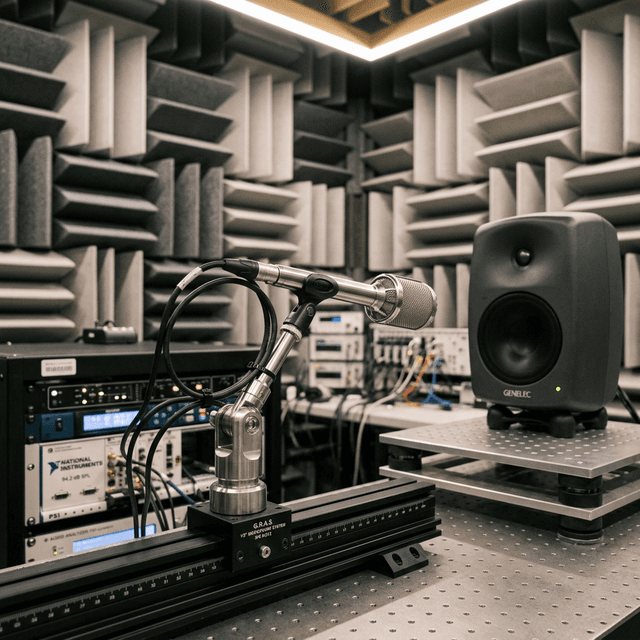
To isolate the material's true effect on sound, the tests were conducted inside the full anechoic chamber at LYN RESEARCH. In an ordinary room, reflections from walls, floors, and ceilings would contaminate any attempt to understand the panel itself.
Inside the chamber, thick absorbing wedges suppress almost all reflected energy, allowing the measurement microphone to capture only the direct sound that successfully passes through the micro-perforated timber panel.
2.1 The Limit-Testing Matrix
The lab built a controlled matrix around a full-band reference source, pink-noise and sine-sweep excitation, and calibrated omnidirectional microphones. Panels were inserted sequentially between the source and the receiver to reveal how different physical variables reshape the transmitted response.
- Perforation diameter, from near-invisible 0.5 mm micro-openings to more conventional fine perforation sizes.
- Open Area Ratio (OAR), sampled across the approximate range of 3% to 15% of total surface area.
- Panel thickness and substrate composition, including multiple high-density fire-retardant MDF constructions.
Each panel swap produced a new frequency-response curve and a new acoustic fingerprint, revealing how a visual finish projects itself into the listening domain.
03. Core Data Decoding: The Physical Laws Revealed by Response Curves
The moment a micro-perforated wood panel enters the signal path, the loudspeaker's ideal response stops being theoretical and becomes a negotiation with mass, pore geometry, friction, and diffraction.
3.1 Acoustic Transparency as Insertion Loss
In practical electro-acoustic terms, acoustic transparency can be expressed as insertion loss: the amount of acoustic energy lost when a panel is inserted between the sound source and the listener. A perfectly transparent barrier would introduce zero loss, but any real material with thickness and mass inevitably absorbs, reflects, or delays part of the wavefront.
This makes insertion loss the most honest metric for concealed reinforcement. It tells us, in decibels, what the material steals from the loudspeaker before the sound ever reaches the room.
3.2 The Different Fate of Low and High Frequencies
The data showed a clear physical split. Low frequencies below roughly 200 Hz remain comparatively resilient because their long wavelengths can diffract around the panel or pass through with limited attenuation. The response curve stays relatively calm in this region.
High frequencies behave very differently. Once wavelengths shrink toward the scale of pore spacing and panel detail, energy is strongly reflected by the solid surface and dissipated by friction in the micro-openings. The result is high-frequency roll-off, reduced 'air,' and in some cases comb-like notches caused by phase interference across the perforation field.
3.3 Finding the Golden Ratio of OAR
The single most important physical parameter in the study was the Open Area Ratio. More open area generally means better high-frequency transparency and a more recoverable response curve. But it also weakens the material visually and structurally, reducing the sense of seamless timber while compromising mechanical robustness.
The engineering objective is therefore not to maximize OAR blindly. It is to find the golden ratio at which the panel remains visually credible and physically stable while preserving enough acoustic transparency for DSP compensation to finish the job.
04. System Integration Application: From Curve Data to Precise DSP Compensation
At LYN, the measured attenuation curves are not treated as proof that concealed reinforcement is impossible. They are treated as calibration maps. Once the material's behavior is known precisely, the digital system can be tuned to anticipate it.
4.1 Concealed Reinforcement Without Acoustic Compromise
Traditional installations often force an ugly binary decision: expose the speaker behind a visible grille so the sound survives, or hide it behind timber and accept a muffled result. With empirical panel data, that binary collapses. The integration team can select a realistic OAR target, confident that the remaining physical loss is measurable and therefore recoverable.
4.2 DSP as the Inverse of the Material
- If the panel introduces a known high-frequency insertion loss at a specific band, parametric EQ can pre-emphasize that exact region before the wave reaches the timber.
- If the panel also distorts phase through complex reflection and pore interaction, FIR filters can be derived from chamber measurements to restore time-domain coherence.
- The physical barrier and the DSP correction then work against each other deliberately, so the audience hears the intended loudspeaker response rather than the raw material defect.
This is where concealment becomes a system-integration problem instead of a material problem. The panel no longer acts alone; it becomes part of a calibrated electro-acoustic chain.
05. Conclusion and Future Exploration
The highest form of integration is perceptual invisibility: architecture remains visually complete while the audience receives open, detailed, uncompromised sound.
The material-science lesson is clear. Micro-perforated timber does not become transparent by wishful thinking or by relying on simulations alone. It becomes usable only when empirical measurement, material selection, and DSP compensation are designed together.
Future work points toward finer perforation methods, higher open-area ratios with less visual penalty, and composite concealed materials that combine acoustic transparency with top-tier fire performance. The broader goal remains the same: invisible audio without invisible compromise.